
Mumbai airport revamp: Tour operators see leisure travel take the hit
ADVERTISEMENT
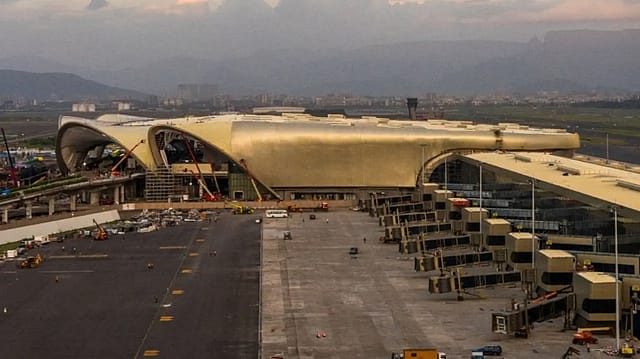
Mumbai’s airport reshuffle may not be enough to stop people from travelling, but it is already making the journey to the city more expensive and cumbersome, particularly for leisure travellers. Tour operators say travellers are factoring in higher airport transfer costs and longer road journeys while planning trips, with some even considering alternative destinations instead of Mumbai.
From October 25, at least 265 of Mumbai International Airport Ltd’s 770 weekly international flights are expected to move from Mumbai’s Terminal 2 to Navi Mumbai International Airport as preparations begin for the redevelopment of Terminal 1. At least a third of the traffic movements at T1 will also be shifted to T2. The redevelopment is expected to temporarily affect around 5 million passengers annually, or about 9% of Mumbai Airport’s total traffic of roughly 55 million passengers a year, according to Adani Airport Holdings .
The connectivity problem
On the ground, however, the impact is emerging less as a wave of cancellations and more as an added cost and logistical headache.
“For the travellers, the only cost that might go up is the connectivity issue to Navi Mumbai airport,” said Gaurav Shiva, general manager, The Orchid Hotel, Mumbai. “It will increase the travel time for the end user. Both in terms of the transportation cost and the transportation time.”
That concern is more pronounced among tour operators. Vishwajeet Patil, director, Raja Rani Travels Pvt. Ltd. and president of the Maharashtra Tour Organisers’ Association, said around 95% of travellers still prefer Mumbai’s existing T1 and T2 terminals, largely because of cost and convenience. Only about 5% prefer Navi Mumbai because it is closer to where they live.
According to Patil, a taxi from Navi Mumbai to Mumbai city, including areas such as Bandra, can cost around ₹3,000. “Nobody really wants to spend that kind of money just for getting from airport to your residence,” he said.
At least, T1 and T2 have metro connectivity, but travellers going to Navi Mumbai will have to currently bear with fewer convenient public transport options. Patil said travellers are therefore often forced to rely on private taxis or larger vehicles such as Innovas, adding significantly to the cost of a trip.
Business holds, leisure wavers
For now, though, the additional cost does not appear to be prompting most travellers to abandon their plans. Instead, the impact is showing up earlier in the booking cycle.
Christopher Mathias, director, Flexi Travels, said some travellers planning to visit Mumbai are already reconsidering the destination because of the additional transportation expense. “Once they are shifted, the cost for the transport is increased because of which people who are planning to come to Mumbai are rethinking to go to some other destination instead of coming to Mumbai,” he said.
Mathias said this is particularly visible among leisure travellers, rather than corporate travellers. While he has not seen large-scale cancellations, some customers are choosing another destination even before preparing their itinerary because of the additional cost of getting to and from Navi Mumbai.
Anil Kumar Kailash Gupta, director, SIMI Travel Pvt. Ltd., estimates that leisure travel could see a 10%-20% impact, while corporate travel is likely to remain largely unaffected. “Mumbai is a running place, so I don't think business would be much impacted,” he said.
The operators also expect the phased nature of the transition to limit the immediate disruption. According to Gupta, airlines have suggested moving flights in phases, with only around 10-15 flights shifting at a time rather than a much larger movement in one go. He expects the airport shift itself to have a relatively small impact of around 10%-20% on the business, particularly because leisure travel has already been under pressure from the wider geopolitical situation and higher airfares caused due to the Iran conflict.
Airfares have already risen sharply amid higher fuel costs and disruptions to international travel. IndiGo, the country's largest airline has announced a hike in fuel surcharge for domestic and international flights and it will push airfares higher.
Mathias said the combined increase in fuel-related transport costs and hotel rates has made travel around 10%-15% more expensive, while the overall industry has seen business decline by about 15%.
There is also uncertainty around airline policies. Patil said travel agents are still unclear about whether passengers whose flights are moved to Navi Mumbai will be eligible for free cancellations or changes. “If the airlines have forced the departures to another terminal, we are still clueless about the airline policy,” he said.
Travel trade-off
Hotels, meanwhile, are taking a more measured view. Shiva of The Orchid said the immediate impact on his hotel, in particular, is likely to be limited because its business is linked more closely to T1, while hotels closer to T2 could feel the impact sooner as international flights move to Navi Mumbai. He expects corporate business to remain largely stable in the near term, with a more visible impact potentially emerging in January or later as the redevelopment progresses.
He also said current hotel demand remains strong, with occupancy crossing 80%, and does not expect a major business disruption through December. “We are still trying to get some more information from our sources to see what is the volume of business that will get moved,” Shiva said, adding that the real impact would become clearer in January.
What this really means is that Mumbai may not lose travellers overnight, but it could lose some destination demand at the margin. Leisure travellers have more flexibility to choose another city, while corporate travellers are more likely to absorb the additional time and cost because their trips are often need-based.
There could also be a counter-effect. Gupta expects Navi Mumbai’s lower airport charges to eventually translate into lower airfares, although that benefit would have to be weighed against the additional time and cost of reaching the airport. “The price could go down, in fact not up,” he said.