
Navi Mumbai International Airport rolls out DigiYatra facility
ADVERTISEMENT
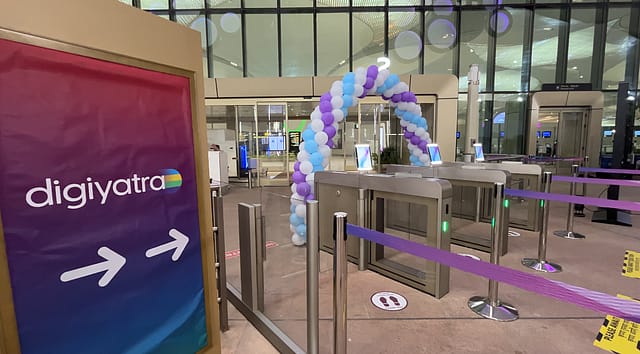
Navi Mumbai International Airport (NMIA), the greenfield international gateway operated by Adani Airport Holdings Ltd., has digitally joined the Ministry of Civil Aviation’s nationwide DigiYatra rollout, alongside five other airports across the country.
The integration was inaugurated remotely, with the proceedings streamed live on a large screen inside the terminal for visiting passengers. To mark the occasion, three passengers ceremonially passed through the DigiYatra e-gates and performed a ribbon-cutting at the biometric entry points.
Facial recognition powers seamless travel
DigiYatra uses facial recognition technology to enable contactless and paperless passenger processing at airport checkpoints. The system is aimed at reducing wait times and streamlining airport movement, while incorporating data privacy and security safeguards.
Navi Mumbai Airport joins expanding AAHL portfolio
NMIA is part of the AAHL portfolio, currently India’s largest private airport operator, managing eight airports across the country — Ahmedabad, Guwahati, Jaipur, Lucknow, Mangaluru, Thiruvananthapuram, Mumbai, and now Navi Mumbai.
India’s aviation sector is expanding rapidly, with millions of new passengers flying each year. To meet this surge in demand, the airport has been designed to handle over 90 million passengers annually once all four runways become fully operational. Currently, operations are being managed through Terminal 1, which has an annual capacity of 20 million passengers.
The development follows the formal inauguration of the Navi Mumbai International Airport by Prime Minister Narendra Modi in October last year. During the event, the Prime Minister also launched and dedicated several other development projects in Mumbai.
Addressing attendees at the inauguration, Modi said Mumbai’s long wait for a second international airport had ended, adding that the new facility would play a pivotal role in positioning the Mumbai Metropolitan Region as one of Asia’s largest connectivity hubs.
He also highlighted the launch of Mumbai’s fully underground metro corridor, describing it as a symbol of a developing India. In a densely built city like Mumbai, he noted, the underground metro had been constructed while preserving historic structures. The Prime Minister congratulated the engineers and workers involved in the infrastructure projects.
With DigiYatra integration now in place, NMIA’s entry into the national biometric travel ecosystem signals a broader push towards technology-driven passenger experience and seamless aviation infrastructure in India.