
Prime Video’s APAC playbook: Why Amazon is betting on local content, ad-led scale, and streaming aggregation
ADVERTISEMENT
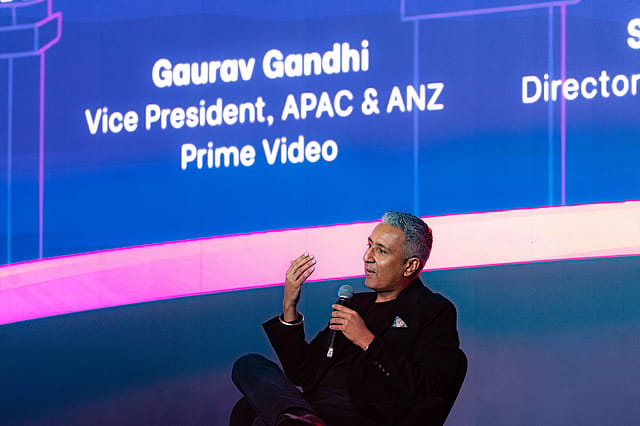
The next phase of the streaming wars may not be won by a single global formula. That was the underlying message from Prime Video’s leadership at APOS 2026, where executives outlined how the company is tailoring its strategy across Asia Pacific (APAC)—balancing a unified business model with country-specific content, distribution and monetisation approaches.
For Prime Video, APAC is no longer just an expansion market. It is increasingly becoming a growth engine and an experimentation ground for new entertainment formats, consumer propositions and revenue models.
Speaking at the conference, Gaurav Gandhi, vice president, APAC & ANZ, Prime Video & Amazon MGM Studios, said operating across markets such as India, Japan, Southeast Asia, Australia and New Zealand requires local execution despite a common business architecture.
“We operate a common business model, but we cannot have a common playbook for a diverse region like APAC,” Gandhi said.
At the centre of that strategy is Prime Video’s push to evolve beyond a traditional subscription platform into an “entertainment hub” model—bringing together subscription video-on-demand (SVOD), transactional video-on-demand (TVOD), add-on channels and advertising-led offerings under one consumer interface.
The shift reflects a broader reality facing the global streaming industry. As subscriber growth moderates, platforms are under increasing pressure to improve engagement, diversify monetisation and reduce customer friction.
Can India become Prime Video’s biggest growth market in APAC?
India appears central to Prime Video’s next growth chapter.
Marking 10 years in India, Prime Video executives highlighted multilingual consumption and original content as the two pillars shaping investment decisions in the market.
According to Shilangi Mukherji, director and head of SVOD business, Prime Video India, more than 60% of Indian customers stream in four or more languages—a consumer behaviour that has driven the platform’s programming strategy.
Prime Video currently offers content across 10 languages while maintaining deeper investments in Hindi, Tamil and Telugu, alongside international programming.
The company has also expanded aggressively in originals. Prime Video says it has launched more than 100 Originals in India and has another 100-plus projects in various stages of development and production. Nearly 60% of its series have returned for additional seasons, making India its largest Originals market outside the US.
But the bigger strategic move may be happening on distribution.
Following the integration of Amazon MX Player, Prime Video is broadening its business model to combine advertising video-on-demand (AVOD) with existing subscription and transactional offerings.
The integration creates a unified streaming proposition that combines premium audiences with mass-market reach—opening up a larger opportunity for creators, advertisers and content partners.
Globally, Prime Video now works with more than 600 content partners, including more than 30 in India, as it strengthens its role as an aggregation platform.
Japan, meanwhile, represents a different stage of the streaming lifecycle.
Keisuke Oishi, country manager, Prime Video Japan, said the company spent its early years creating a subscription video category in a market long dominated by free-to-air television. Its content strategy today is anchored around four pillars—anime, scripted programming, unscripted content and live sports.
Looking ahead, Prime Video sees APAC contributing not only audience growth but also innovation—from mobile-first propositions and tiered offerings to building for multilingual consumption.
If the first decade of streaming was about acquiring subscribers, the next may be about creating ecosystems. Prime Video’s APAC strategy suggests it intends to compete on both scale and choice.