
Ramkrishna Forgings shifts gears beyond commercial vehicles, bets on EVs and passenger cars: Chaitanya Jalan
ADVERTISEMENT
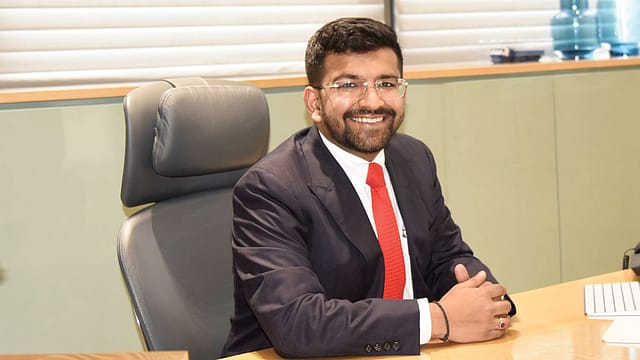
Ramkrishna Forgings Ltd (RKFL) is widening its growth playbook beyond commercial vehicles, betting on passenger vehicles, exports, railways, electric vehicles, and specialty alloys to build its next phase of expansion. In an exclusive interview with Fortune India, Chaitanya Jalan, Joint Managing Director, Ramkrishna Forgings, says the company is eyeing ₹10,000 crore in revenue by 2030, even as it seeks to increase the contribution of exports to more than 40% by FY28.
The shift is already visible in its order pipeline. The company has secured new orders worth ₹278 crore, of which around 82% are from the passenger-vehicle segment. It is also stepping up investments in transmission gears, shafts, differential gear pinions, and other components for passenger vehicles while expanding its footprint in railways and non-ferrous forging.
Jalan says the next two years could be particularly strong for the passenger vehicle business as the company looks to reduce its dependence on commercial vehicles. "We have started working very aggressively on the passenger-vehicle segment over the last year," Jalan says.
From commercial vehicles to passenger cars
Automotive currently accounts for around 80% of Ramkrishna Forgings' total revenue. Of this, roughly 90% comes from commercial vehicles, while passenger vehicles and two-wheelers contribute about 10%. The company expects this mix to change materially over the next three to four years. Passenger vehicles could account for 20–25% of automotive revenue, with commercial vehicles making up the balance.
To support the transition, Ramkrishna Forgings has announced a ₹170 crore capex programme focused primarily on transmission gears, shafts, differential gear pinions, and other differential components for passenger vehicles. "We have got new order book of ₹278 crore, of which approximately 82% is from PV and believe the next two years can be exceptionally strong for this segment and become an important transformation lever for RKFL," Jalan says.
The strategy is not limited to conventional internal-combustion vehicles. The company is also building capabilities for EVs, including aluminium forgings, transmission gears, shafts, and differential components, according to Jalan.
EV transition offers new opportunities
Jalan sees the shift towards electric mobility as an opportunity rather than a major disruption to the company's existing portfolio. Around 90–95% of RKFL's automotive revenue remains EV-agnostic, while engine-related components account for only around 5% of auto revenue.
"Most of our powertrain, axle, transmission and differential products remain relevant, although their design and specifications are evolving," he says.
The company is increasingly moving beyond manufacturing components to print and is co-developing products with customers. Its capabilities in warm and cold forging, dimensional precision, microstructure control and lightweighting are becoming increasingly important as vehicle architectures evolve.
RKFL's Jamshedpur facility is already supplying EV components, including transmission gears and shafts, primarily to North American customers. The company is also developing aluminium-forged solutions for EV applications.
Over the next 12–24 months, it plans to expand its product portfolio across passenger vehicles, EVs and non-ferrous applications. This includes advanced warm-forged differential components for passenger cars, commercial vehicles, farm equipment and driven axles, as well as fully assembled non-driven trailer axles. "We have also started bulk supplies of aluminium forgings, transmission gears, shafts and differential components for EV applications," Jalan says.
Exports to cross 40% of revenue
International markets will be another major pillar of the company's growth strategy. Exports accounted for around 30% of revenue last year, and RKFL expects this to rise to 35–40% in FY27 and around 40% or more in FY28. The increase will come from both a recovery in existing markets and new business wins.
North America is showing signs of a recovery after a weak previous year, while Europe is generating new commercial-vehicle opportunities. The company has also started operations at its Mexico facility to serve North American customers more effectively.
"North America was quite weak last year due to tariffs and broader market volatility, but this year we are seeing a significant improvement in demand and strong order inflows, including into India," Jalan says.
In Europe, the company is seeing good traction and winning new business. It is also looking to expand its presence in Latin America and ASEAN markets. "Given the new business wins and improving order flows, we are optimistic that both markets will continue to improve quarter-on-quarter through FY27 and FY28," he says.
Railways becomes another growth engine
The company's diversification is also extending beyond automotive. Railways has emerged as one of its most visible growth opportunities, with RKFL moving up the value chain from individual components to complete undercarriage assemblies and railway wheels.
The railway order book is growing at around 20–30% year-on-year, and the company expects the business to account for close to 10% of standalone revenue by the next calendar year.
RKFL has also entered the forged-wheels business through its Chennai facility, which has an annual capacity of around 220,000 wheels. Trial production has started, with bulk production expected to commence later this quarter.
Over time, more than 60–70% of the capacity is expected to serve domestic customers, including Indian Railways and metro manufacturers, while exports could support further ramp-up. Beyond railways, the company sees opportunities in earthmoving equipment, oil and gas, farm equipment and other industrial applications.
Aluminium, Inconel, and specialty alloys widen the opportunity
The next leg of diversification is likely to come from non-ferrous materials. RKFL started aluminium production last year with an initial capacity of around 10,000 tonnes and is seeing traction from both EV and non-EV customers.
It is also developing capabilities in stainless steel, Inconel and other specialty alloys, targeting industries such as aerospace, semiconductors and robotics. "Non-ferrous materials such as aluminium, stainless steel and Inconel will be our next growth levers, with applications across aerospace, semiconductors and robotics," Jalan says.
The company expects these businesses to make a meaningful revenue contribution as customer programmes mature over the next 12–24 months, although the opportunity is expected to scale more significantly thereafter. These new materials and applications are also part of RKFL's longer-term ambition to reach one million tonnes of metal-processing capacity by 2030.
For FY27, Jalan says the priority is to accelerate international growth while building multiple scalable businesses across products and markets. "Our approach is not simply to chase volumes, but to build long-term customer relationships through quality, reliability, design and value-added capabilities," he adds.