
‘Scale, Capital, Risk’: Macron breaks down Europe’s tech gap, bets big on quantum computing
ADVERTISEMENT
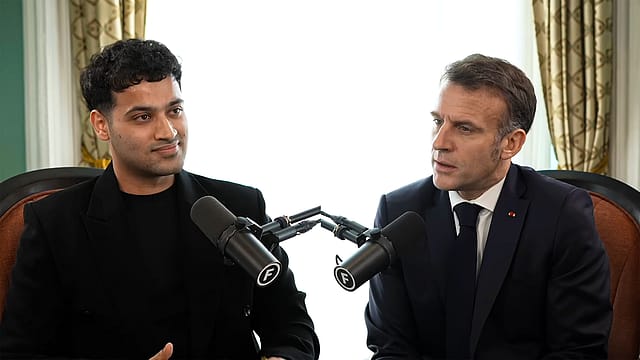
As global technology leadership consolidates around American and Chinese giants, French President Emmanuel Macron used an appearance on entrepreneur and content creator Raj Shamani’s Figuring Out podcast to outline how France plans to close the gap.
In a wide-ranging conversation, Macron addressed Europe’s structural disadvantages in scale and capital, defended France’s foreign-backed AI infrastructure push, and articulated why India is central to his vision of a more multipolar global order.
The discussion, which spanned quantum computing, venture capital, geopolitics and transatlantic tensions, saw Macron acknowledge that while France has been home to foundational scientific breakthroughs, it has struggled to translate that legacy into globally dominant technology platforms.
“Scale, capital and appetite for risk,” he said, summing up Europe’s structural disadvantages vis-à-vis the United States and China.
Why Europe fell behind in big tech
Macron’s critique of Europe’s innovation ecosystem was unusually direct. Despite strong research institutions and deep mathematical talent, he argued that Europe remains “too fragmented,” preventing startups from scaling across a unified domestic market comparable to the US.
On capital, he pointed to a paradox: Europe has high savings rates, but financial regulation and conservative investment patterns channel funds into bonds or overseas assets rather than high-growth technology ventures.
The third issue, he suggested, is cultural. “We have to find more appetite for risk,” Macron said, arguing that innovation ecosystems must normalise failure. Without repeated attempts, moonshot breakthroughs remain improbable.
The remarks reflect a broader European debate on competitiveness, especially as US hyperscalers and Chinese platforms consolidate dominance in AI, cloud and semiconductor value chains.
Sovereign AI — but funded abroad?
Macron also addressed questions surrounding France’s €109 billion AI infrastructure plan, announced last year. A significant portion — about €50 billion — is expected to come from Gulf investors, including the UAE, while core technologies in data centre hardware and hyperscale cloud still originate largely in the US.
The structure has raised questions about how “sovereign” such AI infrastructure can be if foreign capital and non-European technology underpin it.
Macron’s argument: domestic location and regulatory control matter more than the origin of capital. Hosting infrastructure within France allows enforcement of European data laws, supports local startups and enables technology transfer.
He cited domestic players such as Mistral AI as examples of Europe’s attempt to build alternatives to American large language model providers.
The strategic framing is consistent with Macron’s long-standing call for a “sovereign Europe” — one that cooperates with both Washington and Beijing but avoids structural dependency.
The 2035 bet: Quantum computing
Asked which technology France could plausibly dominate by 2035, Macron singled out quantum computing.
“Quantum computer would be where we can take the lead,” he said, pointing to France’s depth in mathematics and research laboratories.
Quantum computing is widely viewed as a strategic frontier with implications for encryption, defence simulations, materials science and drug discovery. A practical breakthrough could significantly shift geopolitical and economic balances.
However, Macron stopped short of claiming inevitability. Innovation, he noted, is not centrally programmable. Governments can create enabling conditions but must accept that most bets will fail.
India’s leapfrog moment
Macron repeatedly referenced India’s digital public infrastructure — Aadhaar, UPI and DigiLocker — as examples of how large, complex economies can leapfrog legacy systems.
India’s scale in engineering talent production, he observed, is unmatched. The implication: partnerships between France’s research depth and India’s scale could produce mutual gains in sectors ranging from AI governance to clean energy.
The discussion also touched on initiatives such as the International Solar Alliance and the India–Middle East–Europe Economic Corridor (IMEC), which Paris and New Delhi support as alternatives to binary alignment with major powers.
Multipolarity as strategy
A central theme of the podcast was multipolarity. Macron argued that France and India share a desire to maintain strong ties with both the US and China without becoming dependent on either.
“Having an ally doesn’t mean you are dependent on your friend,” he said, reflecting growing European discomfort with volatility in American political and trade policy.
For Europe, strategic autonomy has shifted from rhetorical ambition to policy priority. For India, it has long been doctrine.
Whether this convergence translates into sustained economic integration — such as a comprehensive India–EU trade agreement — remains to be seen. Negotiations have moved in fits and starts, often stalled by regulatory and market-access disputes.
The real test
Macron’s appearance on Figuring Out was notable not just for its format — his first major global podcast engagement — but for its audience: young founders, engineers and investors.
The pitch to them was clear. France offers research depth, access to the European market and a startup ecosystem he described as the “most vibrant in Europe.” But the subtext was equally evident: Europe must still prove it can produce the next global-scale technology champion.
In the coming decade, the contest will not only be about who builds the most powerful AI models or quantum processors, but about who controls capital flows, regulatory frameworks and supply chains.
Macron’s message in Mumbai was that France intends to compete — not by choosing sides, but by building leverage. Whether that strategy can overcome structural disadvantages in scale and risk capital will determine whether Europe’s sovereignty push reshapes the global tech hierarchy — or remains an aspirational slogan.