
Why AI alone isn’t enough: Pascal Daloz on why virtual twins are becoming industry’s operating system
ADVERTISEMENT
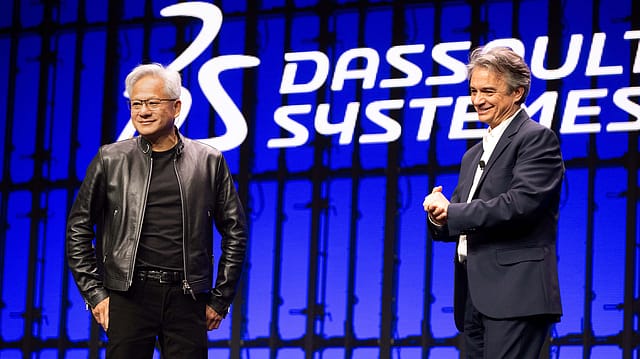
Artificial intelligence (AI) may be the loudest promise in modern industry, but according to Dassault Systèmes CEO Pascal Daloz, AI on its own is not enough. “AI is transforming industry, but only when AI is connected with the real world. That’s the fact,” said Daloz on the sidelines of 3DEXPERIENCE World 2026 in Houston.
AI can recognise patterns, not physics
Daloz is precise about what he believes much of the market misunderstands. AI accelerates pattern recognition. It does not understand physics. It does not understand materials, energy systems, regulatory constraints or the cascading consequences of capital decisions in heavy industry.
For that, he argues, industry needs something more foundational: virtual twins. “These models are here to power AI not only to understand the real world, but also to understand how to build it.”
For decades, Dassault Systèmes built design and simulation tools used by engineers across aerospace, automotive, manufacturing, energy and life sciences. What is changing now, Daloz suggests, is not just capability but hierarchy. AI is not replacing simulation. It is sitting on top of it.
“If you have computing without knowledge, it’s blind. And if you have knowledge without computing, we cannot scale. So that’s really the core of the partnership.”
Deepening partnership with NVIDIA
That partnership, deepened with NVIDIA, is about embedding accelerated computing and AI directly inside physics-based industrial models. The sequencing matters. The virtual twin comes first. AI operates within it.
NVIDIA CEO Jensen Huang, who joined Daloz during the conversation, framed the shift as part of a broader computing transition.
“Dassault Systèmes creates tools for virtual twins, for simulated worlds, and that is possible only on top of computers. Each time the computing platform fundamentally changes, the capabilities of virtual twins fundamentally change as well.”
But where Huang emphasises computing power, Daloz returns to constraint.
In software, errors can be patched. In factories, aircraft, power grids or pharmaceutical production lines, they cannot. Optimising without validated models of the physical system may produce short-term efficiency while creating long-term fragility.
That concern is increasingly echoed by AI researchers working in industrial systems.
Data engineering consultant and AI expert Yogesh Brar describes heavy industry as entering a maturity phase in artificial intelligence.
“In heavy industry, the transition from Generative AI to physics-informed AI marks a critical shift. Unlike a software glitch, an industrial error can result in catastrophic physical failure. AI is powerful at pattern recognition, but it has no innate understanding of thermodynamics, material science or regulatory safety margins. An unconstrained system can generate solutions that are mathematically optimal but physically impossible.”
“For complex systems, optimisation must prioritise decision quality over speed. This is where the virtual twin becomes essential. Embedding AI within science-validated models creates a guardrail of reality, ensuring insights are grounded in the actual physical properties of the assets. Without that grounding, AI risks creating local efficiencies that introduce systemic fragility.”
Daloz frames the issue in similarly pragmatic terms.
“We are doing probably the most sophisticated things on Earth, at least in the industries we are touching,” he said. “The problem is there is only a limited number of people on Earth who know how to do that.”
Virtual twins, augmented by AI, are meant to encode that sophistication into systems that can be scaled. The goal is not marginal productivity. It is decision quality, particularly when billions in capital are at stake.
This becomes even more consequential as AI reshapes industry itself. Huang described NVIDIA’s own use of Dassault’s tools to design what he called AI factories.
“AI factories are a new type of factory, the most complex of all the world’s factories,” he said, adding that NVIDIA is “building them inside Dassault Systèmes.”
For Daloz, that example reinforces the thesis. As factories become more software-defined and energy-intensive, the cost of poor decisions rises. Virtual twins allow companies to simulate cost, energy, resilience and sustainability trade-offs before those decisions become irreversible.
Sustainability, in his framing, is not a branding exercise. It is an engineering constraint. “If you look at a manufacturing plant, this could be largely optimised if you are using AI.”
The deeper point is that inefficiency is already embedded in global production systems. AI, when tethered to validated models, can expose and eliminate it at the design stage rather than after deployment.
The conversation also turned to accessibility. Daloz drew a parallel with the early days of structured design software.
“Thirty years ago, only large enterprises could afford structured design offices. And now it’s pervasive. Millions of people are using it.”
He sees a similar trajectory for virtual twins and for what he calls cognitive augmented design. “For a long time, 3D CAD meant computer-aided design. Now it’s cognitive augmented design. Why should design be only in the hands of a very limited number of people?”
Huang reinforced that idea, predicting an explosion of AI companions embedded inside industrial workflows.
“Every engineer will have companions that help them,” he said. “The number of virtual engineers is going to skyrocket.”
Yet even in that future, Daloz’s argument holds. AI agents still require validated environments grounded in physics to act responsibly. Without that foundation, intelligence becomes abstraction.
Strip away the hype around generative AI and Daloz’s position is disciplined. AI is powerful. But in heavy industry, power without constraint is risk.
Virtual twins, he suggests, are becoming the operating system beneath industrial intelligence, embedding knowledge, physics and lifecycle awareness into every decision.
“AI is transforming industry, but only when AI is connected with the real world. That’s the fact.” For Daloz, that connection is not philosophical. It is architectural. And in that architecture, AI is not the base layer. The virtual twin is.