
With Jewar Airport take-off, it is set to boost Noida’s real estate market
ADVERTISEMENT
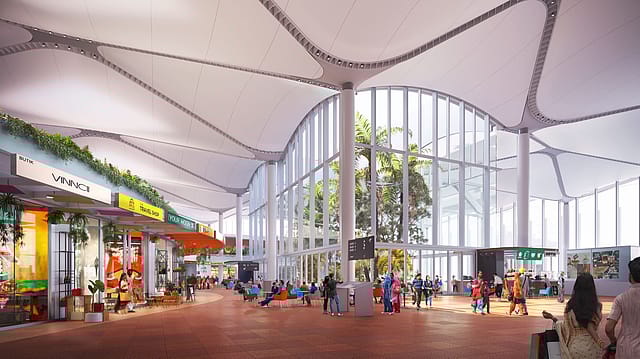
Prime Minister Narendra Modi is expected to inaugurate the first phase of the Noida International Airport on March 28, 2026. The new aviation hub is set to significantly alter the real estate dynamics of the National Capital Region (NCR), with industry experts pointing to a structural shift that could position Noida as the region’s next major property hub.
The airport is also commonly referred to as Jewar Airport due to its proximity to the town of Jewar in Uttar Pradesh.
“It is a revolutionary infrastructure development. It has the potential to benefit the region in a manner that has happened in the case of Gurugram, which rose to prominence due to its proximity to Indira Gandhi International Airport,” Sahil Agarwal, CEO, Nimbus Group, told Fortune India.
Once fully completed, the airport is expected to be among the country’s largest aviation infrastructure projects, with five runways. It is being developed by the Uttar Pradesh government in partnership with Switzerland's Zurich Airport International AG at an estimated cost of around ₹30,000 crore. The airport is designed with an annual passenger capacity of up to 300 million while its phase-1 is able to accommodate more than 12 million travellers annually with one runway and one terminal initially.
“On the commercial real estate front, the international airport is expected to attract global occupiers in the coming years, further enhancing the value proposition of Noida’s office market,” Vimal Nadar, National Director & Head, Research, Colliers India, said.
How do big projects scale up growth?
Beyond improving connectivity and transport, when large infrastructure projects like this are unveiled, they attract significant investment, enable rapid development, and drive up nearby land values. For example, around Indira Gandhi International Airport, areas like Dwarka and Aerocity saw strong price appreciation after airport expansion and metro links. In another example, the Kempegowda International Airport led to the rise of North Bengaluru as a business corridor with tech parks, hotels and warehousing hubs. Similarly, the Yamuna Expressway triggered early land price jumps in Greater Noida and nearby belts even before the airport announcement.
Experts believe this project is most likely to follow a similar trend.
“Its wide, multi-layered economic base fundamentally alters demand. It is less speculative and more employment-led, which typically results in deeper, more durable real estate cycles,” added Agarwal.
“On the commercial real estate front, the international airport is expected to attract global occupiers in the coming years, further enhancing the value proposition of Noida’s office market,” said Nadar.
Will the project lead to a sharp rise in property prices?
Experts say yes, and the sharp price movement is already visible. Reports suggest that Micro-markets around Jewar and along the Yamuna Expressway have already seen noticeable price appreciation over the past few years. Industry estimates suggest land and residential prices in certain pockets have risen between 25% and 60% since the airport project gained traction.
“We are witnessing sustained demand across both mid and premium housing segments, supported by rising aspirations and growing confidence in long-term value creation. With strategic positioning, increasing end-user as well as investor interest, Noida is no longer an emerging market, it has evolved into NCR’s next real estate powerhouse,” Rohit Kishore, CEO, Hero Realty said.
However, experts caution that the pace of growth will depend on timely project execution and the speed at which supporting infrastructure is delivered.
Residential projects will drive near-term growth
According to field experts, in the near term, residential development will continue to dominate due to affordability and early investor entry. Proximity to cities like Aligarh, Mathura, Agra and Lucknow, through the Yamuna Expressway and Agra-Lucknow Expressway, will also fundamentally alter the region’s character.
“However, the medium-term trajectory is residential first, followed closely by commercial developments. With aviation-linked industries, logistics parks, data centres, and the Film City taking shape, the region is structurally aligned to emerge both as residential and commercial hubs,” Agarwal explained.