
With quick commerce at its heels, why analysts still back retail giant DMart
ADVERTISEMENT
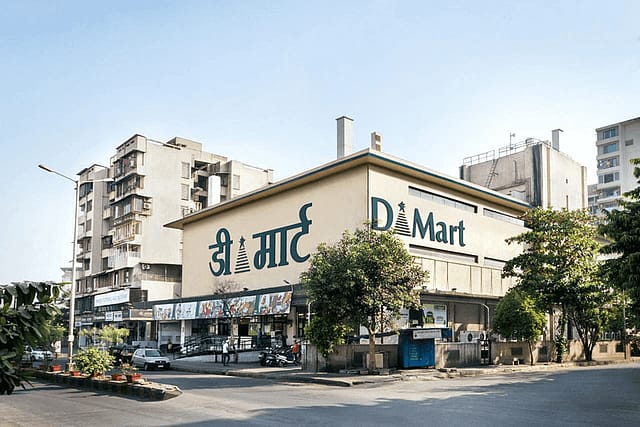
Quick commerce players like Blinkit , Swiggy Instamart and Zepto have trained urban consumers to expect deliveries in minutes, putting pressure on traditional retailers that built their business on weekly stock-up trips. Yet analysts believe India's largest supermarket chain, DMart, is not retreating from the battle. Instead, it is sticking to an aggressive store expansion strategy.
Avenue Supermarts , the operator of DMart, added 85 stores in FY26, its highest-ever annual store addition, taking its network past the 500-store mark. According to a report by Geojit Investments, the retailer's aggressive expansion into Tier-2 and Tier-3 micro markets is emerging as its primary response to mounting competition from quick commerce platforms.
Quick commerce now accounts for nearly 50% of online spending in food and fresh categories and contributes 3% to 20% of sales for major FMCG companies, according to Elara Capital. The brokerage notes that combined quick commerce orders are now almost four times DMart's bill cuts, highlighting how rapidly the channel has scaled.
According to Geojit, the company's investment case continues to rest on a "long, visible runway for store-led growth", adding that its physical-store model remains the principal defence against escalating quick commerce competition. The brokerage expects benefits from stabilising macroeconomic conditions, normalising consumer demand and GST-related efficiencies to support volume-led growth.
The impact is most visible in metros, where around 40% of DMart's stores are located. According to Karan Taurani, EVP at Elara Capital, quick commerce has become a structural competitive force that is likely to weigh on like-for-like growth in urban markets. He argues that while the threat is meaningful, it is unlikely to derail DMart's long-term growth story because the retailer is expanding into geographies where quick commerce penetration remains low.
The tier-2 playbook
The strategy appears to be paying off for now.
DMart reported a 19% year-on-year increase in fourth-quarter revenue to ₹17,205 crore, its fastest growth in eight quarters. Same-store sales growth for outlets older than 24 months accelerated to 10.8% from 8.1% a year ago, marking the strongest performance in two years and suggesting a broader recovery in consumer demand. Meanwhile, EBITDA rose 25.4% to ₹1,232 crore and adjusted net profit increased 16.9% to ₹725 crore.
The retailer added a record 58 stores in the March quarter alone, helping expand its retail footprint to 20.6 million square feet from 17.2 million square feet a year earlier. Customer traffic also remained robust, with total bill cuts rising to 39.8 crore in FY26 from 35.3 crore in FY25.
More importantly, store expansion is increasingly moving beyond large cities. Elara estimates that North India's share of DMart's network has more than doubled from 6% in FY20 to 15% in FY26. The company is also expanding deeper into states such as Rajasthan, Punjab, Madhya Pradesh and Uttar Pradesh, where modern retail penetration remains low.
So, the opportunity is massive. According to Redseer data, Tier-2 cities are expected to grow at a 13.7% CAGR through 2030, faster than Tier-1 cities and rural markets, while contributing the largest share of incremental retail spending.
Both brokerages argue that the future of Indian retail may not be a winner-takes-all contest between supermarkets and quick commerce. Geojit believes physical stores remain DMart's primary defence against rising competition, supported by a measured expansion of DMart Ready, which now operates in 18 cities and is placing greater emphasis on home delivery.
Taurani draws parallels with global retailers such as Walmart and Costco, saying modern trade and quick commerce are likely to coexist. While quick commerce will continue to dominate top-up purchases in dense urban centres, large-format retailers can continue gaining share in smaller cities where economics favour scale, assortment and value pricing.
Home delivery gets more attention
DMart is not ignoring online retail altogether.
Its online grocery platform, DMart Ready, now operates in 18 cities. However, rather than chasing rapid expansion, the company is focusing on key metro markets and placing renewed emphasis on home delivery as its preferred fulfilment channel. Geojit described the approach as a measured scale-up aimed at complementing the retailer's store-led model.
However, not all metrics improved. Revenue per square foot slipped marginally to ₹33,422 in FY26 from ₹33,896 in FY25, while the contribution from higher-margin general merchandise and apparel remained largely unchanged at around 22.3%. Geojit expects the accelerated store rollout to temporarily increase inventory days and result in moderately higher debt levels.
Even so, the brokerage believes DMart's core formula remains intact. With over 500 stores, a growing presence in smaller cities and a calibrated online strategy, the retailer is betting that scale, value pricing and physical reach can continue to drive growth even as quick commerce reshapes India's grocery market.