
16th Finance Commission proposals offer long-term relief for state finances: Crisil
ADVERTISEMENT
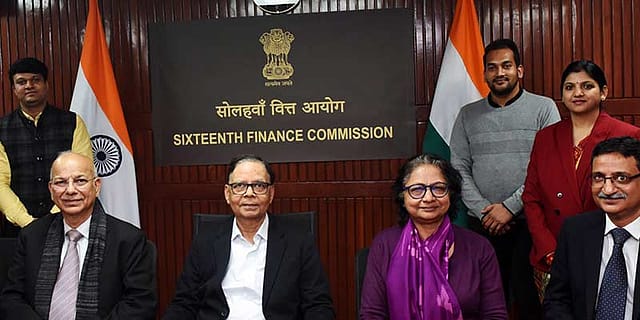
The 16th Finance Commission (FC), tasked with recommending fiscal transfers for 2027–31, has outlined measures aimed at strengthening state finances over the long term, according to a research report by Crisil. The recommendations emphasise reducing revenue deficits and promoting growth-oriented capital outlays.
For the first time, tax devolution will factor in states’ contribution to GDP. While vertical devolution—the states’ share of central taxes—remains at 41%, Crisil notes that this approach incentivises investment-led growth over short-term spending.
Revenue deficit (RD) grants, a feature of past commissions, have been discontinued. “Discontinuation of RD grants can compel states to constrain populist spending. The 16th FC has also recommended uniform disclosure and rationalisation of subsidy expenditures, especially unconditional cash transfers, which have been a drain on state finances,” says Anuj Sethi, Senior Director, Crisil Ratings. Crisil estimates social welfare spending at ~1.9% of GSDP in fiscal 2026, up from ~1.5% in 2024, with ~43% of the increase attributable to direct transfer schemes.
Urban local bodies and infrastructure
While RD grants are removed, Crisil projects allocations for local bodies to rise ~81% over 2021–26, with urban local body grants up 145%. The aim is to modernise civic infrastructure, strengthen internal controls, and improve financial accountability. Performance-linked grants—tied to revenue augmentation and better solid waste and water management—could position local bodies as drivers of urban economic growth, according to Crisil.
The FC also recommends privatising state electricity distribution companies, whose debts stood at 2.3–2.5% of GSDP in 2025. Crisil analysts say, “Privatisation is expected to improve operational efficiency, ensure financial sustainability, and free resources for productive spending.”
Near-term pressures
Despite long-term positives, fiscal pressures persist. “With vertical devolution retained at 41% and FC grants at similar levels, incremental revenue support is limited. Revenue deficits are likely to remain elevated (~0.9% of GSDP), and the 3% fiscal deficit cap constrains capital outlay expansion,” says Aditya Jhaver, Director, Crisil Ratings.