
Why shouldn’t India have its own Big Four consulting, accounting giants? PM Modi asks SRCC students
ADVERTISEMENT
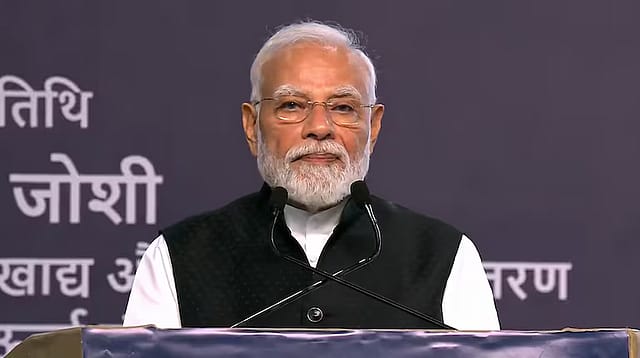
Prime Minister Narendra Modi on Saturday challenged India’s young business talent to move beyond working for global consulting and accounting giants and build Indian firms capable of competing with the world’s biggest professional-services companies.
Speaking at the centenary celebrations of Delhi University’s Shri Ram College of Commerce (SRCC), Modi questioned why Indian consulting and accounting firms could not themselves emerge as global leaders, putting the challenge in the context of India’s broader economic transformation and its expanding pool of skilled professionals.
His address also sought to draw a sharp contrast between the economic environment he encountered during his previous visit to SRCC in 2013, when he was Gujarat chief minister, and India’s position today. Modi said the country had moved from “policy paralysis to policy dynamism” and argued that the latest 7.8% GDP growth underscored the change.
“From policy paralysis to policy dynamism, India has come a long way,” Modi said, adding that those who had once placed India among the “Fragile Five” were now finding it difficult to digest the country's growth performance.
From ‘Fragile Five’ to 7.8% growth
Modi used his 2013 SRCC address as the starting point for much of his economic argument, saying the speech had been about presenting a vision at a time when optimism about India's prospects was low.
“In 2013, when I came to SRCC, I presented a vision. Whatever I said back then was my conviction. I have always lived by those words,” he said.
Recalling the analogy he had used at the time, Modi said he had compared the country's situation to a glass that could be viewed as either half full or half empty.
“I said there are people who can see the glass as fully filled, half with water and half with air,” he said.
Modi said his own assessment had been that the glass was “fully filled”, even though the economic and political environment at the time was bleak.
“At that time, development was at its lowest; inflation had hit the skies. At that time, scandals were at their peak, and the corrupt roamed fearlessly,” he said.
The Prime Minister argued that the country's subsequent economic performance had vindicated the optimism he expressed at SRCC more than a decade ago.
“They once called us the ‘Fragile Five’. Today, they are talking about India as the fastest-growing major economy,” Modi said.
He pointed to India's 7.8% GDP growth amid global uncertainty as evidence of the economy's resilience, while taking a swipe at those he said were responsible for the conditions that had led to India being clubbed with the Fragile Five.
Modi also urged young Indians to revisit the economic headlines of 2013 to understand the scale of the change he was describing.
“I would urge the youth to look at what the situation was back then, in 2013, and look at the headlines of that time,” he said.
He cited headlines around Indian soldiers being killed along the Line of Control, the World Bank lowering India's growth forecast, the current account deficit reaching an all-time high and inflation touching 10%.
“I am sure the youth is not aware of what the situation was like then,” Modi said.
Modi’s Big Four challenge to India’s young professionals
It was against this backdrop that the Prime Minister turned to the ambitions of India's next generation of business leaders.
Modi questioned why Indian companies in consulting and accounting should not rise to the same global stature as the leading international firms.
The challenge is significant for a country whose professionals have become deeply embedded in the global consulting, accounting, financial and technology industries. Modi's argument was that India's talent pool should increasingly translate into Indian-owned businesses with global scale and influence.
He urged young Indians to think about creating companies rather than simply seeking employment with established global names.
The same ambition, he said, should extend beyond professional services. India needs globally competitive companies across sectors as it moves towards becoming a larger and more influential economy.
Manufacturing, space and the next growth phase
Modi also positioned manufacturing as a central pillar of India's future economic expansion.
He said India would become a global manufacturing hub, linking the ambition to the broader Make in India programme and the government's vision of building a developed economy.
Space is another area where Modi sees India moving into a higher-value position. He said the country would eventually have its own space station, with the Bharatiya Antariksh Station being developed in phases.
The first module is targeted for 2028, while the complete space station is planned for 2035.
India wants an Olympics that makes the world watch
Sport also featured in Modi's long-term vision for India. Speaking about India's ambition to host the 2036 Olympics, the Prime Minister said the country would organise the Games on a scale that would attract global attention.
“Bharat aise Olympics ka ayojan karega ki duniya dekhti reh jayegi,” he said.
Hosting the Olympics would carry implications well beyond sport, potentially generating large opportunities across infrastructure, construction, transport, hospitality, tourism and technology.
For Modi, the Olympics ambition sits alongside manufacturing and space as another demonstration of India's ability to execute projects at global scale.
Modi recalls his 2013 SRCC address
The Prime Minister repeatedly returned to his previous appearance at SRCC, saying the speech had continued to resonate more than a decade later.
He said that even though he had been in the Opposition at the time, he had chosen to focus on his own vision rather than use the college platform primarily to attack the government of the day.
“Even though I was in the Opposition, and despite being a critic of the government of the day, I did not use this platform for that purpose,” Modi said.
He recalled presenting the idea of P2G2 — Pro-People Good Governance — and argued that governance should focus on anticipating problems rather than waiting for crises to emerge.
Modi said people had subsequently revisited his 2013 speech and that its central message had remained relevant.
The Prime Minister also recalled the scepticism that greeted initiatives such as Make in India, saying there had been questions over whether the programme could deliver the transformation being promised.
His response at SRCC was to point to the country's current economic performance and the opportunities opening up for young Indians.
SRCC’s ‘OGs’ and a century of alumni
Modi also used the centenary celebration to pay tribute to SRCC's alumni, referring to them in language aimed at connecting with the college's Gen Z audience.
“When a human being lives for 100 years, they are considered a person of deep knowledge and great experience. When an institution completes 100 years, it becomes an ocean of achievements,” Modi said.
“SRCC has shaped generations and connected them to a brighter future,” he added.
Describing the institution's alumni, Modi said, “Those who came, they studied; those who left, they left sculpted.”
He then used a distinctly contemporary reference to describe the college's alumni network.
“SRCC alumni have been very special. In your language, they are OGs,” Modi said.
The Prime Minister also recalled prominent SRCC alumni, including former Union finance minister Arun Jaitley and economist Sanjeev Sanyal.
He also released a commemorative ₹100 coin to mark the institution's centenary.
Modi's appearance at SRCC comes as the BJP continues its outreach to younger voters and professionals. In April, he had met the college's governing body and a delegation from the institution at his residence to mark its 100th anniversary. A special commemorative postage stamp was also released on the occasion.