
India's industrial output accelerates to 7.3% in June, led by manufacturing and electricity sectors
ADVERTISEMENT
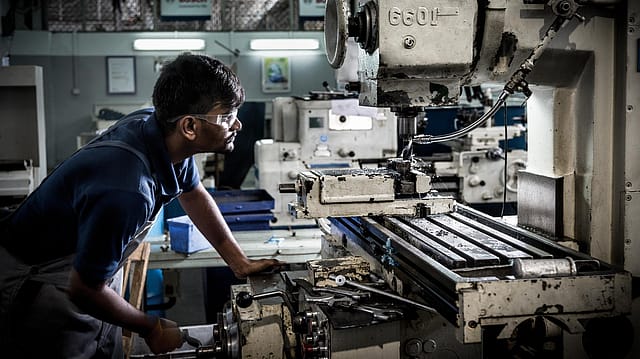
India's industrial output grew at a faster pace of 7.3% year-on-year in June 2026, driven by a robust expansion in manufacturing and strong growth in the electricity and gas supply sector, according to data released by the National Statistics Office (NSO) on Tuesday.
The latest reading marks a sharp improvement from the 5.1% quick estimate for May while the NSO revised May's industrial growth slightly lower to 5%. June is also the third month for which the Index of Industrial Production (IIP) has been released under the new base-year series.
The NSO said the June growth was primarily supported by a 7.8% expansion in manufacturing and 10.6% growth in electricity and gas supply. Mining and quarrying grew by 1%, while the water supply, sewerage and waste management segment recorded 6.1% growth compared with the corresponding month last year.
Manufacturing continued to be the biggest contributor to industrial activity, with 19 of the 23 industry groups registering positive growth during the month. Among them, the manufacture of electrical equipment posted the highest growth at 34%, followed by the manufacture of motor vehicles, trailers and semi-trailers at 17.5%, and food products at 10.8%.
Shashwat Singh, Fundamental Analyst at Bajaj Broking, said the June IIP print significantly exceeded the market expectation of 5.6%, indicating broad-based strength in industrial activity.
"India's Index of Industrial Production accelerated to 7.3% year-on-year in June 2026, significantly higher than the revised 5% growth recorded in the previous month and above market expectations. The sharp uptick reflects broad-based strength in industrial activity, supported by improving manufacturing output, resilient domestic demand and sustained momentum in investment-led sectors," Singh said.
He said that the stronger-than-expected reading suggests industrial activity gathered pace at the end of the quarter despite global uncertainties. According to him, investment-linked sectors such as capital goods, engineering products, automobiles and electrical equipment continued to benefit from strong domestic demand, ongoing infrastructure spending and an improving capital expenditure cycle. "The better-than-anticipated print signals improving business activity and reinforces confidence in India's industrial growth outlook," he added.
Singh also highlighted that the June data is based on the government's recently introduced IIP series with FY22-23 as the base year, under which the Output Producer Price Index (Output PPI) has replaced the Wholesale Price Index (WPI) for deflating industrial output. He said the methodological change would improve the accuracy of real output measurement by providing a more representative measure of producer prices and aligning India's industrial statistics with global best practices. According to him, the revised framework is expected to enhance the quality and reliability of industrial production estimates in the coming months.
Aditi Nayar, Chief Economist, ICRA Ltd, said, "The year-on-year (YoY) growth in the IIP surged to a 23-month high of 7.3% in June 2026 from 5.0% in May 2026, amid a broad-based acceleration in growth across the four sectors between these months, albeit partly benefitting from a modest base. Manufacturing output growth, in particular, witnessed a sharp uptick in June 2026, contributing as much as 199 bps of the 235 bps uptick in the IIP growth relative to May 2026. Four of the six use-based segments, barring capital goods and consumer durables, witnessed an improvement in their growth performance in June 2026 relative to May 2026. While capital goods expanded by double digits for the third consecutive month in June 2026, infra/construction goods output rose by a healthy 7.5% in the month; this suggests investment activity remained robust in the month, benefitting from the easing of tensions in West Asia as well as the large rainfall deficit seen in June that offered extended period for activity. Besides, consumer non-durables output rose by 4.9% in June 2026, the highest pace in six months, while durables output grew by a strong 7.7% in the month."
Vikrant Chaturvedi, Vikrant Chaturvedi, Associate Director, Brickwork Ratings, said, "The acceleration in industrial production to 7.3% in June 2026 indicates resilient domestic momentum, anchored by a robust 14.2% expansion in capital goods. The looming reality of a below-normal monsoon threatens rural consumption and poses upward inflation pressure. Furthermore, although active military engagement in the Middle East has paused, persistent regional tensions continue to drive troubling oil price volatility. For corporate credit profiles, these overlapping headwinds signal potential margin compression in the second half of the fiscal year. Sustaining the current industrial trajectory will increasingly depend on domestic investment durability to offset these mounting macroeconomic pressures."