
Iran strikes US bases across the Gulf after American attacks; oil prices may surge to $150 per barrel
ADVERTISEMENT
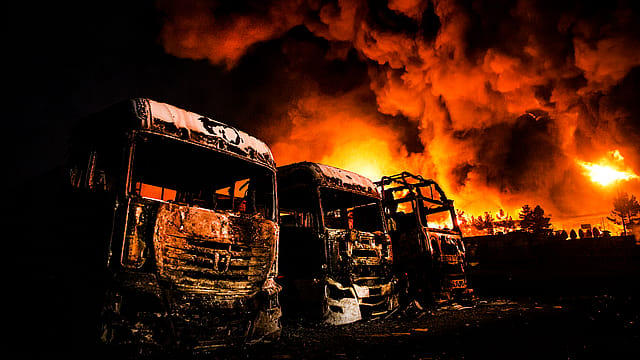
Tensions in West Asia escalated sharply again after Iran's Islamic Revolutionary Guard Corps (IRGC) claimed to have launched ballistic missile and drone attacks on multiple US military targets across the Gulf region in retaliation for recent American strikes inside Iran.
In a statement, the IRGC said it targeted around 18 military sites, including US bases and fighter jet deployments in Jordan, Kuwait, and Bahrain. The attacks came after US forces carried out overnight strikes on Iranian targets, including locations near the capital Tehran.
According to the IRGC, 12 ballistic missiles were fired at Jordan's Al-Azraq Air Base, where US fighter aircraft, including F-15, F-16, and F-35 jets, were stationed. The Iranian military claimed that several aircraft were destroyed, although there was no immediate confirmation from US or Jordanian authorities.
Iran also reported attacks on two air bases in Kuwait and one in Bahrain. The headquarters of the US Fifth Fleet in Bahrain was among the targets, according to the IRGC statement.
US attacks on Iran
The latest exchange follows a fresh round of US military action against Iran. US President Donald Trump told Fox News that American forces launched 49 Tomahawk missiles during overnight operations, including strikes on targets located as close as 64 kilometres from Tehran.
Regional governments reported heightened security threats following the attacks. Kuwait said it was responding to missile and drone strikes while air raid sirens sounded across Bahrain. The US State Department also issued a warning about possible "missiles, drones, or rockets" in Jordanian airspace.
Meanwhile, Iranian authorities said water supplies had been restored to residents in the country's Sirik region after US attacks damaged water storage reservoirs earlier this week.
Oil prices may surge by $150 per barrel
The conflict sent shockwaves through global energy markets. Oil prices surged by more than $2 per barrel after Iran announced the complete closure of the Strait of Hormuz, one of the world's most important oil shipping routes, in response to what it described as US "aggression".
According to Oslo-based energy research firm Rystad Energy, crude oil prices could climb to as high as $150 per barrel if the conflict escalates further. The firm estimates that around 11.8 million barrels per day (bpd) of oil production across six Gulf countries has been disrupted, making it one of the most significant supply shocks in the history of the global oil market.
US attack on oil tanker, 3 Indians missing
In a separate development, the US Central Command confirmed on Wednesday that American forces struck an oil tanker in the Gulf of Oman for the second consecutive day. The vessel reportedly had 24 Indian nationals on board.
India's Ministry of External Affairs said three Indian citizens remain missing following the incident and that search and rescue operations are continuing. The latest escalation has raised concerns over a broader regional conflict and potential disruptions to global oil supplies, with investors closely monitoring developments in the Gulf.