
Pension savings can power India’s infrastructure push and Viksit Bharat goal: CEA Nageswaran
ADVERTISEMENT
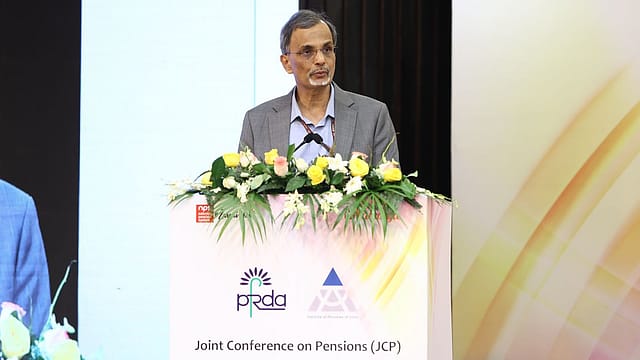
Long-term pension savings can become a critical source of patient capital for infrastructure creation and economic development, helping India progress towards its Viksit Bharat goal while generating returns aligned with long-term liabilities, Chief Economic Adviser V. Anantha Nageswaran said on Tuesday.
Addressing an event organised by the Pension Fund Regulatory and Development Authority (PFRDA), Nageswaran said a deep, well-governed pension ecosystem can support growth-oriented investments without compromising the financial security of subscribers.
Among those who addressed the gathering were V. Anantha Nageswaran, S. Ramann, Preeti Chandrashekhar, and Inagaki Ayako.
Nageswaran said pension capital, by its nature, is among the longest-duration pools of money and can play an important role in financing India’s development agenda while maintaining liability-aware returns. “A developed India requires not just economic expansion but also financial systems that provide stability and long-term security for citizens,” he said.
Nageswaran cautioned against global trends that have pushed pension funds towards increasingly risky and illiquid investments in pursuit of higher returns.
He said that pension systems across Western economies have historically struggled with funding gaps, especially during prolonged periods of ultra-low interest rates that encouraged investors to move into riskier asset classes.
According to him, while the funding situation has improved somewhat as interest rates moved away from near-zero levels, a new challenge has emerged in the form of excessive exposure to macro-sensitive and illiquid assets.
Highlighting investment choices, he pointed to gold as an example, noting that for countries such as India, higher allocations to the asset could also have implications for the balance of payments and therefore require careful consideration by domestic liability-driven funds.
The CEA also raised concerns over the increasing influence of short-term investing behaviour across financial markets, saying even institutions traditionally viewed as long-term investors have shortened their investment horizons.
He warned that prioritising higher returns at the expense of retirement commitments could weaken pension systems over time.
Highlighting the broader development agenda, Nageswaran said the success of Viksit Bharat should not be measured solely through economic output but also through the quality of financial security available to senior citizens.
He said a truly developed society is one where security and dignity in old age are widely accessible rather than concentrated among a few.
The inaugural session brought together policymakers, regulators, actuaries and global experts to discuss retirement preparedness, pension sustainability and the role of social security in India’s Viksit Bharat @2047 roadmap.
A key development during the event was the exchange of a memorandum of understanding (MoU) between Mamta Shankar and Preeti Chandrashekhar to strengthen collaboration in research, actuarial studies, knowledge exchange, innovation, and capacity building across India’s pension sector.