
Viksit Bharat needs private investment to bridge financing gap: Economic Affairs Secretary Anuradha Thakur
ADVERTISEMENT
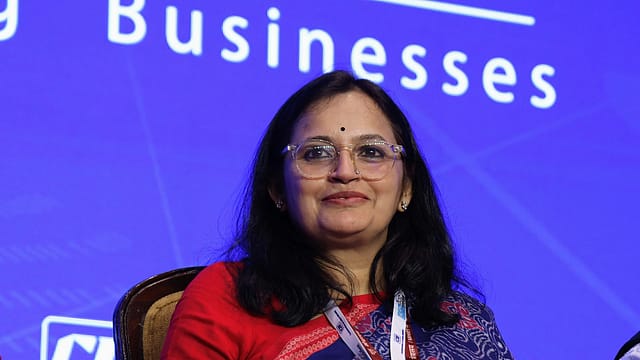
Achieving India's 'Viksit Bharat' vision will require critical private sector investment, as public expenditure alone cannot bridge the massive financing gap, Economic Affairs Secretary Anuradha Thakur said on Friday.
Speaking at a conference of finance ministers and finance secretaries of states and Union Territories, Thakur highlighted the sovereign rating upgrades from major international rating agencies received by India over the past one-and-a-half years, and said such global recognition underscores India's growing economic strength, improving business climate, and strengthening position in the global investment landscape.
Stating that India holds "firm promise" to move forward on the already achieved goals and scale new heights, he said Centre-state partnership on policy issues, on tapping financial sources, and implementation can spearhead towards Viksit Bharat decisively.
"We know that we meet today in the backdrop of ongoing global difficulties. Under these circumstances, and because of the scale of transformation we envisage towards ourselves to reach our shared goal, it needs to be borne in mind that this scale cannot be met solely by government budgets, and that private sector financing will need to play a critical role," Thakur said.
The secretary said the conference will keep this perspective at the forefront while discussing the theme 'Financing India's Journey Towards Viksit Bharat'.
Noting that the Centre-state partnership has helped India get recognised by global agencies for macroeconomic stability and fiscal prudence, Thakur said India has been noted to be amongst the top attractive destinations for the global business environment, as highlighted in the World Economic Forum's Chief Economists Outlook of May 2026.
Earlier this month, Japanese credit rating agency JCR had upgraded India's sovereign rating to 'A-', a feat achieved after a gap of 35 years, citing solid economic growth and a strong financial system.
Last year, India's sovereign rating was upgraded by three agencies, S&P Global Ratings (BBB), Japan's Rating and Investment Information, Inc. (BBB+) and Morningstar DBRS (BBB).
The rating upgrades reflected global recognition for India's robust and resilient macroeconomic fundamentals and prudent fiscal management, and underscore global confidence in India's medium-term growth prospects amid prevailing global uncertainties.
"This kind of global recognition goes to underscore India's growing economic strength, improving business climate, and strengthening position in the global investment landscape," she said.
Talking about the conference, Thakur said it was divided into eight sessions, including the inaugural and the closing sessions.
"We, in the Finance Ministry, hope that this conference will help identify modes and issues that need addressing and pinpoint the different ways in which those can be responded to. Focus on innovative means of financing would be a central piece of this conference's deliberations," she said.
Speaking at the conference, NK Singh, the former Chairman of the 15th Finance Commission, said India should aim for a gross domestic savings rate of 38-40 per cent from the current level of 34 per cent of the GDP to support the investment needed for Viksit Bharat.
"We need to augment and seek additional resources. Equally, public finance must seek to crowd in private capital," he said.
Simultaneously, he said, there is a need to improve the incremental capital-output ratio (ICOR), which has moved from about 5 to 4.5.
"Currently, the states, taken together, stand at roughly 28 per cent. The Sixteenth Finance Commission projects general-government debt at 73.1 per cent by 2030-31, down from 84 per cent today. The trajectory is still somewhat daunting," he added.
Singh recommended that state-wise debt sustainability analysis be done for better achieving fiscal discipline.
"I suggest the Reserve Bank of India or the Ministry of Finance, supported by the C&AG, could undertake an independent assessment of state-wise debt sustainability, with specific thresholds for each and what would be a sustainable path for each," he said.
Singh also suggested that the fiscal space of both the Centre and states can be greatly enhanced through revenue augmentation.
It is for the GST Council to consider broadening the ambit of the GST and the appropriate time to move towards including electricity, aviation turbine fuel and eventually real estate within GST, he added