
Weak monsoon keeps kharif sowing below last year despite normal July rainfall
ADVERTISEMENT
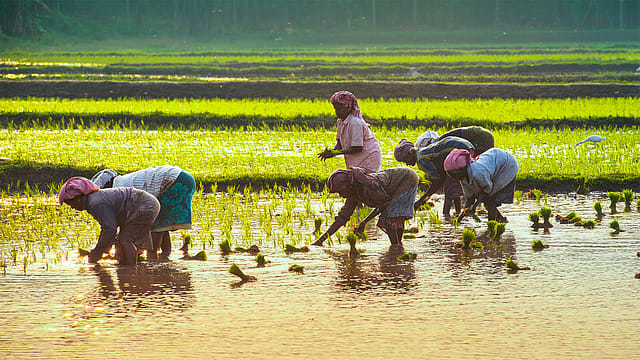
India's southwest monsoon showed signs of improvement in July, but cumulative rainfall remains below normal, keeping kharif sowing lower than last year and raising concerns over crop health in several parts of the country.
According to an analysis by Emkay Research based on data from the India Meteorological Department (IMD), the Ministry of Agriculture and the Central Water Commission (CWC), as of August 1, cumulative rainfall across the country was 12% below the long-period average (LPA), an improvement from a 24% deficit in mid-July. While July ended with rainfall at around 99% of the LPA, the distribution remained uneven, with short spells of heavy showers followed by prolonged dry periods, posing risks to standing crops.
Regionally, Central India emerged as the only area with a rainfall surplus of 6%. In contrast, North and West India recorded a 12% deficit, the Southern Peninsula remained 22% below normal, while East and North-East India continued to face a sharp 29% rainfall deficit.
The uneven rainfall has also affected sowing activity. Total kharif sowing stood at 89.4 million hectares as of July 31, nearly 3% lower than the 92.1 million hectares recorded during the same period last year. The total sown area represents 81% of the normal acreage, compared with 84% a year ago.
Among major crops, rice sowing declined 2.2% year-on-year to 30.1 million hectares, pulses fell 6.3% to 9.5 million hectares, and coarse cereals dropped 7.5% to 15.8 million hectares. Cotton acreage was also down 2.4% at 10.4 million hectares. Oilseeds were the only major food crop category to register growth, rising 0.7% year-on-year to 17.2 million hectares.
With the sowing window for most kharif crops nearly over, Emkay expects the overall cultivated area this season to remain marginally lower than last year.
Food inflation, however, has remained largely under control. Weekly retail price increases for cereals, spices and eggs were modest at around 0.5%, while vegetables, pulses, milk, and edible oils recorded smaller gains. On an annual basis, egg prices were up 13% and edible oils and fats rose 11%, while cereals, pulses, vegetables and milk saw relatively moderate increases.
The report noted that healthy cereal buffer stocks should help contain food inflation, although erratic rainfall could push up prices of perishable items such as vegetables, fruits and pulses if crop damage increases.
Water storage remains another area of concern. As of July 31, reservoir levels across the country stood at 44% of total capacity, 36% lower than the same period last year and 8% below the 10-year average. Western India had the highest storage at 51% of capacity, while Southern India recorded the lowest at just 30%, highlighting continued stress on water availability despite the improvement in monsoon rainfall.