
Trashing in
ADVERTISEMENT
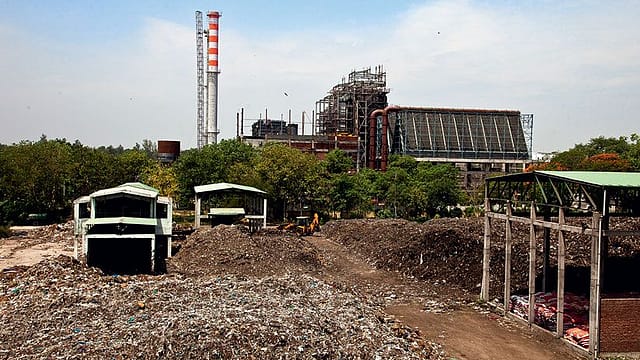
A TOWERING RED-AND-WHITE STRIPED chimney dominates the skyline of Okhla, a densely populated locality in south Delhi. It marks the site of India’s largest waste-to-energy plant, being set up by Jindal Ecopolis for the Delhi government. Jindal fought off 30 other bidders, including heavyweights such as Tata Power.
So what’s driving the big names to waste management? With urbanisation showing no signs of slowing, and Indians consuming more, and therefore generating more waste, any investment in waste management has the potential to generate recurring profits. Waste-to-energy is just one way to create a profitable business from refuse. Depending on the kind of waste—municipal solid waste, e-waste, or industrial waste—different business models are attracting established businesses as well as entrepreneurs.
According to industry estimates, in 2010 India generated 60 million tonnes to 70 million tonnes of municipal solid waste (MSW), 0.12 million tonnes of bio-medical waste, and around half a million tonne of electronic or e-waste. A tonne of MSW can cost around Rs 1,000, depending on the mix, and a tonne of e-waste between Rs 45,000 and Rs 90,000.
Profit margins on segregation and recycling of municipal waste can be as high as 80%; depending on the composition of e-waste, the profit margins can vary between 20% and 30%. A 2010 study by the Associated Chambers of Commerce and Industry of India found that by 2012, about
1,500 MW of power could be generated from India’s urban households and municipal waste, and 1,000 MW from industrial waste. “It is a capital-intensive business with the project cost of 1 MW being three to five times costlier than a thermal plant. But we are hoping for an internal rate of return between 18% to 20% from this project,” says Indersh Batra, vice chairman and managing director, Jindal ITF, of which Jindal Ecopolis is a part. The Okhla plant will process 1,350 tonnes or 200 truckloads of waste daily to generate 16 MW of power for Delhi, and will also earn carbon credits worth 2.6 million certified emission reductions (CERs) over a 10-year period. (CERs are issued in return for a reduction of atmospheric carbon emissions—one CER for an emission reduction of one tonne of carbon dioxide.)
In 2006, Manik Thapar, a science graduate from Delhi University, shocked his family by deciding to start a garbage collection and disposal business. He invested Rs 1 crore of his family’s money, hired 25 people and began EcoWise. Today, EcoWise employs nearly 100 people, and its five trucks collect nearly 60 tonnes of municipal solid waste from 23,000 houses in Noida and Kaushambi in Uttar Pradesh. Thapar earns anything from Rs 2 to Rs 8 for 1 kg of compost, and there’s also a monthly fee that he gets from each house for collecting the waste. All this might not seem big, but with a 30% margin, EcoWise became profitable within three years of Thapar starting it. Today, it’s a Rs 2 crore business. “As income levels go up and quality of life improves, India will generate better quality waste,” says Thapar, adding that Delhi alone has a Rs 3,000 crore potential in waste management.
It’s not just municipal waste that’s profitable; there’s big money in e-waste too. According to industry estimates, India will have almost 1 million tonnes of e-waste by 2012. As Indians use more electronic equipment with shorter lifespans, the segment is expected to grow at 25% or 30% annually.

What makes e-waste processing so profitable is the amount of precious metal that can be extracted from electronics. For example, there are at least 50 metals on a printed circuit board, of which 15 can be extracted. These include gold, silver, platinum, aluminium, and copper.
Greenpeace, the international environment activist network, conservatively estimates that the industry in India is worth $5 billion (Rs 22,575 crore). Greenpeace says a huge amount of e-waste is imported into India, but there are only 25 or so organised recyclers to handle the entire load. “Almost 95% of e-waste goes into the informal sector; Delhi is a hotbed for illegal metal extraction from such waste,” says Abhishek Pratap, senior campaigner, Greenpeace India. However, most recyclers are not equipped to extract, so, in many cases, the valuables are lost while exporting to companies such as Umicore Group in Belgium.
“India exports the goodies and keeps the waste,” complains Rohan Gupta, chief operating officer, Attero Recycling. His plant started operating in January 2010 and recycles 300 tonnes to 400 tonnes of waste at present. It has already attracted $15 million in funding, and expects to break even by 2012.
But profits aside, waste management projects such as Jindal’s waste-to-energy plant have been opposed by environmentalists and residents. They say that a waste disposal plant in the middle of a residential area is a health hazard, with furan and other toxic gases likely to be produced when waste is burnt. The minister for environment and forests, Jairam Ramesh, is on the side of the residents, saying that there are flaws in the project’s environment clearances.
Batra defends the plant and says that all clearances were taken by IL&FS, which handed over the project to Jindal. Ramesh, however, says that once the project was handed over to a different operator, it needed a new set of clearances. Since the project is 70% complete, it’s too late to shift it.
The Central Pollution Control Board will put strict monitoring systems in place to check for toxic emissions. However, Batra says this will not be needed. Plastics and other materials likely to emit toxic gases will be segregated, and only non-toxic waste will be burnt. “There are many such projects, including one in Paris, within city limits and close to residential areas. We have invested in the best technology as far as emissions and pollutants are concerned,” he says.
The problem for all recyclers is the collection and segregation of waste. With the concept of tipping fees (a fee charged for disposing of every load of waste) still at a nascent stage, recyclers struggle to make the early stages viable. Traditionally, municipalities in cities collect waste, but with the private sector entering and setting up profitable businesses based on waste, there is a growing debate about whether the generators of waste should pay to have it removed, or be compensated for providing business to the recyclers.
Satish Sinha, associate director, Toxics Links, a non-government organisation working to provide solutions in municipal, hazardous, and medical waste management, says the efficiency of the private sector has reduced the cost of waste management to almost a third. “There should be policies on making waste available to recyclers. On a standalone basis, the plant might be profitable but the system is at a loss.”
Sushil Sethi, managing director, SPML Infra, a waste management firm, adds that in the current format, business risks are high. “Waste generation in India will double in the next 10 years. Local bodies must share the risks and rewards to effectively manage this quantity,” he says.
The industry is not in favour of making waste a traded commodity, fearing that developed countries might pay more to dump their waste in countries where environmental laws and regulations are not strict enough. An example of this is the ship-breaking industry in Alang, a small coastal town in Gujarat and the world’s largest ship-breaking yard. Decommissioned ships from around the world are sent to Alang, where unskilled labourers cut them into pieces. The town became notorious for the number of deaths due to explosions or poisoning by toxic material. Oil and hazardous material often ended up in the sea, harming marine life.
However, some groups in developed countries say they provide an economic stimulus to areas such as Alang, which would otherwise be among the country’s poorest. The debate is complex, but Sinha tries to settle it. “Waste should be treated as a resource and should be exploited according to our needs,” he says.