
Coal gasification plans gain momentum as Adani, NTPC enter fray
ADVERTISEMENT
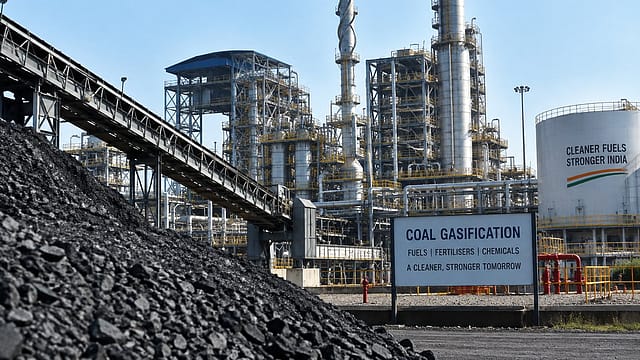
India’s coal gasification programme is gaining momentum, with large corporates such as Adani Enterprises and NTPC entering the first round of the government’s ₹37,500 crore scheme to promote surface coal and lignite gasification projects.
Seven applications have been submitted in the first round, according to the Ministry of Coal. NTPC has proposed a synthetic natural gas (SNG) project, while Adani Enterprises has submitted three urea projects. Other applicants include Gallantt Ispat for direct reduced iron and syngas, Shyam Sel & Power for syngas and Talcher Fertilisers for urea.
The scheme is aimed primarily at reducing India’s dependence on imports of LNG, urea, ammonia, methanol and other chemicals. India imports more than 50% of its LNG requirement, 20% of urea, 100% of ammonia and 80-90% of methanol. Together, imports of LNG, urea, ammonia and methanol were worth about ₹2.77 lakh crore in FY25.
Coal gasification converts coal into syngas—a mixture of carbon monoxide, hydrogen, carbon dioxide and methane—which can then be used to produce electricity, fuels, fertilisers, methanol, ammonia and other chemicals.
Approved by the Union Cabinet on May 13, 2026, the scheme provides incentives of up to 20% of plant and machinery cost and extends coal-linkage tenure to 30 years. It is expected to catalyse investments of ₹2.5-3 lakh crore. The incentive will be released in four equal instalments linked to project milestones. Support is capped at ₹5,000 crore for an individual project, ₹9,000 crore for a single product, excluding SNG and urea, and ₹12,000 crore for a single entity group across projects.
The programme supports the national target of 100 million tonnes of coal gasification capacity by 2030, including 75 million tonnes to be developed under the scheme. It builds on the National Coal Gasification Mission and the ₹8,500 crore scheme approved in January 2024, under which eight projects are under implementation.
Economics will decide
The entry of Adani and NTPC marks an important shift for the sector, says Atanu Mukherjee, CEO of US-based new energy firm Dastur Energy.
“The entry of large players such as Adani and NTPC is significant because it indicates that coal gasification is beginning to be evaluated as a serious industrial investment proposition rather than only a policy-led initiative,” he says.
India has abundant domestic coal but remains dependent on imported gas and industrial feedstocks. “India has abundant domestic coal, while continuing to import significant quantities of gas, fertiliser feedstocks and other industrial molecules. Gasification creates an opportunity to convert a domestic resource into higher-value products and reduce part of that external dependence,” Mukherjee says.
But the next phase will depend on project economics. Gasification plants are capital intensive, and their viability will hinge on technology suited to Indian coal, adequate scale, long-term product offtake, competitive financing and effective carbon management. Government incentives can reduce initial risks, but projects will ultimately have to generate sustainable returns without permanent dependence on subsidies.
“If the first set of projects establishes that economic model, it could unlock a much larger investment cycle around coal-to-chemicals, gas, fertilisers and other industrial feedstocks, while strengthening India’s energy and raw-material security,” Mukherjee says.
Projects take shape
Several coal gasification projects are already under implementation. These include Talcher Fertilisers in Odisha, a joint venture between Coal India, GAIL, Rashtriya Chemicals and Fertilisers and Fertiliser Corporation of India, which plans to produce 1.27 MMTPA of urea using high-ash coal from the Talcher coalfields blended with pet-coke.
Bharat Coal Gasification and Chemicals, a Coal India-BHEL joint venture, is setting up a 2,000 tonnes-per-day ammonium nitrate plant at Lakhanpur in Odisha’s Jharsuguda district at an investment of ₹11,782 crore.
Another Coal India-GAIL joint venture is developing the Coal Gas India Sonepur Bazari coal-to-SNG project in West Bengal. It will produce 1.83 MMSCMD of syngas using coal from the Sonepur Bazari and Raniganj areas, with an investment of ₹13,052.81 crore. Coal India is also planning a similar 1.83 MMSCMD syngas project at Niljai in Maharashtra at an investment of ₹12,214.86 crore.
Several other projects are also in the planning and execution stage.
Technology remains a challenge
Coal gasification is an established technology, having been used extensively in Germany during World War II and later in the US, South Africa, Saudi Arabia and China. China is now the global leader, gasifying around 340-350 million tonnes of coal annually to produce methanol, ammonia, hydrogen, SNG and other chemicals.
India’s challenge is adapting the technology to its coal. Feedstock quality, particularly high ash content, is a major constraint. Domestic projects are therefore relying on configurations suited to Indian coal rather than imported plug-and-play technologies. The Lakhanpur project uses BHEL’s Pressurised Fluidised Bed Gasification technology, while Jindal Steel and Power’s Angul complex uses Lurgi fixed-bed dry-bottom gasifiers.
The economics will also have to withstand competition from alternative feedstocks. Several US coal-gasification projects lost competitiveness after the shale-gas revolution sharply increased the availability of low-cost natural gas.