
Govt weighs allowing airport operators to run airlines; SpiceJet under scrutiny
ADVERTISEMENT
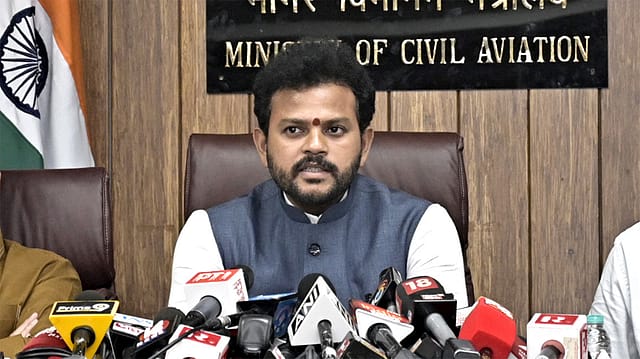
The government is weighing the pros and cons of allowing airport operators to enter the airline business, even as it keeps a close watch on SpiceJet’s operations and finances, Civil Aviation Minister K Rammohan Naidu said on Tuesday.
The comments came after the Adani Group sought an amendment to restrictions governing airport operators’ ownership of airlines. Adani Airports had earlier reportedly sought a waiver from the restriction that prevents the operator of Mumbai airport from holding more than 10% in a scheduled airline. However, Adani Enterprises subsequently denied that it was evaluating any proposal to enter the airline business.
Speaking to media, Naidu said no decision had been taken on the matter.
Govt weighs airport-airline cross-ownership
Responding to a question on the Adani Group’s interest, Naidu said the government was examining both the potential benefits and risks of allowing airport operators to run airlines.
“The first idea is to provide the passenger with more airlines as an option. And if there is someone who is interested to do it, then the government supports the idea,” Naidu said.
“But when the airline operator only has to do it, then what are the cons also that might come out? We need to create a system where the cons are also taken care of,” he added.
Naidu said the government was taking a “balanced approach” and would examine how the potential advantages of such a structure could be weighed against its risks.
He also said there was no general government rule preventing an airport operator from owning an airline, apart from restrictions contained in the Operation, Management and Development Agreements (OMDAs) for the Delhi and Mumbai airports.
“So if, let us say, BIAL, which is still a private operator, if he wants to operate in airlines, then there is no rule as such that is stopping him,” Naidu said.
SpiceJet under operational, financial scrutiny
At the same press conference, Naidu said SpiceJet was undergoing operational and financial scrutiny through the Directorate General of Civil Aviation (DGCA), as the airline continues to face financial and operational challenges.
“The immediate activity in the ministry regarding SpiceJet is that we have operational and both to a certain extent financial scrutiny also being done from the ministry through the DGCA because we don't want safety to be at any lapse,” he said.
The minister said the government was engaging with the airline but had limited scope to intervene because SpiceJet is a private carrier.
“There are certain limits with which government also can operate with them,” Naidu said.
He added that the government had extended the Emergency Credit Line Guarantee Scheme (ECLGS) to airlines affected by difficulties during the West Asia crisis, with ₹150 crore already provided to SpiceJet. The remaining funding would have to be worked out between the airline and its lenders, he said.
“Our major priority right now is to ensure the passengers shouldn't face any inconvenience. The safety shouldn't be compromised at any cost in terms of operations,” Naidu said.
The scrutiny comes as SpiceJet continues to grapple with cash-flow pressures and operational disruptions. Reuters separately reported on Tuesday that the airline had been placed under operational and financial scrutiny following its prolonged financial difficulties.
Govt wants at least five airlines
Naidu linked both developments to the government’s larger objective of creating a more diversified airline market.
“With the kind of numbers that we have in the country, the airports that are there in the country, definitely we have to see at least five airlines,” he said.
“That is the number that I've talked about. Five airlines with at least 100 aircrafts each. And that is the ambition that the ministry also has in encouraging these airlines.”
He pointed to Akasa Air’s steady fleet expansion and Fly91’s order for 40 ATR aircraft as signs of new players emerging in the sector.
UDAN to expand aviation infrastructure
The minister also said the next phase of the regional connectivity scheme UDAN would support the expansion of India’s aviation ecosystem.
The government has signed MoUs with 21 states for the next phase and expects to complete the remaining agreements within two to three weeks. Under the new approach, the Centre wants to bring down the airport construction timeline from as much as three years earlier to 18 months.
The government plans to spend around ₹30,000 crore over 10 years under the scheme, with the overall impact potentially reaching ₹60,000 crore when contributions from states and other stakeholders are included. Naidu also said the government was targeting 200 heliports across the country.
The minister said India had added more than 90 airports through the earlier UDAN phase, with around 1.54 crore passengers benefiting from the scheme.