
How govt’s excise duty cut on fuel is shielding consumers — and for how long
ADVERTISEMENT
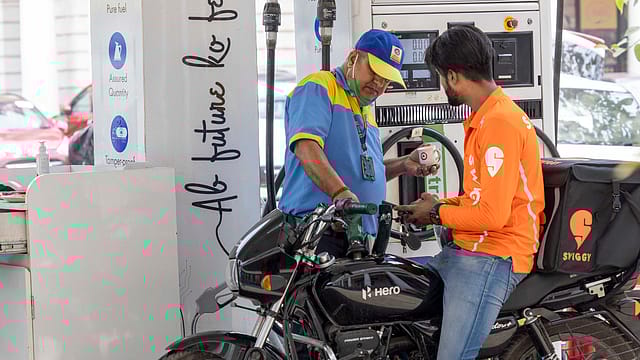
The union government's move to sharply cut excise duty on petrol and diesel is providing a temporary buffer against surging global crude prices, but the move comes at a steep fiscal cost and may prove difficult to sustain if oil markets remain elevated.
The government has reduced excise duty on petrol to ₹3 per litre from ₹13 and eliminated it entirely on diesel, down from ₹10. The move effectively lowers the tax component in retail fuel prices, allowing state-run oil marketing companies (OMCs) to absorb part of the rise in crude without immediately passing it on to consumers.
Industry experts say the measure is less about lowering pump prices and more about preventing a sharp increase.
“The excise cut enables the government to absorb a portion of the global crude shock rather than passing it entirely to households,” said Sourav Mitra, Partner – Oil & Gas at Grant Thornton Bharat.
Loss absorption, not price relief
"By lowering excise duty on petrol to ₹3 per litre from ₹13 and bringing diesel excise duty to zero from ₹10, the Centre has created room for oil companies to neutralise higher crude costs, thereby preventing a sharp spike in pump prices and helping contain transport and food inflation. Even if the full benefit is not immediately visible at fuel stations due to ongoing losses faced by oil marketing companies, Mitra added.
Despite the reduction in duties, retail fuel prices are unlikely to fall in the near term. OMCs are currently facing heavy under-recoveries — estimated at about ₹24 per litre on petrol and ₹30 per litre on diesel — due to elevated crude prices.
The duty cut is being used to offset these losses, effectively stabilising prices rather than reducing them.
This distinction is critical: while headline taxes have been slashed, the benefit is being absorbed within the system to prevent a sharper pass-through to consumers.
Deliberate fiscal trade-off
The decision carries a substantial cost for the exchequer.
With daily consumption estimated at 164.8 million litres of petrol and 325.7 million litres of diesel, the revenue impact of the excise cut is pegged at roughly ₹490 crore per day.
However, the current arrangement has limited durability.
If global crude prices remain above $120 per barrel for more than a few weeks, both the government and OMCs will find it increasingly difficult to absorb the financial burden, Mitra said.
At current levels of under-recovery, continued losses would eventually necessitate price revisions at the pump.
Earlier in the day, petroleum minister Hardeep Singh Puri has sought to reassure markets and consumers that fuel supplies remain stable and that there is no disruption under consideration, including any form of lockdown.
Finance minister Nirmala Sitharaman said, "today we have announced a decision whereby we will support oil marketing companies so that they can import fuel."
"Even if it is imported at a higher cost, the common citizen will not have to face any increase in the price of petrol. Similarly, for ATF required for aviation, we are ensuring prices do not go up and oil marketing companies are supported to bring these commodities to India," she added.