
One GCC every day now, says Sitharaman as India shifts from cost hub to global innovation engine
ADVERTISEMENT
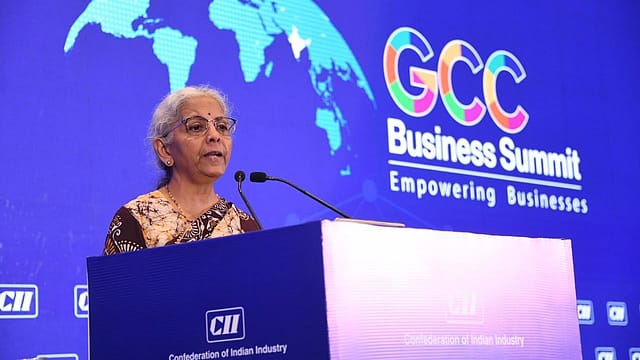
India is no longer competing merely as a low-cost outsourcing destination but is emerging as a global hub for innovation, artificial intelligence and enterprise leadership, finance minister Nirmala Sitharaman said on Thursday, as she highlighted the rapid expansion of the country's global capability centre (GCC) ecosystem.
Addressing the CII National GCC Business Summit, Sitharaman said India is now witnessing the establishment of one new GCC every day, a sharp acceleration from one new centre every week in 2024, reflecting growing confidence among multinational companies in the country's talent and innovation ecosystem. She also reiterated that the government's target of 5,000 GCCs by 2030 is both "realistic" and "achievable".
India currently hosts more than 2,100 GCCs, employing 2.3 million professionals and generating nearly $100 billion in annual revenue.
From cost efficiency to capability leadership
Sitharaman said the role of GCCs has evolved far beyond traditional back-office operations.
"The question before us is no longer whether India can host global capability centres. We have answered that convincingly already. The real question now is whether India can become the country from which global enterprises create their most valuable capabilities, design their next generation of products, develop frontier technologies and shape enterprise strategy itself," she said.
According to the finance minister, more than half of the new GCCs being established in India are AI-first, with engineering research and development emerging as one of the fastest-growing capability areas. Increasingly, these centres are handling artificial intelligence, cybersecurity, product architecture, digital platforms and enterprise-wide transformation rather than routine support functions.
"India's value proposition has evolved from cost efficiency to capability leadership. Enterprises are now moving beyond minimising cost to maximising innovation, accelerating discovery and strengthening long-term competitiveness," she said.
Tier-II cities to drive the next phase
The finance minister said the next wave of GCC expansion cannot remain concentrated in Bengaluru, Hyderabad, Gurugram and other major metropolitan centres.
Cities such as Chandigarh, Varanasi, Visakhapatnam, Tiruchirappalli and Mysuru have the talent, infrastructure and innovation potential to emerge as the next generation of global capability hubs, she said, urging companies to expand into Tier-II and Tier-III cities. Such a shift, she argued, would create a multiplier effect by boosting local employment, startups, research collaborations and urban development.
Sitharaman also called on industry body CII to work closely with state governments to accelerate GCC policy adoption. She noted that around 10 states have either announced or are drafting dedicated GCC policies, while more than 14 states participated in the summit.
Knowledge economy takes centre stage
Opening her address, Sitharaman said every era of economic history has been defined by a different source of prosperity—industrial production in the 19th century, financial capital in the 20th century and, increasingly, "organised human capability" in the 21st century.
She said GCCs represent the clearest expression of that transformation by bringing together engineering, research, finance, data science, cybersecurity and AI to continuously generate innovation across global enterprises.
The minister added that around two-thirds of Fortune 2000 companies are yet to establish a GCC in India, presenting a major untapped opportunity for the country as it seeks to become the world's preferred destination for knowledge-intensive investments. She cited the proposed GCC of French industrial gases major Air Liquide in Pune as an example of continued global interest in India's capabilities.
Concluding her address, Sitharaman urged companies to move further up the value chain by creating intellectual property, leading frontier research, developing AI applications and strengthening partnerships with universities and startups, saying India's ambition should not merely be to host more GCCs but to shape the next generation of global technologies and enterprise innovation.