
Kochi’s constellation of art
ADVERTISEMENT
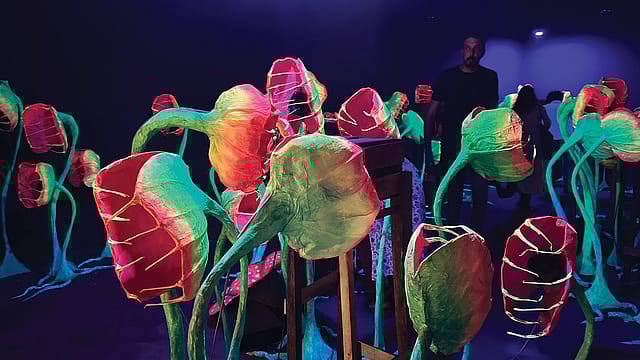
The giant gates of Aspinwall House swing shut as a convoy of slow-moving trucks carrying giant crates of art, memories, and stories emerges into the narrow, timeworn streets of Fort Kochi. As the trucks rumble forward, brushing past the crowded, spice-scented lanes of Mattancherry and the wide, grid-like roads of Willingdon Island, one can spot artists carefully rolling their canvases, slipping paintbrushes and spatulas back into their cases like treasured tools.
Performers fold away their costumes as the last notes fade from the musicians’ strings. Tents that once buzzed with conversations and colours are being dismantled, the poles uprooted and stacked away. Hotel foyers fall back to the uncanny quiet as the curtains come down on the sixth edition of the Kochi-Muziris Biennale (KMB).

For 110 days until March 31, Kochi’s historic waterfront turned into a global stage for artistic experimentation and exchange. Performances, actions, and conversations activated exhibition spaces across 29 venues in Fort Kochi, Mattancherry, Willingdon Island, and Ernakulam. Durational works that blurred the boundary between process and presentation invited the audience into embodied and participatory encounters, challenging the idea of a static exhibition. It made the biennale a space of aliveness, presence, and communion—a place where people gather not only to see art, but to experience it together, and to be present with one another.
With close to a million visitors from all over the world and nearly 60% artists from abroad, the biennale went truly global this time.
Celebrated artist Nikhil Chopra, along with H.H. Art Spaces that he co-founded, curated KMB 2025. The edition’s theme, “for the time being”, combined with conversations, performances, displays of exceptional art and artists, and dynamic installations, among others, made this biennale special, the curator says. As art installations invaded the nearby Willingdon Island—India’s largest artificial island created in 1928 by the British—for the first time, and footfall touched nearly a million, it was not just about the who’s who attending the event this time.
The biennale featured several critically acclaimed works, among them Ghanaian artist Ibrahim Mahama’s Parliament of Ghosts. The work, an evolving installation featuring salvaged, second-hand materials repurposed into a parliamentary chamber, explores the themes of migration and displacement through Ghana’s colonial past.
Berlin-based Anja Ibsch is another artist who mesmerised art lovers. Exploring the act of hosting as a way of holding space for verbal and non-verbal exchanges around different facets of reality, the artist presented Still, a dynamic installation that also functioned as a shared gathering space. She also explored the human body as a site of endurance, transformation, and relational communication through performance art and installation. “This is my second time here, and I loved the curation by Nikhil Chopra. Working with him was so beautiful and brilliant,” says Ibsch. “Of course, there were initial hiccups, but for an event of this scale, that is expected.”
Founded in 2010 by the Kochi Biennale Foundation—a collective of artists—the inaugural edition of the mega art event went live 14 years ago on 12/12/12. Since then, every two years (barring the pandemic years of 2020 and 2024), the tiny islands that dot the backwaters of the coastal city of Kochi transform themselves into live installations of contemporary art. It’s a global celebration of art and artists spanning three months. Though planned at a scope and ambition unheard of in India’s creative space until then, there was little doubt in the founding team’s ability to pull off something the art world would cherish. Backed by acclaimed curators and artists, the art wave from KMB soon created unprecedented ripples as the world sat up and took notice of its scale and quality.
“When KMB started in 2012, it was an uncharted territory. Plus, there were over 130 biennials already taking place around the world,” says Thomas Girst, head of cultural engagement, BMW Group. A renowned author and cultural manager, Girst’s tryst with KMB dates back to the inaugural edition, courtesy of his role at BMW. The luxury carmaker, a long-time patron of the arts, has backed hundreds of artistic initiatives worldwide over the past five decades. “We realised that we also want to be active across India with cultural initiatives. We knew that if we threw our weight behind KMB from the very start, it would be easier for the organisers to get other partners on board, as BMW was already fully committed,” he says.
And the association continues. Over the years, it has transcended into a personal relationship for Girst. “The impact and the importance of KMB, its international recognition, cannot be underestimated. If I were a gardener who helped plant a seed in 2012, I would now sit in the shadow under a beautiful tree bearing beautiful and manifold fruit!” he says. As for the current edition, he adds, “It is a bouquet of the finest flowers, thought through without shying away from addressing societal issues, yet also honoring the beauty that comes with great art.”
In a global art circuit often dominated by bourgeois, invite-only affairs, the Kochi biennale continues to be a defiant outlier: it is unguarded and deeply embedded in the public sphere. Add to that the sheer expanse of the venue: 4.5 sq. km extending up to Willingdon Island, which also made it easier for people to make their ‘in and out’ visits rather than confining them to a large enclosed area, as is with most exhibitions. “It’s Kerala’s culture not to be elitist. This was what I wanted as well, and I treated everyone—from a painter or a contract labourer to someone who flew in on his private jet—with love and respect,” says Chopra.
“The event was not based on any judgement. Instead, it was all about camaraderie and friendship. The word friendship will be incomplete without mentioning Marina Abramović...she epitomises that term apart from being such an accomplished performance artist.” Often called the “grandmother of performance art”, the world-renowned Serbian’s work confronts the limits of the body and mind through endurance, pain, and audience interaction—an ethos that mirrors the biennale’s own insistence on participation, presence, and shared experience.
As the red glow of departing trucks—carrying fragments of imagination, dialogue, and discovery—dissolves into the distance and the dusk unfolds gently over the Arabian Sea, the silence they leave behind feels anything but empty. It is a quiet afterglow of shared experiences—strangers who become companions, art that lingers long after it was seen, conversations that turn into camaraderie, and a city that, once again, opens its arms to the world.
It doesn’t feel like Kochi is bidding farewell. Instead, it is suspended—caught in a quiet inhale between heartbeats, already imagining the return of stories, colours, and conversations that would soon find their way back to its shores, in 2027. The stillness is only for the time being.