
Drone warfare boom puts defence stocks in the spotlight; HDFC Sec sees opportunities in electronics-heavy players
ADVERTISEMENT
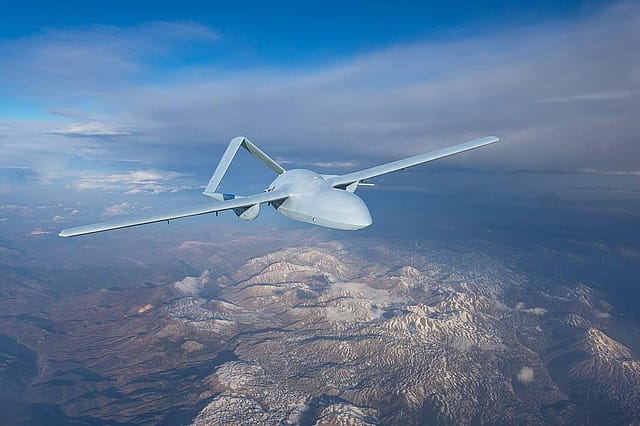
The rapid evolution of drone warfare in recent geopolitical conflicts is reshaping the global defence industry, with unmanned aerial vehicles (UAVs) emerging as one of the most disruptive military technologies of the decade, according to a report by HDFC Securities.
The brokerage noted that conflicts such as the Russia–Ukraine war and the recent tensions involving the United States, Israel and Iran have transformed drones from experimental military tools into critical battlefield assets.
“A consistent pattern across these battles is the heavy reliance on drones, particularly long-range UAVs capable of striking targets hundreds of kilometres away from the frontline. The integration of drone capabilities with conventional weapon systems is quickly becoming a defining feature of modern warfare,” the report said.
Compared with traditional defence platforms that are expensive and slower to deploy, drones offer militaries a low-cost, agile and scalable alternative capable of inflicting significant damage on enemy infrastructure. Their relatively lower cost and ability to be deployed in large numbers have made them increasingly central to both offensive and defensive military strategies.
As a result, several global militaries are ramping up investments not only in drone fleets but also in counter-drone technologies designed to detect, disrupt and neutralise hostile UAVs.
Global drone market expanding
Industry estimates cited by HDFC Securities suggest the global military drone market could grow to around $40 billion by 2030 from about $26 billion currently, implying a compound annual growth rate (CAGR) of roughly 9%.
At the same time, the counter-drone or C-UAV market—which focuses on detecting and intercepting hostile drones—is expected to expand much faster. The segment is projected to grow at nearly 21% CAGR, rising from about $3.9 billion in 2025 to nearly $10 billion by 2030.
The scale of real-world deployment already demonstrates the growing strategic relevance of drones. Ukraine alone has deployed hundreds of thousands of drones since 2022 for both offensive strikes and defensive reconnaissance operations.
According to the report, the economics of warfare are increasingly shifting toward mass-produced, expendable drones rather than expensive legacy systems such as fighter jets or heavy artillery.
Demand is particularly strong for intelligence, surveillance and reconnaissance (ISR) drones and loitering munitions, which have emerged among the fastest-growing segments in NATO-aligned defence markets.
The rapid proliferation of UAVs is also triggering large investments in counter-drone systems, including radar-based detection, radio-frequency jamming systems and directed-energy interception technologies.
India’s UAV ecosystem gaining momentum
India is increasingly aligning its defence policies with these global trends. The domestic UAV market is projected to expand from about $0.5 billion in 2025 to nearly $1.4 billion by 2030, translating into a robust 24.4% CAGR, according to the report.
This growth is expected to be supported by government initiatives such as production-linked incentive (PLI) schemes, import restrictions on certain defence equipment and the development of defence manufacturing clusters.
The Ministry of Defence has also intensified support for indigenous UAV development, particularly in ISR drones, loitering munitions and payload systems integrated with electro-optical sensors.
Recent border and maritime security incidents have further highlighted the need for counter-drone capabilities, including radars, radio-frequency jammers and interceptor platforms.
HDFC Securities believes that listed MSMEs and private defence electronics companies are technologically well-positioned to capitalise on these opportunities, though they will need to scale production capacities to meet both domestic demand and export opportunities.
Key defence stock picks
Within the listed defence universe, the brokerage maintains selective preferences for companies with strong exposure to defence electronics and advanced systems.
It has a “Buy” rating on Apollo Micro Systems, citing its strong positioning in defence electronics, avionics and electronic warfare subsystems used in missile and UAV platforms.
Data Patterns is another preferred play with a “Buy” rating, driven by its capabilities in radar systems, electronic warfare, avionics and space electronics.
Among larger defence players, Bharat Electronics Ltd (BEL) carries an “Add” rating, supported by its dominant presence in radars, electronic warfare systems and communication equipment for the armed forces.
Mazagon Dock Shipbuilders is also rated “Add”, citing strong order visibility in naval defence programmes. Astra Microwave has an “Add” rating, backed by growth opportunities in radar and radio-frequency systems used in defence electronics.
However, the brokerage remains cautious on some defence stocks due to valuation concerns. It maintains “Reduce” ratings on Hindustan Aeronautics Ltd (HAL), Bharat Dynamics Ltd (BDL) and Paras Defence and Space Technologies, despite the sector’s strong long-term outlook.
Defence sector entering a growth phase
According to HDFC Securities, the global defence sector is entering a structurally elevated growth phase. Military expenditure worldwide has grown at a CAGR of about 8.6% over the past three years, significantly higher than the long-term average of roughly 4%.
Countries are accelerating investments across missile defence systems, UAVs, space technologies and electronic warfare capabilities.
India, the world’s fourth-largest defence spender, is also stepping up its military modernisation efforts. The FY27 Union Budget has allocated ₹7.8 lakh crore (about $85 billion) for defence, an increase of around 15% year-on-year.
Nearly 28% or ₹2.2 lakh crore of this allocation has been earmarked for capital expenditure aimed at acquiring advanced technologies, including fighter aircraft, naval ships, defence platforms and UAVs and drones.
Together, rising geopolitical tensions, accelerating drone adoption and strong policy support are expected to create multi-year growth opportunities for India’s defence electronics and UAV ecosystem, the brokerage said.
(DISCLAIMER: The views and opinions expressed by investment experts on fortuneindia.com are either their own or of their organisations, but not necessarily that of fortuneindia.com and its editorial team. Readers are advised to consult certified experts before taking investment decisions.)