
Fortune India 40 Under 40 2026: Sebi chief Pandey urges founders to build boards for the future
ADVERTISEMENT
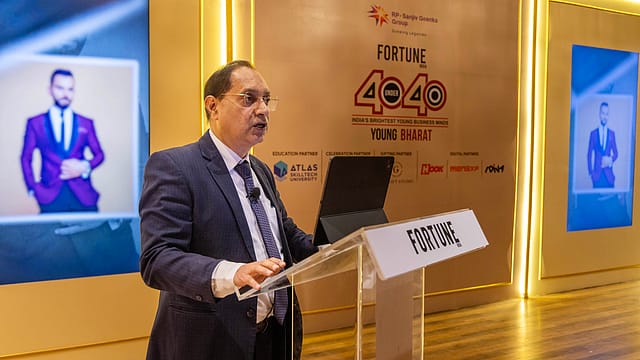
Sebi Chairman Tuhin Kanta Pandey has urged founders and promoter families to build boards with the expertise their companies will need five or 10 years from now, rather than treating them merely as a regulatory requirement.
Speaking at the Fortune India 40 Under 40 event in Mumbai on Wednesday, Pandey said corporate governance must grow as enterprises become larger and more complex, and founders need to make an important transition “from control to stewardship”.
“A founder may begin by thinking, ‘This is my company.’ A steward asks a vital question: Whose capital am I responsible for?” Pandey said.
He said independent directors should have the right information, enough time to deliberate and the freedom to disagree. Boards should also be willing to ask key questions early, including which assumptions are being made, how strong the data is and whether a decision would appeal to a shareholder who does not sit in the room.
“Such questions can prevent small governance concerns from becoming larger failures,” Pandey said.
He said minority shareholders deserve particular attention and rejected any inherent trade-off between good governance and business performance.
“In fact, both complement each other. The link between the two is trust,” Pandey said, adding that trust is an economic asset that influences investor confidence, access to capital and the willingness of shareholders to stay invested through difficult periods.
Pandey also cautioned entrepreneurs against viewing public markets simply as a fundraising event. “Being able to raise public capital is not the same as being ready for public capital,” he said.
Once companies access public money, they become accountable to a larger set of shareholders, many of whom are investing household savings. “Public capital, therefore, comes with public accountability,” he said.
Public markets can finance expansion and innovation, diversify funding, create liquidity and allow more citizens to participate in the value created by an enterprise, Pandey said. They also impose a useful discipline, requiring companies to explain their strategy, capital allocation and performance to a much wider set of stakeholders.
Pandey also said technology must become a board priority as businesses adopt artificial intelligence and other emerging technologies.
“AI can improve productivity and decision making, but poor governance can create bias and accountability problems,” he said. Cyber incidents, data breaches and technology dependency can also disrupt operations.
“Technology must therefore be a board priority. It's no longer merely an operational concern; it's central to business continuity,” Pandey said.
He also called for a stronger culture of research and development, saying India’s R&D spending has remained at around 0.6% to 0.8% of GDP in recent years. Closing the gap, he said, would require a larger and sustained contribution from industry.
Pandey said India should not remain only a market for technologies developed elsewhere and urged the new generation to build technological capability in India, own intellectual property and take Indian innovation to the world.