
NSE debut puts BSE under pressure; ₹4.45 lakh crore valuation nearly 2x BSE, MCX, IEX combined
ADVERTISEMENT
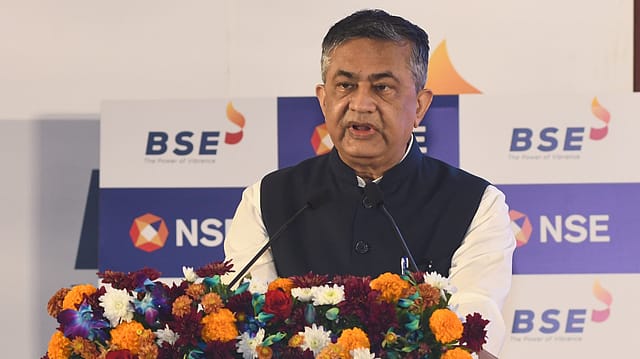
Shares of BSE fell as much as 1.52% on Thursday as the National Stock Exchange (NSE) made its much-awaited stock market debut, with the new listing putting the spotlight on the wide valuation gap between India’s two leading exchanges.
BSE shares fell to ₹3,221 in intraday trade, snapping a two-session gaining streak, amid a broader market sell-off. The BSE Sensex fell 880 points, or 1.17%, to hit a low of 73,947.70, while the NSE Nifty 50 declined 280 points, or 1.19%, to 23,166.
Meanwhile, NSE made a muted debut, listing at ₹1,800 on the BSE, 0.84% above its issue price of ₹1,785. The stock subsequently gained as much as 5.2% to ₹1,878.
At its listing price, NSE commanded a market capitalisation of around ₹4.45 lakh crore, making it India’s largest listed exchange by market value.
NSE’s valuation is nearly twice the combined market capitalisation of India’s other listed exchange companies - BSE, Multi Commodity Exchange (MCX) and India Energy Exchange (IEX).
Together, BSE, MCX and IEX had a combined market capitalisation of around ₹2.28 lakh crore. BSE was valued at about ₹1.31 lakh crore, while MCX had a market capitalisation of ₹86,875 crore and IEX ₹9,973 crore, according to exchange data.
BSE shares down 5% since NSE gets Sebi clearance
BSE shares have remained volatile since NSE received Sebi clearance for its IPO on September 4, marking the start of the exchange's listing process.
From the September 4 close of ₹3,409.80, BSE shares rose to a high of ₹3,452.70 on September 15 before falling to ₹3,161 on September 21. At Thursday's intraday low of ₹3,221, the stock was down more than 5% from its September 4 closing level.
Despite the recent volatility, BSE shares remain up 23.13% year-to-date and 55.84% over the past one year. The stock touched a 52-week high of ₹4,446.80 on May 27, 2026, and a 52-week low of ₹2,021.50 on September 26, 2025.
NSE listing below Street expectations
NSE's ₹22,562-crore IPO, the second-largest public offering in India after Hyundai Motor India's ₹27,859-crore issue, made a relatively muted debut.
The stock listed at ₹1,800, below pre-listing grey-market expectations. A premium of ₹40 ahead of listing had indicated an expected debut of around ₹1,825, or a 2.24% premium to the issue price.
Brokerages, however, remain positive on NSE's dominant market position, strong cash generation and India's financialisation opportunity, while flagging its dependence on trading volumes and regulatory changes as key risks.
Shivani Nyati, Head of Wealth at Swastika Investmart, said NSE's modest listing premium reflected realistic market expectations. She highlighted its approximately 93% share of the cash segment and 99.8% share in equity futures.
Nyati noted that NSE's issue-price valuation of 40.9-42.9 times FY26 diluted earnings was below BSE's roughly 54.3 times. However, nearly 79% of NSE's revenue is linked to trading activity, leaving earnings sensitive to market volumes and regulatory changes.
Domestic brokerage Emkay Global initiated coverage on NSE with a BUY rating and a September 2027 target price of ₹2,050, implying around 15% upside from the ₹1,785 issue price.
The brokerage expects NSE to deliver around 13% EPS CAGR in FY27-29, following approximately 19% growth in FY22-26. Revenue is estimated to grow at around 12% annually, while EBITDA and PAT are expected to grow at roughly 13%.
PL Capital initiated coverage with an Accumulate rating and a target price of ₹1,950, valuing NSE at 35 times FY29 earnings.
The brokerage flagged the decline in NSE's index-options market share as a key drag. Its share fell from around 97% in FY24 to 72% in FY26 and 65% in YTDFY27, amid regulatory changes including restrictions on weekly expiries, the Closing Auction Session and prop-trading rules.
PL Capital expects NSE's revenue and PAT to grow at around 11% CAGR over FY26-29, compared with 25% revenue growth during FY21-26.