
The AI prodigy whose leveraged bet on tokens cost him billions
ADVERTISEMENT
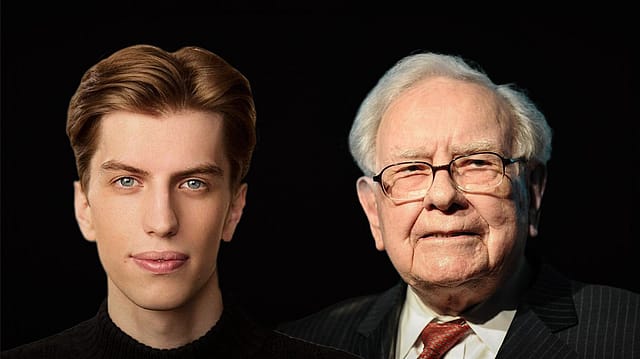
In his annual letter to shareholders in 2000—the peak year before the dotcom bust—Warren Buffett, the legendary investor and chairman of Berkshire Hathaway, wrote on the perils of getting caught in speculative frenzy.
“The line separating investment and speculation, which is never bright and clear, becomes blurred still further when most market participants have recently enjoyed triumphs. Nothing sedates rationality like large doses of effortless money. After a heady experience of that kind, normally sensible people drift into behavior akin to that of Cinderella at the ball. They know that overstaying the festivities, that is, continuing to speculate in companies that have gigantic valuations relative to the cash they are likely to generate in the future, will eventually bring on pumpkins and mice. But they nevertheless hate to miss a single minute of what is one helluva party. Therefore, the giddy participants all plan to leave just seconds before midnight. There’s a problem, though: They are dancing in a room in which the clocks have no hands.”
Two years later, somewhere in Berlin, Leopold Aschenbrenner was born into a family of physicians. His exceptional academics—he was ranked among Germany's top 50 mathematics students three years in a row—got him a seat at Columbia University in 2017, when he was just 15. Not surprising that he also got to work as research assistant to Prof. Robert Y. Shapiro (political science) and Prof. Joseph E. Stiglitz (economics), before graduating at the age of 19.
Both Buffett and Aschenbrenner passed through the same institution—Buffett from Columbia Business School and Aschenbrenner from Columbia College as the top-ranked graduate (valedictorian) with a BA in economics and mathematics-statistics. But while one was schooled by Benjamin Graham in the discipline of value investing, the other was just a decorated economics prodigy who had never once managed a dollar—until he did and squandered it.
While Buffett—a child prodigy himself who had been investing since the age of 11—sharpened his investing acumen under Graham, Aschenbrenner literally went from classroom to managing billions with no track record whatsoever.
If at all, Aschenbrenner began his journey on a weak note.
In early 2022, he joined FTX Future Fund, backed by the now disgraced Sam Bankman-Fried, but quit within months before the FTX blowup. OpenAI was the next stop, where he joined the superalignment team—tasked with addressing long-term risks from superintelligent AI systems—but was fired in May 2024, following disagreements over internal cybersecurity practices.
In June that same year, Aschenbrenner self-published an essay series, Situational Awareness: The Decade Ahead, on how exponential scaling in computing and algorithms will result in the ultimate dawn of the age of superintelligence. The essay coincided with peak AI narrative on the Street, that saw some prominent investors, including Stripe co-founders, pouring money into his San Francisco-based hedge fund, Situational Awareness.
Still raw in investing—and unaware of Buffett’s timeless wisdom—Aschenbrenner gatecrashed into the ball without ever having learned to dance.
He had the momentum going in his favour. By early this year, his fund in just two years into its launch saw its assets surge to $13.7 billion, hitting a peak of $45 billion. With a record 439% net return in the first half of 2026 alone, Aschenbrenner was seen as this AI genius given that his fund had gained more than 1,000% since inception.
Aschenbrenner was bullish on AI infra companies including names such as Nebius, SanDisk, SK Hynix, Nvidia, Bloom Energy and the likes. As long the AI trade was in play, his fund made most of the narrative, the returns were amplified because he was running his fund on leverage, reportedly up to 400%.
A snapshot of the fund's sector allocation tells the story of how completely that bet took over the portfolio. Information Technology made up more than half the book by Q4 2025—54.36% in one quarter alone. The same filing shows a fund in constant, aggressive motion: 23 new purchases against 10 complete sell-outs in a single quarter, a 63.46% turnover rate, and an average holding period across the top 20 positions of just one quarter. Top 10 positions alone made up 72.66% of the portfolio.
Yet another lesson that Buffett cautioned against was leverage—and here was a 24-year-old romping away at the party with leverage as his dancing partner. It worked well till prices headed north, but when the tide turned with AI stocks losing steam beginning July, especially in names such as Nebius, SanDisk and SK Hynix, margin calls from the lenders kicked in. Nebius, where the fund had disclosed a multi-billion-dollar stake as recently as May, fell roughly 48% from its peak, erasing about $35 billion in market value in the position alone. Sandisk dropped 56% in barely a month. As the margin pressure became unbearable, Aschenbrenner had to sell his entire leveraged book of public stock holdings — including SK Hynix and CoreWeave — to Kenneth Griffin's Citadel at a discount. As a result, the fund took a hit of 67% in the month of July.
The only saving grace for Aschenbrenner is that the fund is still holding its private holdings — primarily a $5 billion stake in Anthropic. The rapid rise and fall just goes to prove why investing is more of an art than maths.
Interestingly, in the concluding section of his essay, Aschenbrenner wrote that a small group of people, including himself, possessed an understanding of AI's trajectory that the broader public had yet to grasp, and suggested that group could one day be remembered alongside physicists Leo Szilard, J. Robert Oppenheimer and Edward Teller. He wrote that whether that group's predictions for the years ahead would prove correct "remains to be seen."
As it turns out, Aschenbrenner saw the future clearly enough to build a portfolio, but not smart enough to hold it through. Though it’s not all over for the young fund manager given his age, he would do well adhering to the advice of his fellow Columbia alum who had famously warned that leverage is the only way a smart guy can go broke.