
Despite digital push, bank branches in India remain vital for KYC, documentation: EY report
ADVERTISEMENT
EY India on Wednesday released a report highlighting how customer experience (CX) is emerging as the defining factor shaping the future of India’s banking sector. The report, titled Customer Experience Reimagined: The New Frontier for Indian Banking in 2026, surveyed 2,030 banking customers across different demographic segments and found that in a market where products and pricing have become standardised, banks will increasingly compete on the quality of customer experience to remain relevant.
The study identified seven major customer personas driving banking behaviour in India — aspiring strivers, rising professionals, middle-age entrepreneurs, mass-affluent urbanites, rural core customers, golden transitioners, and empowered urban women.
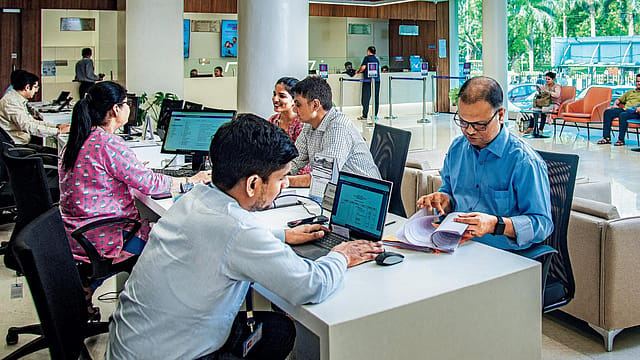
According to the report, branch usage continues to vary significantly across customer segments despite rapid digital adoption. While only 9% of aspiring strivers frequently visit bank branches, physical branches remain important for activities such as KYC updates and documentation. Rising professionals continue to maintain strong branch engagement, with 33% in rural areas and 37% in urban areas visiting branches regularly.
Higher branch dependence among middle-aged entrepreneurs
Middle-aged entrepreneurs showed even higher branch dependence, mainly for cash transactions and account services while 52% of mass-affluent urbanites still rely heavily on branches. Among rural core customers, 56% visit branches for deposits and withdrawals, while nearly 45% of empowered urban women reported frequent branch usage.
“Banks that excel in customer experience can unlock opportunities for cross-selling and upselling while differentiating themselves in an increasingly competitive market,” said Pratik Shah, Pratik Shah, National Financial Services Leader, EY India. He added that banks must strike a balance between automation and human interaction while addressing legacy technology challenges and data privacy concerns.
Aarthy Rangarajan, Partner – Financial Services, EY India, said Indian customers today expect seamless, fast and transparent banking experiences, driven largely by digital-first firms and fintech companies that have redefined convenience standards. “Only 25% of customers rated their overall banking experience as excellent, highlighting a major opportunity for banks to reimagine customer experience as a strategic priority,” she said.
88% of customers considered account opening processes convenient
The report found that 88% of customers overall considered account opening processes convenient, although experiences differed across customer groups. Only 68% of aspiring strivers found onboarding convenient, citing unnecessary branch visits, lengthy procedures and excessive documentation. In contrast, 93% of golden transitioners and 94% of women customers reported smooth account opening experiences.
Mobile banking satisfaction levels were high across segments
Mobile banking satisfaction levels were relatively high across segments, with 74% of aspiring strivers and rising professionals rating their mobile banking experience as good or excellent. Mass-affluent urbanites recorded the highest satisfaction levels at 79%. However, the report noted that banking chatbots remain underutilised and relatively less trusted, indicating a need for more emotionally intelligent conversational AI systems.
On personalisation, the report found that a majority of customers believe banks understand their financial needs. About 74% of rising professionals and 79% of middle-age entrepreneurs said their banks offered products aligned with their lifestyles and spending habits. At the same time, 45% of women customers indicated a need for better timing and relevance in banking offers.
The study also showed growing acceptance of AI-driven banking tools. Around 49% of rising professionals and 51% of entrepreneurs expressed preference for AI-powered financial advice, automated savings tools and budgeting support. Among women customers, 73% said they were comfortable with AI-powered assistants resolving banking queries, although many older customers still preferred speaking to human representatives.
To help banks address evolving customer expectations, the report introduced the EXCEL framework for customer experience transformation, focusing on five pillars — Empathy, eXecution, Convenience, Empowerment, and Listening. According to EY India, applying the framework across different customer personas could help banks build stronger customer loyalty and long-term engagement.