
Fortune India Startup Summit 2026: AI, capital and Bharat shape next phase of startups
ADVERTISEMENT
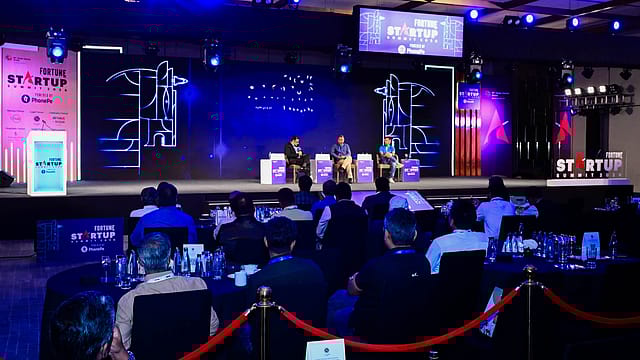
The Fortune India Startup Summit 2026 that took place on Thursday in Bengaluru brought together founders, investors, policymakers and operators, with conversations converging on a clear theme: India’s startup ecosystem is moving from scale-first growth to long-term value creation, even as artificial intelligence reshapes industries.
AI shifts from experimentation to execution
A strong thread across sessions was the evolving role of AI—not as a future concept, but as a present-day business enabler.
Irina Ghose, India managing director at Anthropic, said enterprises are already deploying AI at scale. “India is now our second-largest user base globally… and what stands out is the depth of usage,” she noted, adding that companies are moving towards mission-critical applications and agentic AI systems.
Echoing the shift towards real-world use cases, Ankush Sabharwal, founder of CoRover.ai, stressed that the next phase of innovation must solve for “Bharat, not just India”, particularly through language-led and context-aware AI solutions.
Startup ecosystem at an inflection point
At a broader ecosystem level, Shweta Rajpal Kohli of the Startup Policy Forum described the current moment as an inflection point, driven by maturing founders, increasing liquidity events, and stronger institutional participation.
Bain & Company’s Aditya Shukla added that the next phase will depend on patient capital, talent availability and enabling infrastructure.
VCs pivot from valuation to value
That shift in capital mindset was reinforced by investors. Mohit Bhatnagar of Peak XV Partners said downturns often create the best opportunities.
“You have to measure success over five to ten years, not five or six quarters,” he said.
Pranav Pai of 3one4 Capital argued that AI is fundamentally changing how value is defined. “It’s less about 2021 and more about what 2035 looks like,” he said.
Fintech scale vs monetisation gap
However, even as innovation accelerates, monetisation challenges persist in some sectors.
PhonePe co-founder Rahul Chari cautioned against assuming that digital payments in India are a solved problem. “Payments itself is not done,” he said, pointing to both low penetration and structural monetisation gaps.
Beyond metros: Rise of Bharat-led entrepreneurship
Beyond metros, founders and investors highlighted the growing importance of smaller towns in driving the next wave of growth.
Entrepreneurs such as Satyajit Singh (Shakti Sudha Industries) and Pranav Kapoor (PKapo Perfumes) pointed to localised products scaling globally, supported by rising aspirations and improving access.
Policy push and state-level competition
Policymakers also underscored a shift towards ecosystem-led growth. Karnataka minister Priyank Kharge said states are now “fiercely competitive” in attracting investment, but emphasised that the focus must go beyond capital.
“We pitch Karnataka as a destination for skills, knowledge, collaboration and co-creation,” he said.
Industries minister M.B. Patil added that the state is expanding beyond IT into aerospace, electronics, semiconductors and green energy.
Founders bet on patience and resilience
Meanwhile, repeat founders such as Wakefit’s Chaitanya Ramalingegowda and Optimist’s Ashish Goel highlighted the need for patience, alignment and ground-level learning, as easy capital fades.
The overarching message from the summit was clear: India’s startup ecosystem has moved beyond proving its potential. The next decade will be defined by execution, resilience, and the ability to build globally relevant, large-scale businesses.