
From Alwar village to ₹1,000 crore revenue target: The growth story of DailyObjects
ADVERTISEMENT
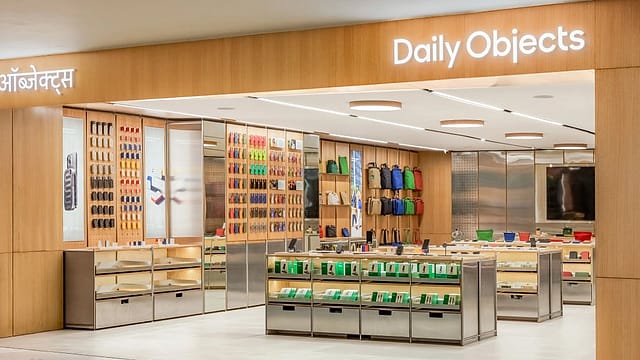
From a small village in Rajasthan’s Alwar district to building one of India’s better-known lifestyle-tech accessory brands, Pankaj Garg’s entrepreneurial journey mirrors the evolution of the country’s aspirational consumer market itself. What began in 2012 as a smartphone case business has now expanded into a multi-category brand spanning bags, charging solutions and workspace accessories, with DailyObjects now betting heavily on premium lifestyle-tech products and offline retail expansion.
Even as several direct-to-consumer (D2C) brands battle slowing demand, margin pressure and rising logistics costs, the Gurugram-based company is charting an aggressive growth path while staying close to profitability. The company has crossed ₹300 crore ARR and is targeting ₹1,000 crore in revenue over the next three years, betting that India’s appetite for premium lifestyle-tech products is only getting stronger beyond metros.
“We are a very capital-efficient company,” co-founder and CEO Garg told Fortune India. “Profitability is not a challenge for us. We are almost break-even while growing nearly 100% year-on-year.”
DailyObjects expects to close FY26 with an estimated net revenue of ₹210 crore, up from nearly ₹110 crore in FY25 while aiming to close FY27 at ₹400 crore in net revenue. The company has raised around $12 million in funding till date, including a $10 million round in October 2024.
Its latest push NODE, which it calls the world’s first modular wireless charging ecosystem, is designed around how people work, travel and power multiple devices through the day. With NODE, DailyObjects is attempting to create a new sub-category within the conventional charger market, where products largely remain static, desk-bound and dependent on cables.
The global wireless charging market is projected to reach $16 billion by 2029, growing at a CAGR of 20.3%, according to a Markets and Markets report.
“We wanted to rethink how charging fits into modern lifestyles,” Garg told Fortune India. “People today are carrying multiple devices and moving constantly between work, travel and home. Existing charging products are still very utility-driven.”
Garg, who grew up in Mubarikpur village with a population of roughly 4,000-5,000 people, said he always wanted to build something of his own despite beginning his career as a software engineer. He even gave up an H1B visa opportunity early in his career to stay back in India and build a business.
“I thought that was a trap for me,” he said. “I wanted to build something in India.”
DailyObjects started with smartphone cases because it was among the fastest-growing consumer tech categories at the time. Over the years, the company gradually expanded into bags and charging solutions, while staying focused on design-led products. Garg said the company spends anywhere between eight and 15 months developing a product before launch.
The company has been doubling down on product development. Garg said every product is designed entirely in-house, with a development cycle of eight to 10 months per product. DailyObjects currently operates with around 50 core SKUs excluding colour and size variants, while using IP protection to safeguard its designs.
Its charging and stack ecosystem categories have emerged as key growth drivers, with sales growing nearly threefold. The company has also launched Qi 2.2 wireless chargers, placing it among only five to six companies globally currently offering the technology.
Premium push beyond metros
The company’s growth is increasingly coming from smaller cities, reflecting how premium consumption is spreading beyond India’s metros. Garg said 35-40% of DailyObjects’ sales now come from tier 3 and tier 4 cities, while another 20-25% comes from tier 2 markets.
“Aspiration is no longer limited to metros,” he said. “Consumers across smaller towns are willing to spend on good design and quality.”
That shift is also driving the company’s offline retail push. Over the past nine months, DailyObjects has opened 11 stores and plans to scale up aggressively to nearly 150 stores over the next four to five years. The brand is also now present across nearly 300 Apple premium reseller stores, which was launched fairly recently with plans to double that footprint over the next three to four months.
According to Garg, offline retail has helped improve product discovery in a category where touch and feel significantly influence buying decisions. “Our products are impulse-buy products. When consumers experience them physically, the conversion is very high,” he said, adding that all its stores have been profitable from the first month. Airport terminal stores are already delivering margins of nearly 15% from month one.
While most D2C brands continue to rely heavily on marketplaces, nearly 70% of DailyObjects’ sales come from its own channels. Garg believes that balance gives the company greater control over both margins and customer experience as it expands deeper into India’s premium lifestyle-tech market.