
Apple at 50: How India went from waiting for iPhones to producing a quarter of the world’s total
ADVERTISEMENT
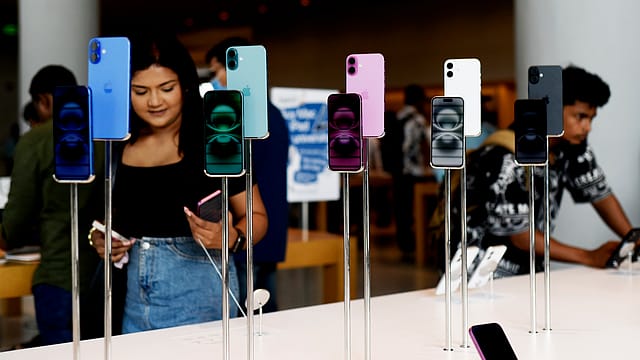
Tara, a final-year BA student, didn’t upgrade immediately. She stayed on her iPhone 15 longer than most, only moving to the iPhone 17 when it began to feel dated. “I’ll always be an Apple loyalist,” she says, “but I don’t need every new release.”
Rajesh, a cinematographer, approaches it differently. He upgrades every year, usually to the Pro Max. “The camera matters for my work. And with exchange values, upgrading yearly doesn’t feel as expensive.”
Both behaviours now sit comfortably in India. That wasn’t always the case. For early users like Suraj Kumar Behera, a finance professional working at an MNC, Apple wasn’t something you bought here. “I started with the iPod around 2006,” he says. “And I bought my first iPhone in 2007 from a duty-free store while returning from Australia.”
That was typical. Apple didn’t create demand in India—people found their way to it anyway. Devices came in through travel, relatives, or grey markets.
At the same time, the experience wasn’t always smooth.
Aditi Ghosh, a secondary school teacher, had a similar entry point. Her iPod Nano was bought in the US. It worked well for basic listening—small, easy to carry, simple to use. But beyond that, it felt limiting. Getting music onto the device wasn’t straightforward if it wasn’t sourced through Apple. Over time, that friction outweighed the convenience. The device still works, but it’s no longer used.
Access came much later
Apple began assembling iPhones in India in 2017, starting with older models like the iPhone SE. For years, India was not where Apple made its best devices. It was where it produced what was already a few cycles old.
Now, that has changed. Apple now assembles newer iPhones in India, with production jumping 53% in 2025 to around 55 million units, up from 36 million a year earlier, as reported by Bloomberg. The country now accounts for roughly a quarter of Apple’s global iPhone output, and the company assembles all iPhone models locally.
According to Reuters, the Indian government is preparing a new round of incentives to expand electronics manufacturing, even as earlier schemes begin to taper. India produced nearly $60 billion worth of mobile phones in FY25, with exports crossing $21 billion, making smartphones the country’s top export category.
Apple is also moving faster on new launches locally. For the first time, the company is manufacturing all models of its latest iPhone lineup in India, including the Pro and Pro Max variants.
The demand caught up
Apple CEO Tim Cook, speaking on an analyst call, pointed to India as a key growth market. “We really like what we see there. It is the second-largest smartphone market in the world. And the fourth-largest PC market. Despite a very nice growth history, we have a modest share there. So, we think there is a huge opportunity for us there. And we could not be more excited about it,” Cook said.
According to Counterpoint Research, Apple recorded its highest-ever value share in India’s smartphone market in 2025, at around 28%. Growth at the premium end has been supported by financing options, trade-ins, and a wider base of consumers willing to spend on higher-priced devices.
Even in a slower market, Apple has held momentum. While overall smartphone sales in India fell 9% year-on-year in the first nine weeks of 2026, Apple grew 12% during the same period, according to Counterpoint’s India Weekly Smartphone Sell-out Tracker.
This highlights how Apple operates in India, and also how India relates to Apple. From the local assembly to produce 25% of the world’s iPhones and generating record revenues, India still poses risks of price sensitivity, and competition from China and Vietnam in terms of cost advantage. Yet, it seems Apple’s bet on the country seems to have paid off.