
Google I/O 2026: We’re entering a new phase of the AI platform shift, says Sundar Pichai
ADVERTISEMENT
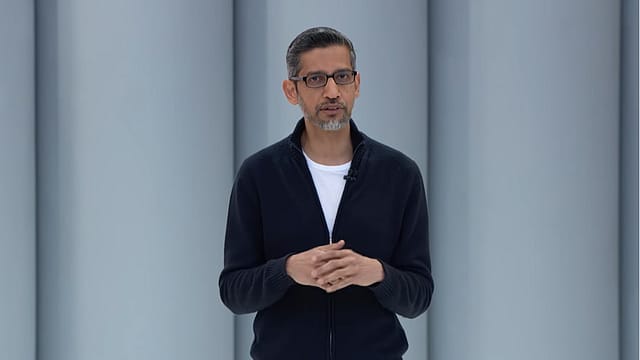
Google used I/O 2026 to show just how aggressively it is scaling Gemini across products, infrastructure and developer ecosystems, positioning AI as the company’s next computing platform rather than a standalone product category.
Opening the keynote, Alphabet and Google CEO Sundar Pichai said, “We’re entering a new phase of the AI platform shift,” as Google detailed the scale at which its AI systems are now operating. The company said it is processing trillions of tokens every month across products and APIs, while Gemini usage has continued to accelerate across consumer and enterprise applications.
Google also highlighted the rapid growth of AI Overviews in Search, which now reach more than 2.5 billion users globally, while the Gemini app has crossed 900 million monthly active users. The company said developers are increasingly building on Gemini APIs and AI Studio as it expands its AI infrastructure footprint globally. Pichai repeatedly stressed the scale of investment underway. “The opportunity with AI is as big as it gets,” he said, framing the company’s infrastructure, model and product expansion as part of a long-term shift in computing.
DeepMind CEO Demis Hassabis, meanwhile, positioned Google’s newer multimodal systems as a step toward more general-purpose AI systems. Speaking about Gemini Omni, Hassabis said the model represents “a step toward a world model.”
All the major announcements from Google I/O 2026
Gemini 3.5 Flash
Google positioned Gemini 3.5 Flash as its flagship deployable frontier model, focusing heavily on speed, lower latency and reduced inference costs. The company said the model improves coding, UI generation, reasoning and long-context task handling while remaining significantly cheaper to run at enterprise scale. Google also directly compared Flash against competing frontier models, arguing businesses could reduce compute costs substantially by shifting workloads onto Gemini infrastructure. Pichai said some enterprise customers could save “over a billion dollars annually” using Gemini Flash deployments at scale.
Gemini Omni
One of the keynote’s biggest launches was Gemini Omni, Google’s omni-modal AI system capable of understanding and generating text, audio, images and video simultaneously. During demonstrations, Omni generated cinematic video sequences, edited visuals conversationally and responded to mixed-format prompts in real time. Google positioned the model as foundational infrastructure for future AI agents, creative workflows and media generation systems. “This is a step toward a world model,” Hassabis said during the presentation.
Search becomes deeply AI-native
Search remained central to Google’s AI strategy, with the company integrating Gemini much more deeply into the experience.
Google announced expanded AI-powered Search experiences with multimodal queries, AI-generated visual explanations and interactive mini-app style responses directly inside Search results. Instead of static blue links, users can increasingly converse with Search and refine results dynamically. Pichai said Google is “bringing generative AI directly into how people explore information.” The company also expanded AI Overviews and introduced more agentic search capabilities capable of completing tasks, summarising information and handling layered queries in real time.
Ask YouTube
Google introduced Ask YouTube, a conversational AI layer for YouTube that allows users to interact directly with videos instead of relying only on keyword search. The feature enables viewers to ask questions about a video’s contents, jump to relevant sections and receive contextual summaries powered by Gemini. Google positioned the feature as part of its broader effort to make video content searchable conversationally.
Docs Live
Google also unveiled Docs Live, a voice-powered document collaboration system integrated into Workspace. The feature allows users to brainstorm, edit and revise documents using conversational voice prompts while Gemini assists with drafting, restructuring and contextual suggestions in real time. Google said the aim is to make document creation more interactive and collaborative.
Antigravity 2.0
Google expanded its push into agentic AI with Antigravity 2.0, an orchestration system designed to coordinate multiple AI agents across workflows and tasks. The platform enables Gemini-powered agents to break down tasks, delegate actions and execute multi-step processes autonomously instead of responding to isolated prompts. Google positioned Antigravity as foundational infrastructure for enterprise automation and productivity systems.
Gemini Spark
Another major launch was Gemini Spark, an always-on AI assistant integrated across Workspace and third-party tools. Spark proactively organises workflows, summarises emails and documents, coordinates schedules and automates repetitive tasks. Unlike traditional assistants that wait for prompts, Spark is designed to continuously assist users contextually across applications. Pichai said Google wants AI to become “more useful, more personal and more proactive.”
TPU 8T and TPU 8I infrastructure
Infrastructure formed a major part of the keynote as Google detailed its next-generation Tensor Processing Units, TPU 8T and TPU 8I. The company said TPU 8T is optimised for large-scale frontier model training, while TPU 8I is focused on inference-heavy workloads and real-time AI applications. Google positioned the split architecture as essential for scaling increasingly complex multimodal and agentic AI systems efficiently. The TPU announcements also reinforced how aggressively Google is investing in vertically integrated AI infrastructure spanning chips, models, cloud and products.
SynthID expansion
Google also expanded SynthID, its watermarking and AI-content identification technology, amid growing scrutiny around synthetic media and misinformation. The company said SynthID will now integrate more deeply across Google products, including Chrome, and will support broader content provenance tracking for AI-generated media.