
Sarvam AI enters hardware with ‘Kaze’ smart glasses, takes on Meta in India’s AI wearable race
ADVERTISEMENT
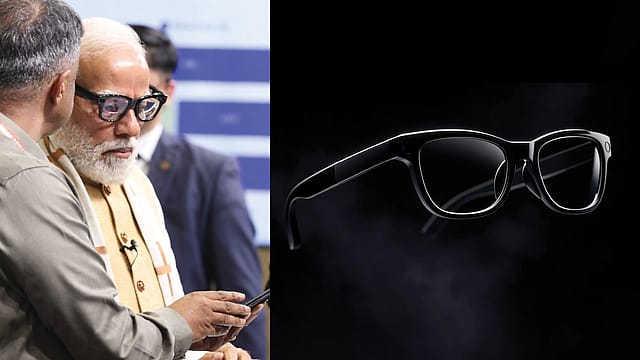
Bengaluru-based AI startup Sarvam AI has made its first move into consumer hardware with the unveiling of Sarvam Kaze, a pair of AI-powered smart glasses positioned as a “Made-In-India” alternative in a category dominated by global tech giants.
The product was showcased at the India AI Impact Summit 2026 in New Delhi, where Prime Minister Narendra Modi was seen trying on the device on stage—instantly propelling the wearable into the national spotlight.
Moving AI from screens to the real world
Kaze is designed as a hands-free extension of the smartphone. Equipped with visible cameras embedded in a conventional spectacles-style frame, the device listens, interprets surroundings, responds to voice commands and captures photos or short visuals.
Co-founder Pratyush Kumar described the launch as Sarvam’s first attempt to “get our models into your hands with our devices—designed and built here in India.”
In another post, Kumar explained the product philosophy: “Sarvam Kaze moves intelligence from the screen to the real world. You wear it. It listens, understands, responds, and captures what you see. And you can build custom experiences for it with the Sarvam platform.”
Unlike most competing products that rely heavily on English-first AI stacks, Sarvam says Kaze runs on its own foundational models trained on Indian languages and datasets. The startup has been part of a government-backed cohort tasked with building AI models grounded in Indian data, spanning speech, text, and document understanding.
The glasses are scheduled to go on sale in May 2026.
A chat-based AI feature is expected to roll out later this week. Pricing, battery life, hardware specifications and the split between on-device and cloud processing remain undisclosed.
The Sarvam Edge factor
Ahead of the hardware debut, Sarvam had introduced Sarvam Edge, an offline AI model designed to run locally on devices without constant cloud dependency. If integrated meaningfully into Kaze, this could offer two advantages: lower latency and improved data privacy—critical in a wearable that continuously captures ambient data.
The company says its broader goal is to build AI systems that are “efficient, private and accessible everywhere,” with smaller memory and compute footprints while maintaining competitive accuracy.
Entering a crowded field
Sarvam’s timing is notable. Meta recently brought its Ray-Ban smart glasses to India, intensifying competition in the smart eyewear segment. The category has so far been defined by global players integrating cameras, voice assistants and AI features into lifestyle and performance eyewear.
At the summit, global brands such as Oakley-Meta also demonstrated AI-enabled eyewear, underlining how fast the space is evolving.
Sarvam’s pitch rests on localisation. The startup is betting that AI tuned for Indian accents, regional languages and document-heavy workflows—such as reading printed forms or understanding vernacular speech—could unlock differentiated use cases beyond social media capture and voice queries.
Beyond glasses: building an AI stack
The hardware push comes amid a broader product blitz. Over the past two weeks, Sarvam has unveiled 11 AI platforms and solutions, including:
• Sarvam Akshar, aimed at digitising complex real-world documents with high accuracy
• Sarvam Studio, focused on multilingual content creation
• Saaras V3, a speech recognition model
Founded in 2023, Sarvam AI builds language and multimodal systems trained on Indian scripts, textbooks, newspapers and scanned records. The company has claimed strong performance on India-focused benchmarks, positioning itself as a domestic challenger to global AI models.
Make in India meets AI wearables
Kaze’s launch marks one of the first visible attempts by an Indian AI startup to vertically integrate—moving from models and platforms to physical devices.
The strategic signal is clear. With India pushing for indigenous AI capabilities across the stack—from infrastructure to applications—consumer hardware represents the next frontier. If successful, Sarvam Kaze could become a proof point for building AI products locally for local contexts.
Yet key questions remain. Can Sarvam match the hardware polish, battery optimisation and ecosystem depth of established players? Will developers build meaningful applications on its platform? And most critically, will consumers see enough differentiation to switch from globally recognised brands?
For now, the optics are strong: a made-in-India AI wearable, launched on a national stage, backed by a localisation narrative and timed to ride the global smart glasses wave.
Whether Kaze becomes a category disruptor or a symbolic milestone in India’s AI ambitions will depend on what happens after May 2026—when pricing, performance and real-world usability come into focus.