
WWDC 2026: Apple expands AI across Photos, Safari, Messages and Passwords
ADVERTISEMENT
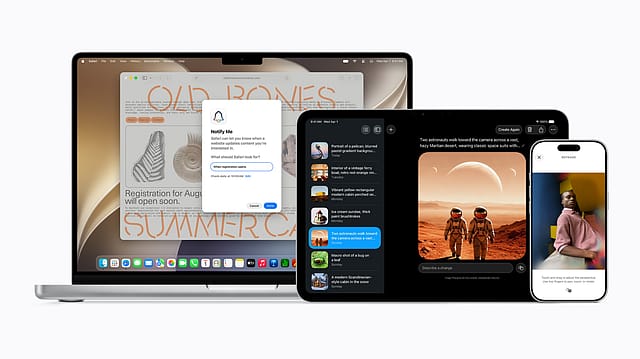
Apple unveiled the next generation of Apple Intelligence, bringing a raft of new AI-powered features to its devices as it looks to weave artificial intelligence more deeply into everyday apps and services.
Announced at WWDC 2026, the update introduces new capabilities across Photos, Safari, Messages, Mail, Calendar and Passwords, while also underpinning the recently announced Siri AI. The company said the new features are powered by a revamped Apple Intelligence architecture built using Apple's latest foundation models alongside Google's Gemini models.
"At Apple, our mission has always been to turn the potential of advanced technology into helpful and intuitive products for everyone, and that has never been more important than today," said Craig Federighi, Apple's senior vice president of Software Engineering. "Truly helpful AI must be centred on our users' needs, deeply integrated into the products they rely on every day, grounded in personal context, and built with privacy at every step. That is our vision for Apple Intelligence."
New AI editing tools arrive in Photos
Apple is expanding its photo-editing capabilities with a feature called Spatial Reframing, which allows users to adjust the perspective and composition of an image after it has been captured. The tool generates new content only where required, enabling users to reposition a shot without substantially altering the original image.
The company is also enhancing existing editing tools. Extend can intelligently fill in missing areas when users adjust an image's aspect ratio, while an upgraded Clean Up feature removes unwanted objects and distractions more realistically. Apple said images edited using these AI-powered tools will automatically include a hidden SynthID watermark.
Safari gets smarter
Safari can now automatically organise tabs into related topics, helping users manage large numbers of open pages. Someone planning a holiday, for instance, could have hotel bookings, flight searches and travel guides grouped together automatically.
A new feature called Notify Me allows Safari to monitor webpages for changes. Users can track things such as product restocks or price drops and receive alerts when updates occur.
Apple is also bringing AI capabilities to the Passwords app. Beyond identifying weak or compromised passwords, the app can now automatically upgrade credentials on supported websites by navigating the process on a user's behalf. Users will also be able to create custom Safari extensions simply by describing what they want the extension to do.
Image Playground gets a photorealistic upgrade
Apple has rebuilt Image Playground with support for photorealistic image generation. Users can create images through text prompts and make adjustments by selecting, moving or resizing elements within an image. Generated content can be used across Apple's ecosystem, including lock screen wallpapers and contact posters. As with edited photos, AI-generated images will carry a hidden SynthID watermark.
Messages, Mail and Calendar become more helpful
Several of Apple's communication and productivity apps are also receiving AI-powered enhancements. Messages can now suggest actions based on the context of a conversation, including creating reminders or notes. The app can also help locate photos referenced in chats by recognising people, places and keywords.
Mail gains more capable suggestions, including actions that work with third-party apps. Smart Reply in both Mail and Messages has also been updated to better reflect a user's writing style. Call Context, is a new feature that surfaces relevant information when users call businesses. For example, if someone calls an airline, the Phone app can automatically retrieve a booking reference or confirmation number stored elsewhere on the device.
Calendar is also becoming more conversational where users can create or modify events simply by describing them, with Apple Intelligence identifying contacts, locations and other relevant details automatically.
Privacy remains central to Apple's AI strategy
Underlying the new features is a new Apple Intelligence architecture that combines on-device processing with Private Cloud Compute. Apple said the system is built using the latest Apple Foundation Models developed in collaboration with Google's Gemini models. Requests that require cloud processing are handled through Private Cloud Compute, where personal information is not stored or made accessible to Apple.
The new Apple Intelligence features are available for developer testing starting today and will roll out to users later this year through iOS 27, iPadOS 27, macOS 27, watchOS 27 and visionOS 27.