
US-Iran escalation threatens oil supply, shipping as tanker strikes push Brent towards $100
ADVERTISEMENT
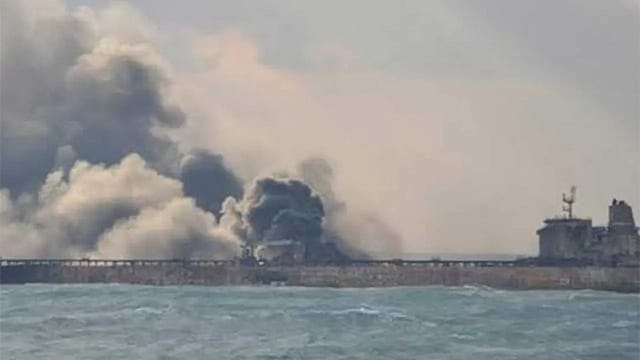
The latest escalation between the United States (US) and Iran has added fresh uncertainty to global oil markets, with Washington striking three Iranian crude carriers after Tehran targeted two US Navy warships, raising concerns over shipping through the Strait of Hormuz and the cost of energy for major importers such as India.
US Central Command (CENTCOM) said American forces struck the three tankers on September 5 after the Islamic Revolutionary Guard Corps (IRGC) launched ballistic missiles towards two US Navy warships patrolling regional waters. According to CENTCOM, the US aircraft carrier and guided-missile destroyer evaded the attacks and no American personnel were harmed.
CENTCOM said the Iranian crude carriers M/T Downy and M/T Stark 1 were permanently disabled, while M/T Kylo, also known as the Noxen, was destroyed in the Gulf of Oman after its crew was directed to abandon the vessel.
“Let the message to the IRGC be clear: If you shoot at two of our ships, we will impose an even higher economic cost —taking out three of yours,” said Adm. Brad Cooper, CENTCOM commander. “We will not hesitate to defend American forces, and if necessary, destroy Iran’s limited and exposed oil fleet.”
In a separate post, CENTCOM said: “Thanks to the precision and professionalism of American service members, the M/T Kylo sank in the Gulf of Oman today and joined Iran’s navy at the bottom of the sea.”
Oil and shipping face fresh risks
The strikes come as crude prices are already elevated amid concerns over disruptions to Gulf supplies. Brent crude settled at $96.28 a barrel on Friday, keeping the benchmark within striking distance of $100.
The bigger concern for oil-importing economies is the Strait of Hormuz, through which a substantial share of global oil and LNG shipments normally passes. Any prolonged disruption would raise not only crude prices but also freight and war-risk insurance costs.
India’s import bill in focus
India, which imports nearly 90% of its crude requirement, remains particularly exposed to a sustained rise in international oil prices, as per industry observers. The government has said around 70% of India's current crude imports are sourced from outside the Strait of Hormuz, providing some cushion against a direct disruption.
However, higher global prices would still increase India's overall energy bill and put pressure on the rupee through higher demand for dollars. Refiners could also face increased freight and insurance costs if vessels avoid high-risk routes.
For Indian businesses, the impact could extend beyond fuel. Airlines, logistics operators, petrochemical companies, tyre manufacturers and other energy-intensive industries could see costs rise if the conflict keeps crude prices elevated. "The key risk for India, therefore, is no longer confined to crude crossing $100 a barrel. A prolonged disruption to Gulf shipping could simultaneously push up oil, freight and insurance costs, creating a wider inflation and corporate-margin challenge," stated an industry observer requesting anonymity.