The FAQs are AI-generated, and Fortune India is not responsible for its content or any associated copyright issues.
How Audi lost the luxury car race in India to BMW and Mercedes
/ 4 min read
Once India’s bestselling luxury carmaker, the German luxury carmaker is grappling with falling volumes, slower EV traction and weakening brand pull as rivals sharpen their India strategy through localisation, SUVs and electric mobility.
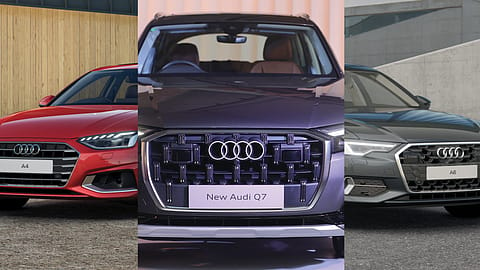
While Audi India declined to disclose its FY26 sales numbers, industry estimates suggest the brand’s annual volumes remained in the 4,500–5,000-unit range during the fiscal, broadly similar to its calendar year 2025 retail sales performance | Credits: Audi India
A little over a decade ago, Audi India sat atop India’s luxury car market. In 2013, the German marque crossed the 10,000-unit sales milestone and briefly overtook long-time rivals Mercedes-Benz India and BMW India. Today, however, the Indian arm of the Ingolstadt-based carmaker reflects a prolonged loss of momentum despite the broader luxury car market continuing to expand.
While Audi India declined to disclose its FY26 sales numbers, industry estimates suggest the brand’s annual volumes remained in the 4,500–5,000-unit range during the fiscal, broadly similar to its calendar year 2025 retail sales performance. Audi India retailed 4,510 units in CY2025, marking a decline of around 14% from 5,249 units in CY2024, underlining the sustained pressure on the company’s India operations.
Notably, the the German luxury carmaker had earlier announced a price hike of up to 2% across its model range from April 1, attributing the increase to rising input costs and currency fluctuations.
Rivals accelerate while Audi loses ground
Industry observers attribute Audi’s slowdown to delayed product refreshes, weaker localisation, limited EV scale and fading brand differentiation in India’s rapidly evolving luxury market. A leading industry analyst also pointed to “structural challenges” arising from Audi operating under the broader Volkswagen Group (Skoda Auto Volkswagen) umbrella in India, where investment priorities and economies of scale have historically leaned more towards the mass-market Volkswagen and Skoda businesses.
“Audi’s problem in India is not that the luxury market has disappeared, but that its rivals have captured the next phase of that market better. Mercedes has strengthened its top-end and SUV play, while BMW has pushed harder on EVs, localisation and fresher products,” said Mohit Yadav, Director at AltInfo. “Audi, by contrast, has looked slower on product renewal and less forceful in electrification, which has hurt its relevance with India’s new luxury buyer.”
The divergence with rivals has widened. Mercedes-Benz India retained leadership in FY26 with record retail sales of 19,363 units, up 2.3% year-on-year from 18,928 units in FY25. The company credited the growth to rising demand for top-end luxury vehicles, AMG performance cars and battery electric vehicles (BEVs).
BMW India, meanwhile, strengthened its position through aggressive EV expansion, fresher products and deeper localisation. The company stated that it crossed the 17,000-unit mark in FY26 and emerged as the country’s largest luxury EV seller with 3,537 EVs sold during the year, aided by localisation and a strong SUV portfolio.
Audi India, however, maintained that it witnessed a “steady performance trajectory” in FY26 despite macroeconomic headwinds. “We continued to witness a steady performance trajectory in FY’26, navigating evolving market dynamics and macroeconomic challenges. We maintained stable momentum across key segments, supported by strong demand for SUVs, top-end models and the growing contribution from Audi Approved: plus,” stated Balbir Singh Dhillon, Brand Director, Audi India, in response to emailed queries sent by Fortune India.
Dhillon also maintained that Audi’s India strategy remains focused on sustainable and profitable growth rather than chasing market share. “Our focus has always been on building a sustainable business with the right mix of products. In the current market context, we are prioritising value and ensuring that every aspect contributes meaningfully to the brand’s equity,” he told Fortune India, adding that one in every three Audi buyers in India is now a repeat customer.
SUV dependence grows as brand positioning weakens
Audi currently sells a portfolio ranging from the entry-level Q3 SUV, priced at around ₹45 lakh, to high-performance models such as the RS Q8 and SQ8 priced upwards of ₹2 crore. Its India lineup includes the A4, A6, Q3, Q3 Sportback, Q5, Q7, Q8, e-tron GT and RS performance models.
The company said SUVs now contribute close to 60% of its overall India sales. “Our Q range, including the Audi Q3, Audi Q5, Audi Q7, Audi Q8, Audi RS Q8 and the recently-launched Audi SQ8, continue to drive strong demand,” Dhillon said.
{{#most-powerful-women-snapshot-individual.slug}} {{/most-powerful-women-snapshot-individual.slug}} {{^most-powerful-women-snapshot-individual.slug}} {{/most-powerful-women-snapshot-individual.slug}} {{#showRanking}} {{current-rank}} {{/showRanking}} {{#photo.0.url}}
{{name}}
Several Audi models, including the A4, A6, Q3, Q3 Sportback, Q5 and Q7, are locally assembled at its Chhatrapati Sambhajinagar facility in Maharashtra under parent Skoda Auto Volkswagen India Limited. However, the company refrained from commenting on future localisation plans tied to upcoming launches such as the next-generation Q3, Q5 and A6.
Analysts say Audi’s challenges now extend beyond products. “Audi’s challenges in India go beyond product cycles or model refreshes. Around 15 years ago, the brand aggressively chased volumes, but in the process diluted some of its exclusivity and aspirational value,” said Avik Chattopadhyay, Founder of Expereal. “Over time, that altered consumer perception, and Audi gradually lost some of its appeal among core luxury and enthusiast buyers.”
He added that Audi has also failed to fully leverage its global performance heritage and the strength of the ‘quattro’ identity in India. “Instead of carving out a distinct sporty and driver-focused positioning, the brand has largely been viewed as another luxury badge alongside Mercedes-Benz, BMW and Jaguar,” Chattopadhyay said.
EV strategy stays cautious amid shifting market
Audi, which was among the early movers in India’s luxury EV segment with the e-tron range, is now taking a more calibrated approach compared with rivals.
“We remain committed to the long-term growth of electric mobility in the country and continue to see increasing customer interest in the luxury EV segment,” Dhillon said. “Our approach remains focused on building a sustainable luxury EV ecosystem through globally benchmarked products, customer-centric initiatives and a strong ownership experience.”
The company currently operates over 67 customer touchpoints across India and recently expanded its Hyderabad presence with a second showroom and new service infrastructure. Yet in a luxury car market increasingly defined by localisation, SUVs and electric mobility, Audi still faces a long road back to its former dominance.
Frequently Asked Questions
NEXT STORY