The FAQs are AI-generated, and Fortune India is not responsible for its content or any associated copyright issues.
‘Hatchbacks can sustain themselves despite SUV shift if carmakers keep updating them,’ says Tata Motors PV MD Shailesh Chandra
/ 2 min read
A senior Tata Motors official says rising fuel costs are accelerating interest in CNG and electric vehicles, while the hatchback market has stabilised at over one million units annually
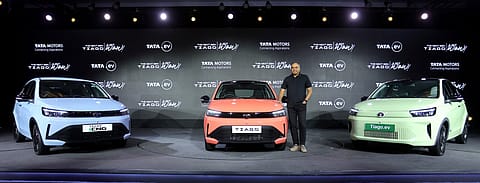
Shailesh Chandra, MD & CEO, Tata Motors Passenger Vehicles with the revamoped Tiago and Tiago.ev | Credits: TMPV
Tata Motors believes India’s hatchback segment can remain relevant despite the rapid shift towards Sport Utility Vehicles (SUVs), provided manufacturers continue investing in product upgrades and technology. A senior official of the company stated that it expects rising fuel costs and changing consumer behaviour to accelerate the shift towards Compressed Natural Gas (CNG) and Electric Vehicles (EVs) in the entry-level passenger vehicle market.
Speaking during a round table interaction with reporters ahead of the launch of the updated Tiago range, Tata Motors Passenger Vehicles (TMPV) Limited Managing Director Shailesh Chandra said the hatchback market, after years of decline, has stabilised at around 21-22% of the overall passenger vehicle industry.
“What is becoming clear is that this remains a one-million-unit segment,” Chandra said. “If hatchbacks receive the same pace of product updates as SUVs, the segment can sustain itself strongly.”
Chandra said hatchbacks gradually lost appeal because automakers focused more heavily on SUVs, leaving smaller cars with slower product refresh cycles and fewer aspirational features. “The hatchback segment lost emotional relevance over time because products became more functional and less aspirational,” he said.
Tata Motors on Thursday launched the updated Tiago hatchback at an introductory ex-showroom price starting at ₹4.69 lakh, with the model continuing across petrol, CNG and electric variants. The Tiago EV is available with 19 kWh and 24 kWh battery pack options, while the company has also introduced a Battery-as-a-Service (BaaS) model aimed at lowering upfront EV acquisition costs.
Fuel costs reshaping buyer choices
According to Chandra, rising fuel prices may not necessarily trigger a sharp recovery in small-car sales, but they are influencing buyer preference towards lower running-cost technologies such as CNG and electric vehicles.
“In smaller segments, customers are very sensitive to operating costs,” he said. “Some may start considering electric or CNG options instead of petrol.”
The Tiago will continue to be offered in petrol, CNG and electric variants, reflecting changing consumer usage patterns. Tata Motors said it has seen a sharp rise in electric vehicle enquiries over the past two months, particularly in the sub-₹15 lakh category.
“In just two months, EV bookings have risen two to two-and-a-half times compared to earlier levels,” Chandra said, adding that many households now want at least one electric vehicle for regular urban commuting.
EV usage largely urban and predictable
Tata Motors said more than 75,000 customers have adopted the Tiago EV since its launch in 2022, with the vehicles collectively covering around 2 billion kilometres. Chandra said usage trends show that most buyers use EVs for office commutes, school runs and city driving.
“The usage pattern in this segment is highly predictable,” he said. “The focus has therefore been on practicality, accessibility and ease of ownership rather than adding excess capability.”
{{#most-powerful-women-snapshot-individual.slug}} {{/most-powerful-women-snapshot-individual.slug}} {{^most-powerful-women-snapshot-individual.slug}} {{/most-powerful-women-snapshot-individual.slug}} {{#showRanking}} {{current-rank}} {{/showRanking}} {{#photo.0.url}}
{{name}}
The company plans to expand its charging network through partnerships with charging point operators and expects to have 1,000 Tata.EV mega chargers and 4,000 verified charging points operational by the second quarter.
Entry-level cars still hold relevance
Chandra said hatchbacks continue to attract first-time buyers because of affordability, ease of driving and their suitability for congested urban conditions.
“There are multiple pathways into car ownership,” he said. “Some customers still prefer hatchbacks because of affordability and ease of driving.”
He added that car price inflation over the past decade has remained lower than growth in disposable incomes, helping consumers spend more on vehicles than before.
Frequently Asked Questions
NEXT STORY