Hyundai has lost its coveted No. 2 position. Can it stage a comeback from here?
/ 5 min read
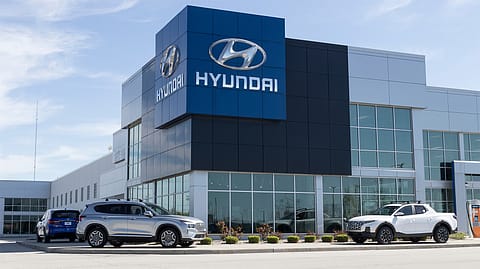
Credits: Shutterstock
Hyundai has lost its coveted No. 2 position. Can it stage a comeback from here?
Hyundai has lost its long-held No. 2 spot in India’s passenger vehicle market to Mahindra and Tata Motors, as FY26 sales slipped 2% to 584,906 units amid fierce SUV competition and muted response to recent launches. Yet, with rising margins, a premiumisation strategy, a new Indian CEO, and a ₹45,000-crore investment plan, the Korean carmaker is plotting a comeback.
This summary is AI-generated, and Fortune India is not responsible for its content or any associated copyright issues.
With rising margins, a premiumisation strategy, a new Indian CEO, and a ₹45,000-crore investment plan, the Korean carmaker is plotting a comeback.
Credits: Shutterstock
It’s been a difficult few years for the Korean automotive giant, Hyundai. The ground beneath had been slipping for some time, but the final nail in the coffin seems to have come this month, when the company finally lost out to home-grown automakers, Mahindra and Tata Motors in the pecking order of India’s largest carmakers. That’s according to the data for the financial year ended FY26.
In all, Mahindra sold 660,276 vehicles during FY26, up a staggering 20%, while another home-grown automaker, Tata Motors Passenger Vehicles, reported domestic sales of 631,387 units, a 14% growth compared to the year-ago period. Hyundai, on the other hand, could only sell 584,906 units. That’s a 2% decline, at a time when domestic car makers have had a phenomenal year, especially on the back of a revision in GST rates, which brought down vehicle prices in the country.
“HMIL has been losing domestic PV market share (MS) over the previous five years,” ICICI Securities says in a report. “Even post the recent GST cut, HMIL’s retail growth has lagged that of the industry. While the company has been successful in improving its brand salience and capturing premiumisation trend by deliberately focusing on the UV segment, it lost UV market share after peaking post Venue’s launch.”
Hyundai is the largest player in the SUV category in the country, with the Creta driving significant volumes for the Korean auto giant. With sales of over 200,000 units a year, the Creta had become the first vehicle in the country's fast-growing midsize SUV segment to reach those figures. That works out to sales of almost 550 vehicles a day for a car that retails at an average price of about ₹16 lakh. The numbers are, without doubt, significant, especially since these sales figures have historically been the forte of smaller vehicles, which cost significantly less.
But it’s in the other segments, where the automaker has been struggling of late. “Barring full-model change (FMC) of Creta, most of the new product launches (such as Exter, Aura) in the last five years were met with lukewarm success amidst heightened competition from incumbents and new entrants (Kia), thereby increasing dependency on Creta to lift volumes,” ICICI adds.
A good long run
Hyundai, a little-known Korean carmaker, arrived on Indian shores a few years after India opened its economy in 1991. Much of its early success was scripted by its first car, the Santro, a hatchback, and by Bollywood superstar Shah Rukh Khan as its brand ambassador. Unlike some of its rivals, which had come to the country with sedans, priced albeit higher, and hence remained out of bounds for Indians, the Santro was a runaway hit and made Hyundai a force to reckon with.
Coincidentally, Hyundai wasn’t the only Korean brand Indians were beginning to get acquainted with; the likes of Samsung and LG were also soon making their way into Indian households, at a time when the country had very limited options. The Santro, an Indianised version of Hyundai’s popular Atos in South Korea, took on the Daewoo Matiz and the Maruti Suzuki 800.
Part of the success for Hyundai in the country also came from moving its large supplier base to Chennai, where the company set up a plant in 1996, and helped bring costs under control, and in the process gave a fight to Maruti Suzuki, the undisputed leader in the market, with a vehicle that offered significantly more features. Since the success of the Santro, Hyundai’s blockbuster models in the country have included the Accent, Verna, i10, Sonata, and Creta, and in the process, it has steadily built itself as the country’s second-best-selling automaker. That was until last month.
“Hyundai has not been able to replicate the success of Creta and Venue in other launches,” ICICI says. “Its domestic volumes remain anchored to Creta and Venue, which account for 55% of volumes, up from 36% in FY20.”
At the same time, even though its market share has declined, there might be some respite on the horizon, as the company has been steadily improving its margins, helped by a conscious shift towards premiumization. Hyundai’s India arm went public in October 2024, in what was then the largest IPO by an Indian company, raising more than $3 billion from the bourses for a 17% stake.
“The company has consciously refrained from price-led volume gains,” brokerage firm BOB Capital Markets said in a report published last month. “Instead, the strategy has focused on improving product mix, increasing feature penetration, and moving customers up the value curve through higher trims and SUVs. This approach has resulted in a portfolio increasingly skewed towards premium segments, supporting sustained ASP (average selling price) expansion (5% CAGR from FY20-25) and margin improvement. Evidently, gross profit margins expanded steadily from 24.3% in FY20 to 27.8% in FY25, barring temporary moderation during the pandemic years.”
{{#most-powerful-women-snapshot-individual.slug}} {{/most-powerful-women-snapshot-individual.slug}} {{^most-powerful-women-snapshot-individual.slug}} {{/most-powerful-women-snapshot-individual.slug}} {{#showRanking}} {{current-rank}} {{/showRanking}} {{#photo.0.url}}
{{name}}
What lies ahead now?
For now, losing the second spot has, without a doubt, been a setback.
That’s also why in January this year, Hyundai elevated Tarun Garg, the company’s chief operating officer, to be its first-ever Indian CEO to turn around the company’s fortunes. Hyundai reckons that the move to onboard the automotive veteran, with a deep understanding of the Indian market, can help arrest the decline in fortunes.
Hyundai has also already announced a strategic investment plan of ₹45,000 crore through FY30. The company is now gearing up to launch 26 new products, including seven new nameplates, with entries into the MPV and off-road SUV segments, alongside India's first locally manufactured dedicated electric SUV by 2027 and the launch of the luxury brand Genesis in India in the same year.
The slew of investments, Hyundai reckons, will help it achieve a 15% market share, with as much as 80% of its portfolio contribution from utility vehicles and more than 50% powered by eco-friendly technologies like CNG, EVs, and hybrids. “In recent years, HMIL has lagged peers in terms of new launches, which has created pressures in the key compact and mid-size SUV segment,” BOB Capital Markets says. “This is visible in the decline in the domestic PV market from the high of 17.6% in FY20 to 13.9% in FY25, alongside a drop in the SUV market share from 23.2% in FY20 to 17.5% in FY25.”
Hyundai’s current portfolio in India includes two compact hatchbacks, a mid-size and compact sedan, a wide SUV ladder, and a limited premium EV presence. “However, the core lies in urban compact UVs and mid-size SUVs, with Exter and Venue addressing the entry SUV segment,” BOB Capital Market says. “Creta and Alcazar anchor higher-volume and higher-value SUV space. Ioniq 5 is positioned as a premium EV to create a brand position and demonstrate advanced technology. Entry in the mass market EV commenced with the launch of Creta EV in 2025.”
“HMIL has announced capex of ₹45,000 crore over FY26–30E; of which, 60% is earmarked for product development and R&D,” ICICI Securities says. “The balance would be for capacity and upgradation. Strong operating cash flow generation of ₹24,000 crore over FY26–28E is expected to support funding of these investments.”
So where does Hyundai go from here? The fight with home-grown car makers such as Tata and Mahindra, who have steadily shifted their focus to the SUV segment with new launches and overwhelming response, will pose a challenge. But Hyundai has been around for a long time and has a good understanding of the domestic market and buyer sentiment. That certainly means it’s a tough ask to write off Hyundai completely.
Follow Fortune India
NEXT STORY