The FAQs are AI-generated, and Fortune India is not responsible for its content or any associated copyright issues.
Hyundai Motor India lines up EV, MPV and crossover launches to arrest market share slide
/ 3 min read
After slipping to fourth place in FY26, the South Korean carmaker is preparing a new product cycle even as rivals tighten their grip on India’s SUV-led market
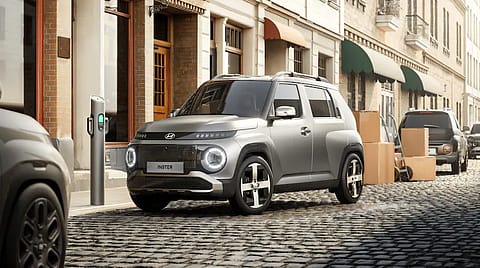
The Hyundai Inster, an A-segment electric SUV, which could be launched in India in the next 6-12 months
Hyundai Motor India Limited (HMIL) is preparing a fresh round of product launches across electric vehicles, crossovers and Multi-Purpose Vehicles (MPVs) over the next 12–24 months as it looks to regain momentum after ceding ground to rivals in FY26, sources aware of the plans said.
“The company is looking at new body styles and Electric Vehicles (EVs) to plug portfolio gaps,” one of the sources said on condition of anonymity. “The focus is on participating in high-growth segments rather than relying only on incremental refreshes.”
A second person aware of the developments told Fortune India, “The company will not just add variants, but will accelerate its pace of hybrid and electric cars across various price points.”
The South Korean carmaker is also expected to introduce hybrid powertrain options across select existing models as part of its broader portfolio refresh.
An emailed questionnaire sent to a spokesperson for Hyundai Motor India did not elicit a response till the time of publication.
Market share erosion, ranking slip
The urgency is reflected in Hyundai’s recent performance. The company slipped to No. 4 in India’s passenger vehicle market in FY26, behind Maruti Suzuki, Mahindra & Mahindra (M&M) and Tata Motors—its first exit from the top three in over two decades.
During FY26, Hyundai India’s domestic volumes declined 2.3% year-on-year to 5.84 lakh units, even as key rivals posted double-digit growth, with Mahindra & Mahindra’s passenger vehicle sales rising about 19% year-on-year and Tata Motors growing around 6% during the same period. More structurally, Hyundai’s market share has fallen to about 12.3% in FY26 from 16.3% in FY22.
Creta anchors portfolio, but gaps remain
Hyundai’s current portfolio spans hatchbacks, sedans and SUVs, including the Creta midsize SUV, Venue compact SUV, Aura and Verna SUVs , Hyundai Exter micro-SUV and Hyundai Tucson.
Among these, the Hyundai Creta continues to anchor volumes, with SUVs contributing a dominant share of the company’s domestic mix, with total Creta sales at 2,01,921 units in FY26, making it the third best-selling passenger vehicle overall and the second highest-selling SUV in India during the year.
However, analysts point to gaps in emerging sub-segments, particularly crossover-style vehicles and entry-level EVs, where competitors have been quicker to build scale.
New launches to target gaps
Hyundai’s upcoming pipeline is expected to address these gaps. A crossover positioned between hatchbacks and SUVs—globally sold as the Hyundai Bayon—is being evaluated for India as a potential volume play to rival models like the Maruti Suzuki Fronx, according to people familiar with the plans.
{{#most-powerful-women-snapshot-individual.slug}} {{/most-powerful-women-snapshot-individual.slug}} {{^most-powerful-women-snapshot-individual.slug}} {{/most-powerful-women-snapshot-individual.slug}} {{#showRanking}} {{current-rank}} {{/showRanking}} {{#photo.0.url}}
{{name}}
The company is also expected to expand its EV portfolio beyond the Hyundai Ioniq 5 with models such as the Hyundai Ioniq 6 and a more affordable electric hatchback, the Hyundai Inster, though timelines remain unclear.
In addition, Hyundai is studying entry into the MPV segment with the Hyundai Stargazer, a category currently dominated by models such as the Maruti Suzuki Ertiga and Kia Carens.
At the premium end, the next-generation Hyundai Santa Fe could be introduced as part of a broader push to improve margins through higher-value products.
Alongside new models, Hyundai is expected to roll out updates to key nameplates, including the Verna, Exter and Tucson, while the updated Ioniq 5 has already been launched with a larger battery and feature enhancements.
These refreshes—along with the planned introduction of hybrid variants on select models—are aimed at maintaining competitiveness in existing segments, even as the company prepares for a broader portfolio transition.
Outlook: Execution key to comeback
While Hyundai has continued to report steady monthly sales—posting a 17% year-on-year increase in April 2026 domestic volumes—the broader challenge remains regaining share in a market increasingly dominated by SUVs and new-energy vehicles.
“Hyundai’s market share decline—from over 16% a few years ago to nearly 12% now—coincides with a sharper SUV and EV push by rivals,” said Puneet Gupta, Director, S&P Global Mobility. “Segments like compact SUVs and entry EVs are growing at a much faster clip than the overall market, and Hyundai has been relatively underrepresented there. The next 12–18 months will be critical—timely launches and localisation will determine whether it can regain 200–300 basis points of share.”
Frequently Asked Questions
NEXT STORY