The FAQs are AI-generated, and Fortune India is not responsible for its content or any associated copyright issues.
Hyundai Motor India Q4 net profit drops 22% to ₹1,256 crore despite 5.4% revenue growth; ₹21 dividend announced
/ 2 min read
Margins came under pressure from rising employee and inventory costs even as the automaker strengthened exports, rural penetration and SUV-led growth momentum
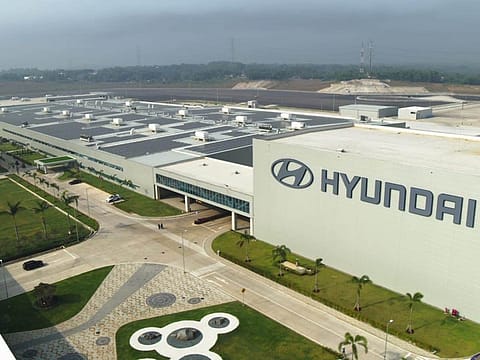
HMIL also announced expansion of its Pune manufacturing facility by another 70,000 units post Phase-II expansion, taking its overall India production capacity to 1.14 million units per annum by 2030 | Credits: Hyundai India
Hyundai Motor India Ltd (HMIL) on Friday reported a 22.2% year-on-year decline in consolidated net profit for the fourth quarter of FY26 at ₹1,255.6 crore, compared with ₹1,614.3 crore in the year-ago period, as rising operating costs weighed on margins.
Revenue from operations, however, rose 5.4% year-on-year to ₹18,916 crore during the January-March quarter, supported by higher wholesale volumes, robust exports and improved traction in rural markets. The company also guided for 8-10% domestic and export volume growth in FY27, driven by new product launches and capacity expansion plans.
The country’s second-largest passenger vehicle maker posted consolidated EBITDA of ₹1,966 crore in Q4 FY26, down from ₹2,533 crore a year earlier, while EBITDA margins narrowed sharply to 10.4% from 14.1%.
For the full financial year FY26, Hyundai reported consolidated revenue of ₹70,763 crore, up 2.3% year-on-year, while profit after tax declined 3.7% to ₹5,431 crore. Annual EBITDA margin stood at 12.2%, compared with 12.9% in FY25.
The board recommended a final dividend of ₹21 per equity share for FY26.
Costs dent quarterly profitability
Hyundai’s profitability came under pressure as expenses increased faster than revenue growth during the quarter. Standalone employee benefit expenses rose nearly 37% year-on-year to ₹699 crore, while inventory-related costs surged, reflecting higher changes in finished goods and work-in-progress.
Profit before tax in Q4 fell to ₹1,558 crore from ₹2,131 crore in the year-ago quarter. The company also recognized estimated financial impacts arising from India’s new labour codes in its employee expenses.
Despite margin pressure, Hyundai recorded an 8.7% year-on-year rise in wholesale volumes during the quarter, aided by what the company described as “GST 2.0 tailwinds” and product-led interventions.
The automaker also posted its highest-ever quarterly rural penetration at 25%, while CNG-powered vehicles contributed a record 18% of quarterly sales. Exports rose 9.4% year-on-year during Q4 and 16.4% for the full fiscal despite geopolitical uncertainties.
SUV, EV launches to fuel FY27 growth
Commenting on the performance, Tarun Garg, Managing Director and CEO, Hyundai Motor India, said, “FY26 was a year where we demonstrated our ability to effectively navigate a challenging environment while capitalizing on emerging opportunities, supported by GST 2.0 reforms, strategic product interventions, strong export volumes and our continued focus on ‘Quality of Growth’.”
Hyundai plans to launch two new nameplates in FY27, including a localized electric compact SUV and a new mid-size SUV, as it sharpens focus on high-growth utility vehicle segments.
RANK
COMPANY NAME
REVENUE
(INR CR)
(INR CR)
{{#current-rank}} {{current-rank}} {{/current-rank}} {{^current-rank}} {{rank}} {{/current-rank}} {{name}} {{#revenue}} {{revenue}} {{/revenue}} {{^revenue}} {{noi}} {{/revenue}}
“We expect this positive momentum to continue and backed by new product launches in high-demand segments and other strategic initiatives, we expect 8-10% volume growth in domestic market,” Garg said.
The South Korean carmaker also announced expansion of its Pune manufacturing facility by another 70,000 units post Phase-II expansion, taking its overall India production capacity to 1.14 million units per annum by 2030.
Frequently Asked Questions
NEXT STORY