India-UK CETA reshapes auto trade: 3.78 lakh British cars to enter India over 15 years as tariffs plummet from 110% to 10%
/ 2 min read
India-UK trade pact introduces phased automotive liberalisation with strict quota controls, deep tariff cuts, and structured EV export access for Indian manufacturers under CETA schedules.
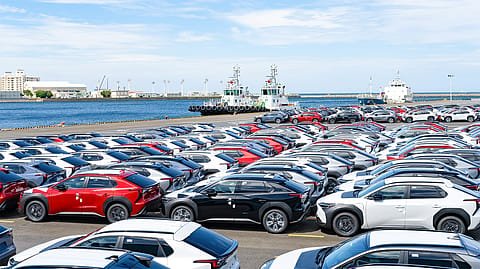
Under the first-year framework, India will permit 20,000 units of PV imports across three categories: small cars up to 1,500 cc, mid-segment vehicles up to 3,000 cc, and high-capacity engines above 3,000 cc. | Credits: Shutterstock
India and the United Kingdom (UK) have formalised a sweeping recalibration of automotive trade under the Comprehensive Economic and Trade Agreement (CETA), allowing imports of up to 3.78 lakh UK-made Passenger Vehicles (PV) into India over a 15-year horizon, alongside a sharp reduction in customs duties from about 110% to 10%.
As per the India-UK CETA schedule on passenger vehicles, “India will allow import of up to 3.78 lakh units of passenger vehicles over a 15-year implementation period,” with market access distributed through engine-wise quotas and staggered tariff phases rather than full liberalisation.
The India-UK Free Trade Agreement (FTA), which comes into force on July 15, establishes a structured tariff transition pathway, where concessions are tied to volume caps, price segmentation and time-bound duty reduction milestones.
CETA schedules map multi-tier tariff cuts and import ceilings
Under the first-year framework, India will permit 20,000 units of PV imports across three categories: small cars up to 1,500 cc, mid-segment vehicles up to 3,000 cc, and high-capacity engines above 3,000 cc. All luxury brands, such as Jaguar Land Rover (JLR), stand to gain out of the deal.
The schedule specifies that tariffs will be reduced from about 66% to 50% initially, before gradually converging to a long-term ceiling of 10% by the fifth year. Import volumes are projected to scale up to around 37,000 units by year five before stabilising at 15,000 units annually from year 15 onward.
The document explicitly notes that customs duty reduction shall not proceed beyond the agreed 10% tariff floor,” locking in the terminal tariff structure.
India secures phased UK access for EV and hybrid exports
On the export side, India will gain access to the UK market for electric, hybrid and hydrogen passenger vehicles from year six, in the £20,000–80,000 Cost, Insurance, and Freight (CIF) band.
Initial quotas remain limited—400 units in mid-price EVs and 4,000 units in higher-value segments above GBP 80,000—before scaling towards a peak of 88,000 units annually by year 15, as outlined in the CETA framework.
Mass-market EV segment excluded from liberalisation
Notably, India has excluded vehicles priced below GBP 40,000 CIF from tariff concessions, effectively insulating the domestic mass-market EV ecosystem from foreign competition.
The agreement also excludes zero-emission two-wheelers, buses and trucks from any tariff commitments, preserving regulatory flexibility in high-volume mobility segments.
This preserves strategic space for domestic manufacturers including Tata Motors Passenger Vehicles (TMPV), Mahindra & Mahindra (M&M), JSW MG Motor India, Hyundai Motor India, Maruti Suzuki, etc., even as premium automotive trade with the UK expands under tightly governed quota structures.
NEXT STORY