The FAQs are AI-generated, and Fortune India is not responsible for its content or any associated copyright issues.
India–EU FTA set to redefine premium car market; Skoda Auto Volkswagen sees import, tech boost
/ 3 min read
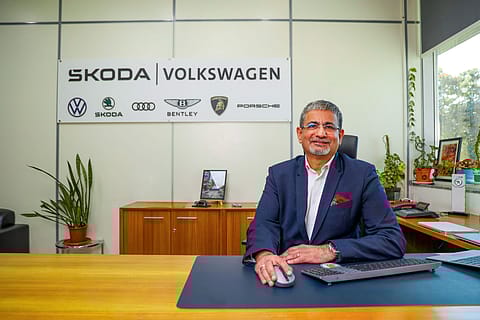
Skoda Auto Volkswagen India Managing Director and CEO Piyush Arora | Credits: SAVWIPL
India–EU FTA set to redefine premium car market; Skoda Auto Volkswagen sees import, tech boost
India’s FTA with the EU is set to transform the premium car market by sharply cutting import duties on CBUs over a decade, from up to 110% to near 10% within a 2,50,000-vehicle quota. Skoda Auto Volkswagen India hails the deal as a progressive step that boosts technology flows, widens product choices and deepens industrial linkages while preserving incentives for local manufacturing.
This summary is AI-generated, and Fortune India is not responsible for its content or any associated copyright issues.
Tariff cuts, quota clarity and technology flows under the India–EU pact are set to reshape import strategies and long-term investments for European carmakers in India
Skoda Auto Volkswagen India Managing Director and CEO Piyush Arora | Credits: SAVWIPL
India’s newly concluded Free Trade Agreement (FTA) with the European Union (EU) could significantly reshape the country’s premium automotive landscape, easing market access, accelerating technology flows, and opening up fresh avenues for imports over the coming decade, according to a senior representative of European automotive giant.
Skoda Auto Volkswagen India (SAVWIPL) Managing Director and CEO Piyush Arora termed the agreement a progressive step that deepens industrial linkages between India and Europe while offering greater predictability to automakers operating across markets.
“A more transparent and structured tariff regime gives us the confidence to evaluate a broader portfolio for India, while continuing to invest in localisation and capability building,” said Arora, in a round table meeting with reporters.
The FTA, which was inked last year, outlines a phased reduction in import duties on Completely Built Units (CBUs), with tariffs expected to decline from current levels of up to 110% to nearly 10% over a defined transition period. This will be implemented through an annual quota of 2,50,000 vehicles, significantly higher than similar arrangements under other bilateral trade agreements.
Within this, 1,60,000 internal combustion engine (ICE) vehicles will see duty cuts within five years, while 90,000 electric vehicles (EVs) will come under the concessional regime from the fifth year onwards, a structure designed to balance import liberalisation with domestic EV ecosystem development. Initial in-quota tariffs are expected to start at around 30% before tapering, while out-of-quota duties will also decline meaningfully over a decade.
Importantly, Completely Knocked Down (CKD) units remain outside the scope of these concessions, preserving the economics of local manufacturing.
Strategy reset amid demand fluctuations
Arora, who was previously associated with Mercedes-Benz India, noted that beyond cost benefits, the agreement could accelerate access to advanced technologies and global supply chains.
Recommended Stories
“Over time, this opens up avenues for deeper technology transfer and strengthens India’s role in the global automotive value chain,” he said.
At the same time, he acknowledged that evolving policy clarity and global uncertainties—from geopolitical tensions to currency volatility—are weighing on near-term demand sentiment. “We are seeing some hesitation, particularly in the fully built import space, as customers wait for more clarity on how the FTA will play out,” he said, adding that buying sentiment is likely to normalise as details firm up.
Product push, growth ambitions intact
Despite short-term fluctuations, SAVWIPL is maintaining an aggressive growth strategy. The Group, which houses Audi, Bentley, Volkswagen and Skoda brands, has lined up 18–19 product interventions in 2026 across local models, imports and component upgrades.
Volkswagen Passenger Cars India alone is targeting at least four product actions during the year, supported by a steady cadence of launches and updates. The broader ambition remains intact: scaling market share to 5% by the end of the decade from current sub-3% levels, driven by a mix of ICE models and emerging alternative fuel technologies.
RANK
COMPANY NAME
REVENUE
(INR CR)
(INR CR)
{{#current-rank}} {{current-rank}} {{/current-rank}} {{^current-rank}} {{rank}} {{/current-rank}} {{name}} {{#revenue}} {{revenue}} {{/revenue}} {{^revenue}} {{noi}} {{/revenue}}
Electrification remains central to the long-term roadmap, although its rollout will depend on localisation economics and regulatory clarity, with hybrid and transitional technologies expected to bridge the gap in the interim. Exports, which contribute roughly 30% of production, will continue to be a key lever, with markets such as North Africa under active consideration.
At the same time, the company is evaluating high-volume segments like sub-4 metre SUVs, which account for nearly a third of India’s passenger vehicle market, as part of its expansion strategy.
Meanwhile, Volkswagen India recently introduced the updated Taigun SUV, reinforcing its position in the competitive mid-size SUV segment and aiming to drive incremental growth through ongoing product upgrades.