The FAQs are AI-generated, and Fortune India is not responsible for its content or any associated copyright issues.
PV market could see avalanche of BEV and SUV launches over next 12-15 months as carmakers pivot to premium vehicles
/ 3 min read
From ₹12 lakh electric crossovers to ₹50 lakh premium global SUVs, carmakers are preparing one of the biggest product offensives in recent years as India’s passenger vehicle market shifts toward SUVs, electrification and premiumisation.
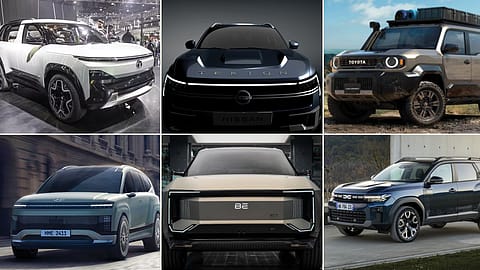
Tata Sierra EV, Nissan Tekton, Toyota Land Cruiser FJ, Renault Bigster, Mahindra BE.07 and Hyundai’s next-generation electric SUV concepts are among the key upcoming launches expected to drive India’s premium SUV and BEV push over the next 12-15 months.
At a time when India’s Passenger Vehicle (PV) market is on course to hit the 5-million-unit mark over the next few years, the industry is bracing for a wave of launches that could reshape the competitive landscape over the next 12-15 months.
Carmakers including Maruti Suzuki, Tata Motors, Mahindra & Mahindra, Hyundai, Renault, Nissan, Toyota, Kia, Honda Cars India and Volkswagen Passenger Cars India are preparing an aggressive pipeline of Battery Electric Vehicles (BEVs), premium Sport Utility Vehicles (SUVs) and lifestyle utility vehicles as competition intensifies across segments.
From ₹12 lakh electric vehicles to ₹50 lakh premium lifestyle SUVs, carmakers are preparing products aimed at capturing the next phase of growth in the domestic passenger vehicle market.
According to Society of Indian Automobile Manufacturers (SIAM) data, India’s passenger vehicle market closed FY26 with wholesale volumes of about 4.64 million units. Industry estimates peg FY27 sales growth at 4-6%, taking volumes close to around 5.10 million units.
SUVs remain the market’s growth engine
SUVs contributed nearly 63% of total passenger vehicle sales in FY26, compared with less than 50% five years ago. Analysts expect that share to rise further to nearly 66-68% in FY27 as carmakers expand offerings across compact, midsize and premium segments.
Tata Motors is preparing the Sierra EV, expected to be positioned in the ₹20 lakh-₹25 lakh bracket, while Mahindra is likely to deepen its born-electric strategy with the BE.07 under its INGLO architecture. Hyundai is expected to expand its urban EV portfolio in the ₹12 lakh-₹20 lakh segment. The country's largest utility vehiclemaker is also building out its broader SUV roadmap through the NU_IQ modular platform, which supports ICE, hybrid and EV powertrains, as it prepares for a wider product expansion across segments.
The country’s largest carmaker, Maruti Suzuki, has an upcoming micro-SUV, a three-row SUV and hybrid expansion planned across models such as the Fronx and Grand Vitara, according to sources privy to the development. The company declined to comment on the plans.
Global manufacturers are sharpening their India strategy as well. French carmaker Renault is considering bringing the Bigster SUV to India, which could target the premium three-row utility vehicle segment around the ₹20 lakh mark. Similarly, Nissan’s upcoming Tekton is expected to intensify competition in the midsize SUV category currently dominated by Hyundai Creta and Kia Seltos.
“The all-new Nissan Tekton will make its global debut in India on July 9, 2026, and will strengthen our presence in the high-volume midsize SUV segment,” a Nissan Motor India spokesperson said, adding that the vehicle will also be exported to over 50 global markets as part of the company’s India-led growth strategy.
JSW MG Motor India, meanwhile, has already commenced production of the upcoming MG Majestor ahead of its commercial rollout as it sharpens focus on the premium SUV space.Volkswagen Passenger Cars India is evaluating a subcompact SUV based on the Kylaq platform as it sharpens focus on the volume SUV market.
Honda Cars India, meanwhile, is preparing to launch its electric SUV based on the Honda 0 Series SUV prototype within this fiscal year, even as the company’s global management has indicated that a sub-four metre SUV for India is targeted around 2028.
RANK
COMPANY NAME
REVENUE
(INR CR)
(INR CR)
{{#current-rank}} {{current-rank}} {{/current-rank}} {{^current-rank}} {{rank}} {{/current-rank}} {{name}} {{#revenue}} {{revenue}} {{/revenue}} {{^revenue}} {{noi}} {{/revenue}}
Last week, Honda Cars India also indicated that the company is planning six launches during the current fiscal. Toyota, meanwhile, is expected to strengthen its lifestyle SUV portfolio with the globally discussed Land Cruiser FJ. The spokespersons of the Indian arms of Volkswagen and Toyota did not respond to queries sent by Fortune India.
Upcoming Passenger Vehicle Launch Pipeline (FY26-FY28):
BEV penetration expected to rise steadily
The launch wave also reflects the market’s accelerating shift toward electrification. BEVs accounted for an estimated 2.7-3% of total passenger vehicle sales in FY26, translating into roughly 1.2 lakh-1.3 lakh units. Analysts expect penetration to rise toward 4-5% in FY27 as more electric SUVs and crossovers enter the market.
According to Puneet Gupta, Director, S&P Global Mobility India and ASEAN, “Premium SUVs and BEVs being an aspirational buy generally generate significantly stronger margins for carmakers compared with entry-level cars ." He went on to add, "This is because of higher transaction values, richer feature content and customer tendency to pay more for such products. This explains why companies are aggressively expanding portfolios across these segments.”
Frequently Asked Questions
NEXT STORY