Tata Motors doubles down on battery subscription model to push affordable EVs
/ 3 min read
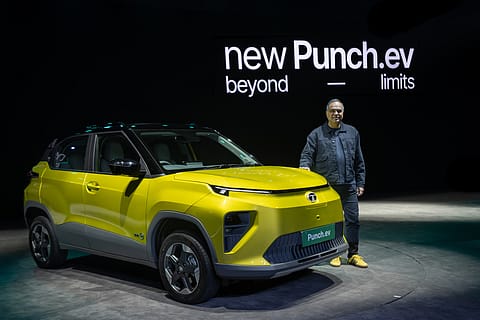
Shailesh Chandra, managing director of Tata Motors Passenger Vehicles and Tata Passenger Electric Mobility, recently launch the Punch.ev | Credits: TMPV
Tata Motors doubles down on battery subscription model to push affordable EVs
Tata Motors is expanding its Battery-as-a-Service model to more EVs, aiming to reduce upfront costs and attract price-sensitive buyers. This strategy, already applied to the Tata Punch EV, could lower prices by ₹2.5–3 lakh, making EVs more competitive with petrol vehicles. The move aligns with Tata's goal to boost EV adoption in India's sub-₹12-lakh segment.
This summary is AI-generated, and Fortune India is not responsible for its content or any associated copyright issues.
The homegrown carmaker is evaluating extending Battery-as-a-Service BaaS) beyond the Punch EV as customer demand rises and rivals experiment with similar ownership models
Shailesh Chandra, managing director of Tata Motors Passenger Vehicles and Tata Passenger Electric Mobility, recently launch the Punch.ev | Credits: TMPV
India’s largest electric passenger vehicle maker, Tata Motors, is evaluating plans to extend the Battery-as-a-Service (BaaS) model across more models in its EV portfolio, including the Tata Tiago EV, Tata Tigor EV, and Tata Nexon EV, according to sources familiar with the development.
“A growing number of customers walking into Tata EV showrooms are specifically asking if they can buy models like the Tiago, Tigor, or Nexon EVs without paying for the battery upfront. Many of these buyers are gravitating toward brands that already offer BaaS,” said a source privy to the discussions. The source added that Tata Motors is exploring the model to remain competitive and attract price-sensitive EV buyers.
The move follows the introduction of BaaS with the Tata Punch EV, where the vehicle’s price drops from about ₹9.69 lakh without BaaS to nearly ₹6.49 lakh with BaaS, with the battery cost linked to usage through a subscription model. Industry observers say such structures directly address one of the biggest barriers to EV adoption—high upfront cost.
However, the company maintained a cautious stance on any expansion plans. “At the recent Punch.ev launch in February, we had categorically mentioned that BaaS, an alternate financing model, is being offered and explored purely for entry-level EVs to accelerate our ongoing efforts to mainstream EV ownership. There is nothing more to share on this, as we have not made any statements beyond this. Anything different is pure hearsay and speculation which we do not comment upon,” a Tata Motors spokesperson told Fortune India.
Price cuts could widen EV adoption
The strategy aligns with Tata Motors’ push to expand EV adoption in the price-sensitive sub-₹12-lakh segment, which accounts for a large share of India’s passenger vehicle market.
According to industry observers, electric variants of the Tiago EV, Tigor EV and Nexon EV are currently priced between ₹8.5 lakh and ₹12.5 lakh. A BaaS option could reduce upfront prices by ₹2.5–3 lakh on average, making these vehicles more competitive with petrol-powered alternatives.
The competitive pressure is already visible. MG Motor India offers BaaS on models such as the MG Comet EV and MG ZS EV, while Hyundai Motor India is learnt to be evaluating similar structures for future EVs, including the upcoming Hyundai Creta EV.
“The new Punch.ev makes electric mobility accessible and practical for a wider set of customers,” said Shailesh Chandra, Managing Director and CEO, Tata Motors Passenger Vehicles at the time of the model’s launch.
Despite its name, Tata Motors sees BaaS less as a service and more as a financing innovation.
“It’s essentially a financing instrument where the vehicle and the battery are financed separately,” Chandra has said earlier, underlining how the model shifts customer focus from upfront cost to usage-based economics.
Not for premium EVs—for now
While the model could expand across entry-level EVs, it may not extend to higher-end offerings.
{{#most-powerful-women-snapshot-individual.slug}} {{/most-powerful-women-snapshot-individual.slug}} {{^most-powerful-women-snapshot-individual.slug}} {{/most-powerful-women-snapshot-individual.slug}} {{#showRanking}} {{current-rank}} {{/showRanking}} {{#photo.0.url}}
{{name}}
“While BaaS may be extended to models like the Tiago, Tigor and Nexon EV, it is unlikely to be offered for premium SUVs such as the Harrier EV, Sierra EV or Curvv EV,” another source said, pointing to margin structures and customer expectations in the premium segment.
Analysts see a structural shift
Industry experts believe such financing innovations could play a decisive role in accelerating EV adoption in India.
“Battery cost accounts for a large share of the EV price, and separating it from the vehicle purchase can significantly lower the upfront entry barrier for consumers,” said Puneet Gupta, director at S&P Global Mobility.
He added that if executed well, BaaS could broaden the EV buyer base while opening up new revenue streams for automakers. “It can make EVs more accessible while allowing companies to innovate around ownership and financing models.”
Follow Fortune India
NEXT STORY