The FAQs are AI-generated, and Fortune India is not responsible for its content or any associated copyright issues.
West Asia crisis, diesel hikes test CV demand resilience, says Ashok Leyland MD & CEO Shenu Agarwal
/ 2 min read
Replacement demand and GST-led price cuts help cushion the commercial vehicle industry even as Gulf disruptions pressure supply chains, according to the Hinduja Group flagship firm.
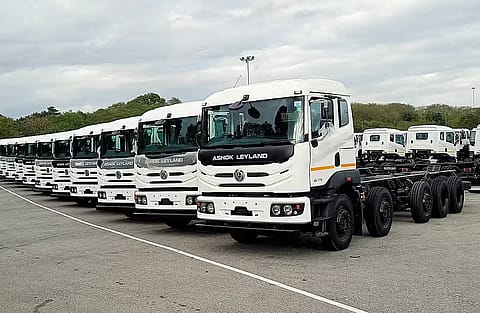
Ashok Leyland claimed that the domestic CV cycle continued to benefit from structural demand drivers after GST revisions reduced truck prices by nearly 10% from October last year.
Ashok Leyland Ltd. has warned that rising diesel prices and disruptions linked to the West Asia crisis could weigh on the Commercial vehicle (CV) industry, although strong replacement demand and lower ownership costs following GST rationalisation continue to keep market sentiment resilient, according to a senior company official.
“From a demand point of view, we see a lot of resilience despite all the challenges on the ground,” Managing Director and CEO Shenu Agarwal told reporters during the company’s Q4 FY26 earnings call. “The resilience is quite amazing.”
The homegrown commercial vehiclemaker stated that the conflict in West Asia had temporarily disrupted operations at its Ras Al-Khaimah facility in the UAE and created logistics bottlenecks across Gulf markets.
“The challenges started in late March and continued in April,” Agarwal said. “We had to even take out some people from the factory to safer areas because of some of the incidents that happened around the factory.” He added that operations were gradually normalising and the plant was expected to return to full capacity from June, subject to how the geopolitical situation evolves.
Despite the uncertainty, Ashok Leyland said demand across Gulf Cooperation Council (GCC) markets remained stable, particularly in essential mobility segments such as school buses and transport vehicles. “Existing inventory in the region also helped the company service retail demand despite shipping disruptions from India, “noted Agarwal.
Ageing truck fleet keeps demand momentum intact
The Hinduja flagship firm said the domestic CV cycle continued to benefit from structural demand drivers after GST revisions reduced truck prices by nearly 10% from October last year. At the same time, ageing fleet levels in heavy-duty trucks had reached historic highs, triggering replacement demand.
“The market was ready to receive this trigger and start replacing the older trucks now,” he said.
The company believes the recent diesel price hikes of around ₹7 per litre remain manageable for fleet operators and are unlikely to significantly derail demand momentum. Industry demand in April remained strong and May volumes are expected to remain at par with or better than last year, executives said.
Ashok Leyland’s Chairman Dheeraj Hinduja said higher fuel prices had also increased customer interest in electric commercial vehicles, though buying patterns had not materially shifted yet.
“There is definitely a lot more interest towards electric vehicles,” Hinduja said during the earnings interaction.
Cost controls sharpen amid uncertainty
Ashok Leyland also claimed that it has initiated cost-control measures to navigate volatility arising from the West Asia conflict. The company’s Chief financial officer K.M. Balaji said the company was focusing on value engineering, e-sourcing and material optimisation to manage cost pressures.
RANK
COMPANY NAME
REVENUE
(INR CR)
(INR CR)
{{#current-rank}} {{current-rank}} {{/current-rank}} {{^current-rank}} {{rank}} {{/current-rank}} {{name}} {{#revenue}} {{revenue}} {{/revenue}} {{^revenue}} {{noi}} {{/revenue}}
The company has guided for FY27 capital expenditure of ₹800 crore-₹1,000 crore as it continues investments in new products, battery manufacturing and alternate fuel technologies.
Meanwhile, Ashok Leyland reported its highest-ever annual revenue, EBITDA and profit after tax in FY26. Revenue rose 14% year-on-year to ₹44,000 crore, while EBITDA crossed ₹5,700 crore with margins touching a record 13%.
Frequently Asked Questions
NEXT STORY