The FAQs are AI-generated, and Fortune India is not responsible for its content or any associated copyright issues.
AI is not a shortcut to power, UAE minister Omar Sultan Al Olama says in conversation with Nikhil Kamath
/ 3 min read
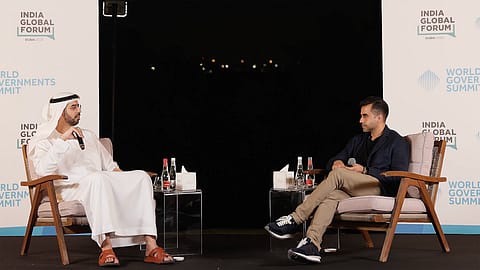
UAE Minister Omar Sultan Al Olama emphasizes that AI is not a shortcut to power, highlighting the importance of decision-making speed, institutional clarity, and leadership priorities. (L-R) UAE minister Omar Sultan Al Olama and Zerodha Co-founder Nikhil Kamath
AI is not a shortcut to power, UAE minister Omar Sultan Al Olama says in conversation with Nikhil Kamath
UAE Minister Omar Sultan Al Olama emphasizes that AI is not a shortcut to power, highlighting the importance of decision-making speed, institutional clarity, and leadership priorities. He argues that AI should be seen as economic infrastructure, not just a productivity tool, and warns against the risks of hyper-specialization in an AI-driven world.
This summary is AI-generated, and Fortune India is not responsible for its content or any associated copyright issues.
On People by WTF, the UAE minister argues that leadership outcomes—not technology adoption alone—will determine economic relevance.
THIS STORY FEATURES
UAE Minister Omar Sultan Al Olama emphasizes that AI is not a shortcut to power, highlighting the importance of decision-making speed, institutional clarity, and leadership priorities. (L-R) UAE minister Omar Sultan Al Olama and Zerodha Co-founder Nikhil Kamath
In a global economy racing to adopt artificial intelligence, Omar Sultan Al Olama, the UAE’s Minister of State for Artificial Intelligence, Digital Economy and Remote Work Applications, offers a blunt warning: technology alone will not decide winners. Decision-making speed, institutional clarity and leadership priorities will.
Speaking to Zerodha Co-founder Nikhil Kamath on the podcast People by WTF, Al Olama argues that AI represents a structural shift in global power—one that weakens the historical advantages of population size and geography, while sharply increasing the cost of policy hesitation.
“AI is the first moment where size stops being destiny,” he says, adding that countries delaying adoption risk falling irreversibly behind.
AI as economic infrastructure
Unlike markets that frame AI as a productivity add-on, Al Olama positions it as economic infrastructure. In his view, nations that embed AI into governance, service delivery and long-term planning can outperform far larger economies.
This approach, he notes, is less about experimentation and more about execution. “Delay is not neutral,” he says, framing AI adoption as a competitive necessity rather than a passing technological trend.
One of the sharper arguments in the conversation challenges prevailing assumptions around careers and education. Hyper-specialisation, Al Olama contends, increases vulnerability in an AI-driven labour market.
“If you are hyper-specialised, AI will beat you at your own game,” he says. The human advantage, according to him, lies in breadth—understanding systems, connecting disciplines and making decisions under uncertainty.
Recommended Stories
Kamath extends the argument beyond careers, suggesting that governance and leadership face a similar risk when decision-makers optimise narrowly without accounting for social or long-term consequences.
Productivity gains, social costs
While AI-driven efficiency continues to rise, Al Olama points to a less visible downside: weakening social cohesion. He cites the growth of services that monetise loneliness as evidence that productivity gains are not translating into stronger communities.
“We are gaining enormously in productivity, but we are losing human connection,” he says, warning that economic metrics alone are becoming insufficient measures of progress.
Governance starts with basic needs
Al Olama’s views on leadership are shaped less by technology policy than by experience in military service. Recalling time spent with young cadets in extreme conditions, he describes a realisation that long-term visions collapse when basic needs are unmet.
RANK
COMPANY NAME
REVENUE
(INR CR)
(INR CR)
{{#current-rank}} {{current-rank}} {{/current-rank}} {{^current-rank}} {{rank}} {{/current-rank}} {{name}} {{#revenue}} {{revenue}} {{/revenue}} {{^revenue}} {{noi}} {{/revenue}}
“When people are hungry, AI does not matter,” he says. Food security, safety and dignity, he argues, must precede innovation agendas.
Kamath echoes the point, noting that leadership discussions often overlook daily human realities in favour of ambition and scale.
Systems over personal authority
On governance, Al Olama downplays visibility and centralised power. Effective governments, he argues, operate best when systems function reliably without drawing attention to themselves.
He also frames corruption as a leadership failure rather than a purely procedural one, suggesting that behaviour at the top sets the tone for institutions more decisively than regulation alone.
Neutrality as strategy
In an increasingly polarised geopolitical environment, Al Olama positions neutrality as an active strategic choice. Smaller nations, he argues, can exert influence by acting as connectors—facilitating dialogue, trade and cooperation—rather than aligning rigidly with competing blocs.
The discussion concludes with a redefinition of leadership success. Instead of speed or visibility, Al Olama highlights discernment—knowing when to act, when to pause and when to listen.
For Kamath, the takeaway is less about AI than about priorities. “Before technology, before vision, people need to be taken care of,” he says.
As governments and businesses accelerate AI adoption, the conversation underscores a growing consensus among policymakers: technology may reshape systems, but leadership failures will continue to determine outcomes.