Beer industry stares at margin pressure, supply disruption amid input inflation
/ 3 min read
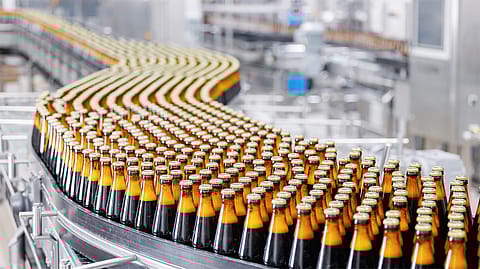
Credits: Shutterstock
Beer industry stares at margin pressure, supply disruption amid input inflation
India's beer industry faces significant challenges as input costs surge due to Middle East conflicts, threatening supply chains and squeezing margins. The Brewers Association of India warns that without price increases or tax relief, supplies may become unviable in states with controlled pricing, potentially impacting summer demand and state revenues.
This summary is AI-generated, and Fortune India is not responsible for its content or any associated copyright issues.
This combination of rising costs and uncertain packaging availability could hit beer supplies during the critical summer months, when demand typically peaks.
THIS STORY FEATURES
Credits: Shutterstock
India’s beer industry is staring at potential supply disruptions ahead of the peak summer season as a surge in input costs — triggered by the ongoing conflict in the Middle East — tightens margins and strains production.
The Brewers Association of India (BAI), which represents companies accounting for 85% of beer sold in the country, has warned that rising costs could make supplies unviable in several states, especially where pricing remains tightly controlled.
The industry body, whose members include United Breweries Limited, AB InBev and Carlsberg, has written to multiple states seeking price increases or excise duty relief. It argues that the financial burden of global disruptions should be shared across industry, consumers and governments.
“We are writing to various states asking for increase in prices or waiver in some excise taxes based on the principle that the pains of war should not be loaded only on industry, but shared amongst the consumers, industry and the Government,” said Vinod Giri, director general, BAI.


Over the past three weeks alone, key inputs have seen sharp inflation. Glass bottle prices have jumped about 20%, paper cartons have nearly doubled, and materials such as LDPE, BOPP and adhesives have become 20–25% costlier. Freight and logistics expenses are up 10%, while the rupee has weakened nearly 3% against the US dollar, raising import costs. Taken together, brewers estimate a 12–15% increase in overall costs.
Karan Taurani, executive vice president at Elara Capital, said packaging costs alone pose a significant risk to profitability. “Glass furnaces are heavily dependent on CNG or crude. For the beer industry, around 30–35% of their cost of product is glass, and for spirits it is about 15–20%. Inflationary pressures in glass can hurt margins for these companies,” he said while adding that there is a likelihood of 5–10% inflation in glass.
The Indian beer market is expanding rapidly, with a projected value of approximately $7.31 billion by 2028, growing at over 8% CAGR. Driven by a young population and rising incomes, the market is dominated by strong lager (>5% ABV) and major players like United Breweries (Kingfisher), AB InBev, and Carlsberg.
Supply strain meets pricing constraints
The pressure is not limited to costs. Supply chains are also under stress. Disruptions in aluminium supplies from the Middle East have raised concerns among can manufacturers, who have warned that prolonged shortages could affect production volumes or even force plant shutdowns. At the same time, a shortage of commercial LPG is impacting glass bottle manufacturers, increasing the risk of partial or full shutdowns.
This combination of rising costs and uncertain packaging availability could hit beer supplies during the critical summer months, when demand typically peaks. A prolonged disruption may even trigger force majeure clauses across supply contracts between brewers, suppliers and buyers, both private and state-run.
{{#most-powerful-women-snapshot-individual.slug}} {{/most-powerful-women-snapshot-individual.slug}} {{^most-powerful-women-snapshot-individual.slug}} {{/most-powerful-women-snapshot-individual.slug}} {{#showRanking}} {{current-rank}} {{/showRanking}} {{#photo.0.url}}
{{name}}
BAI said brewers may be forced to prioritise supplies to states that allow pricing flexibility such as Maharashtra, Karnataka and Goa, while cutting back in markets where price hikes are restricted. “Holding prices back when costs are rising works to no one’s benefit,” said Giri. “Inability to pass on cost increases disincentivises suppliers to maintain supplies, especially when there is a shortage and supplies need to be rationed.”
He added that reduced supplies could also hit state revenues. “As it is, low prices mean lower tax collection per unit for the government, and in this situation it may just compound the problem,” Giri said, calling for “a flexible and pragmatic policy environment” that allows brewers to adjust prices.
However, Taurani has warned that taking price hikes may not be easy for the companies because most of the markets are governed by the state governments. “There is control of e-government on wholesale and retail. So, taking price hikes will not easy, if the pressure continues, there will be margin pressures on the companies.”
With over 55 breweries, ₹25,000 crore in investments and more than 27,000 direct employees, the sector now faces a delicate balancing act: absorb costs and risk margins, or cut supplies and risk market share, just as demand begins to rise with the arrival of summers.
Follow Fortune India
NEXT STORY