Beyond Recycling: Marico’s Harsh Mariwala bets on ReCirqularity to reshape India’s plastic economy
/ 4 min read
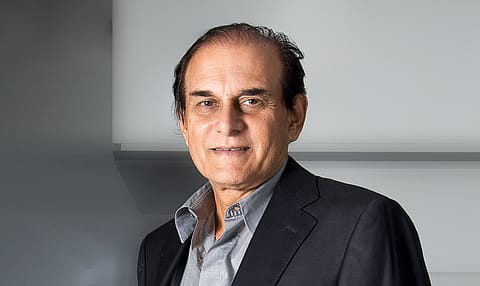
Harsh Mariwala, Chairman, Marico and Founder, Marico Innovation Foundation | Credits: Gettyimages
Beyond Recycling: Marico’s Harsh Mariwala bets on ReCirqularity to reshape India’s plastic economy
Harsh Mariwala, through Marico Innovation Foundation, is championing ReCirqularity, a venture aimed at transforming India's plastic economy. By establishing a closed-loop system in Hyderabad, the initiative seeks to produce high-quality recycled polymers using AI-enabled sorting technologies, offering a sustainable and scalable model that could be replicated across Indian cities, while fostering India-Europe collaboration for a greener future.
This summary is AI-generated, and Fortune India is not responsible for its content or any associated copyright issues.
Mariwala tells Fortune India that India’s plastic challenge demands solutions that are commercially viable, not just philanthropic, and shares how his ReCirqularity model can be replicated across urban centres.
Harsh Mariwala, Chairman, Marico and Founder, Marico Innovation Foundation | Credits: Gettyimages
For over two decades, Harsh Mariwala has been quietly shaping India’s innovation narrative - first by spotlighting pathbreaking ideas, and now by backing models that can scale with purpose. Through the Marico Innovation Foundation, his focus has shifted decisively toward building ventures that sit at the intersection of sustainability, technology, and commercial viability.
That vision is now taking concrete form with ReCirqularity, a bold attempt to create a closed-loop plastics ecosystem starting in Hyderabad. In an exclusive interaction with Fortune India, Mariwala talks about why India needs market-driven solutions - not just CSR-led experiments - to tackle its waste challenge, how the model can be replicated across cities, and why deeper India–Europe collaboration could be key to accelerating the country’s green transition.
Question: Can you briefly explain what the Hyderabad circularity initiative is designed to achieve and how it works as a closed-loop plastics system?
Mariwala: ReCirqularity Ltd is a joint venture between Re Sustainability Limited and Sharrp Ventures (Mariwala’s family office). ReCirqularity is developinganinnovative facility in Hyderabad, India to produce high quality recycled polymers (rHDPE and rPP) for the FMCG industry’s primary packaging needs. Currently the supply of very high-quality recycled polymers at a reasonable price is limited in India and ReCirqularity wishes to bridge that gap with this pilot plant that will leverage AI-enabled sorting technologies for high-speed segregation and processing of plastic waste. The plant in Hyderabad is likely to be operational from the end of 2026.
Question: What makes the Hyderabad model commercially sustainable, and how is it different from traditional CSR-led recycling efforts?
Traditional pilots are typically small-scale investments anchoring around one part of the value chain in waste processing or plastic recycling. For example: a CSR initiative may fund a small Material Recovery Facility (MRFs) for segregation of waste. Typically, such investments do not succeed in becoming sustainable as they do not own the value chain of plastic recycling in an end-to-end manner. ReCirqularity is building an end to end initiative, right from collection, setting up MRFs, setting up a washing and processing plant, quality labs for testing of produced recycled polymers and selling them back to FMCG industry – this way we shall be able to close the loop completely for a majority of the plastic waste that can be scientifically processed for use by brands again. Our machinery will be state of the art and shall run on global standards of processing, and the project shall also generate employment for over 370+ people directly and impact over 2000+ livelihoods indirectly.
Social and Environmental Impact: In its first year of operations, ReCirqularity will:
Waste Management: Divert over 32,000 tons of waste from landfills,
Emission Reduction: Reduce 15,000 tons of CO₂-equivalent emissions.
Employment & Inclusion: Create 370+ direct jobs (targeting 75% women workforce) and indirectly benefit 2,000+ livelihoods.
Zero-Waste to Landfill Circular Model: Implement 100% traceability and transparency across the value chain.
Use AI enabled sorting technology for high speed no touch segregation at the main processing plant.
Question: If successful, how scalable is this initiative across other Indian cities, and what conditions would be necessary for replication?
Other than variation in waste input across cities, we see no material constraints to scale. If we can establish consistent granule quality and generate sustainable returns, the initiative can operate as a viable going concern. Our aim is to replicate this plant / JV in major metro and non-metro towns with the help of collaboration with interested parties. Capital requirements to build such plants in other cities would be another aspect required for successful replication which will be available in plenty, once this initiative proves its success.
Question: How has MIF’s vision of catalysing disruptive innovation evolved since its inception in 2003?
In the past MIF focussed on recognizing innovations and creating awareness about innovations (period 2003 – 2013). We launched Innovation for India Awards in 2006 as the first platform in India to award and recognize truly disruptive and game changing innovations. We also published books and relevant literature to promote Indian Innovations.
RANK
COMPANY NAME
REVENUE
(INR CR)
(INR CR)
{{#current-rank}} {{current-rank}} {{/current-rank}} {{^current-rank}} {{rank}} {{/current-rank}} {{name}} {{#revenue}} {{revenue}} {{/revenue}} {{^revenue}} {{noi}} {{/revenue}}
In the second decade of existence, we supported innovators / startups in depth instead of just awarding or recognizing them alone. We launched an equity free accelerator in 2016 that has helped the likes of Atomberg Technologies and S4S technologies to cross ₹100 crore in revenues in less than 4 years. The accelerator program provides in depth mentorship from Marico experts, Industry CEOs and qualified mentors across India.
In the recent times, MIF has catalysed initiatives such as ReCirqularity to develop proven commercial models at scale for nascent industries such as plastic waste recycling. The objective is to demonstrate success using new advanced technologies to show people how social impact, environmental good and sustainable commercial returns can go hand in hand.
Question: What makes India Exchange 2026 an important platform at this stage to discuss the idea of a structured India–UK/Europe Green Corridor?
A platform like India-UK/Europe Green corridor can be a massive boost to both economies. Indian startups are already selling in the UK and Europe and wish to progress further with such expansion. UK/Europe is targeting India as a market for deployment and consumption of their developed technologies. A structured approach towards this corridor’s growth could unlock capital, research and benchmarks for India while giving the UK/European countries access to our frugal engineering and vast scale of market.
Question: From your perspective, what would it take to enable co-commercialisation between Indian manufacturers and European technology providers beyond knowledge exchange?
Genuine intent to make a difference over a long period of time. If the horizon for collaboration is long and well thought through as a vision, then co-commercialization will succeed. Willingness to learn and adapt to Indian markets and conditions will also be required as India is quite a unique market. For example: our waste streams are so different from the UK/Europe and hence machineries can be customized for our requirements. A partner from India can help structure the co-commercialization deals and bring attention to such an initiative by acting as an anchor partner.
NEXT STORY