Budget 2026: FM Sitharaman’s Kancheevaram saree signals continuity in handloom messaging
/ 2 min read
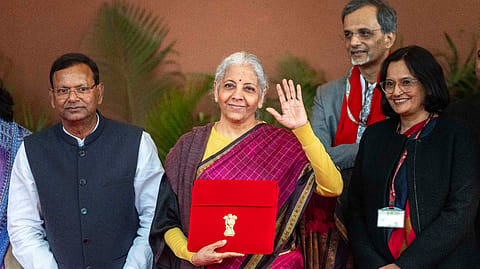
The saree features a deep purple base in the classic kattam (checked) pattern, with subtle golden-brown intersecting lines and a coffee-brown border accentuated with restrained thread work.
Budget 2026: FM Sitharaman’s Kancheevaram saree signals continuity in handloom messaging
Finance Minister Nirmala Sitharaman's choice of a Kancheevaram silk saree for the Union Budget 2026 presentation underscores her ongoing commitment to promoting India's traditional handloom sector. This sartorial decision not only highlights the cultural significance of Tamil Nadu's textiles but also aligns with the state's upcoming Assembly elections, blending economic policy with cultural advocacy.
This summary is AI-generated, and Fortune India is not responsible for its content or any associated copyright issues.
Ahead of presenting the Union Budget, Sitharaman once again uses her attire to spotlight India’s traditional textile economy.
The saree features a deep purple base in the classic kattam (checked) pattern, with subtle golden-brown intersecting lines and a coffee-brown border accentuated with restrained thread work.
As Finance Minister Nirmala Sitharaman prepares to table the Union Budget 2026 in the Lok Sabha at 11 am on Sunday, attention has once again turned to a familiar but deliberate aspect of her Budget day appearances—her choice of handloom attire.
For the Union Budget 2026, Sitharaman has opted for a handwoven Kancheevaram silk saree, underscoring her long-standing practice of using the Budget platform to highlight India’s traditional textile sector. The saree features a deep purple base in the classic kattam (checked) pattern, with subtle golden-brown intersecting lines and a coffee-brown border accentuated with restrained thread work. She has paired it with a mustard-yellow blouse, maintaining the understated yet formal aesthetic associated with her previous Budget presentations.
A handloom legacy rooted in Tamil Nadu
Kancheevaram silk sarees originate from Kanchipuram in Tamil Nadu and are regarded as among India’s most premium handwoven textiles. Known for their use of pure mulberry silk, durability, and intricate weaving techniques, Kancheevaram sarees trace their origins to the Pallava dynasty in the 7th century. The craft remains a key livelihood for thousands of weavers in Tamil Nadu and continues to occupy an important place in India’s handloom economy.
The choice of a Tamil Nadu handloom assumes added significance this year, as the state is scheduled to go to Assembly elections. While Sitharaman has not explicitly linked her sartorial choices to electoral cycles, her consistent emphasis on regional crafts has often coincided with heightened political and economic attention on those states.
Since assuming office in 2019, the finance minister has repeatedly used Budget Day attire to draw attention to India’s diverse handloom traditions. Her previous appearances have featured textiles such as Mangalgiri cotton, Ikat, Bomkai, Kantha and Madhubani, reinforcing a broader narrative around cultural preservation and artisan livelihoods.
Budget day attire as soft economic messaging
In Budget 2025, Sitharaman wore an off-white Madhubani hand-painted saree adorned with fish motifs, gifted by Padma Shri awardee Dulari Devi. The choice was widely viewed as a tribute to Bihar’s folk art tradition and women artisans, particularly from marginalised communities. That year also coincided with Bihar’s Assembly elections, further highlighting how her attire often intersects with regional contexts.
Over time, Sitharaman’s Budget Day wardrobe has evolved into a parallel communication strategy—one that complements economic policymaking with visible support for indigenous crafts. In an environment where the handloom sector continues to face competition from powerlooms and fast fashion, such high-profile endorsements carry both symbolic and commercial value.
As the Union Budget 2026–27 outlines the government’s economic roadmap, the finance minister’s continued preference for handwoven sarees once again places India’s artisanal industries within the national spotlight, reinforcing the link between cultural heritage and economic sustainability.
NEXT STORY