Davos 2026: India’s rise to third-largest economy a certainty, says Ashwini Vaishnaw
/ 3 min read
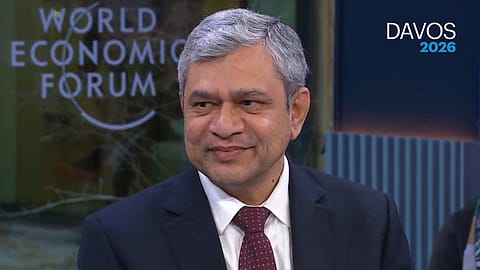
On U.S. tariffs, Ashwini Vaishnaw said India has shown resilience despite global turbulence.
Davos 2026: India’s rise to third-largest economy a certainty, says Ashwini Vaishnaw
Union Minister Ashwini Vaishnaw confidently declared at the World Economic Forum in Davos that India's rise to the third-largest economy is inevitable, driven by a decade of structural reforms and inclusive growth. He emphasized the country's strong technology base and four key growth pillars, predicting sustained real growth of 6-8% with moderate inflation over the next five years.
This summary is AI-generated, and Fortune India is not responsible for its content or any associated copyright issues.
Speaking at a session titled ‘Can India Become the Third-Largest Economy’ at the World Economic Forum annual meeting in Davos, Vaishnaw said the question was no longer about “if” India would reach the milestone, but “when”.
THIS STORY FEATURES
On U.S. tariffs, Ashwini Vaishnaw said India has shown resilience despite global turbulence.
Union Minister for Electronics and Information Technology Ashwini Vaishnaw on Wednesday asserted that India’s emergence as the world’s third-largest economy is inevitable and will happen within the next few years, citing a decade of structural reforms, focused execution and inclusive growth.
Speaking at a session titled ‘Can India Become the Third-Largest Economy’ at the World Economic Forum (WEF) annual meeting in Davos, Vaishnaw said the question was no longer about “if” India would reach the milestone, but “when”.
“It’s not a question of will it become. It’s a certainty—it will happen. Within the next few years, we will definitely become the third-largest economy,” he said.
Four key pillars of India's growth
The minister attributed India’s growth trajectory to what he described as transformational changes over the last decade, built on four key pillars—public investment, inclusive growth, manufacturing and innovation, and simplification. Public investment, he said, has focused on strengthening physical, digital, and social infrastructure while inclusive growth has ensured that the benefits of economic expansion reach all sections of society.
Manufacturing and innovation form the third pillar, supported by policy initiatives across sectors while simplification—through procedural, legal and regulatory reforms—has reduced friction for businesses and investors, Vaishnaw added.

“These pillars, combined with the strong technology base we have created, give us the confidence to say that India can sustain 6–8% real growth, with moderate inflation of 2–4%, translating into nominal growth of 10–13% over the next five years,” he said.
Focus on social security and poverty alleviation
Highlighting the government’s focus on social security and poverty alleviation, Vaishnaw pointed to the opening of over 540 million new bank accounts, construction of around 130 million toilets, and monthly food ration support to nearly 800 million people. These measures, he said, have helped lift about 250 million people out of poverty under the leadership of Prime Minister Narendra Modi.
“The security of the poorest is a priority, and that is why the entire society is benefitting from the growth journey,” he said, describing India’s inclusive growth path as a key strength.
Gita Gopinath, Gregory and Ania Coffey Professor of Economics at Harvard University, Sunil Bharti Mittal, Chairman of Bharti Enterprises, and Juvencio Maeztu Herrera, CEO and President, INGKA GROUP I IKEA, were present at the discussion.
Global debt levels
However, the minister flagged global debt levels in advanced economies as a potential risk. Referring to recent volatility in Japanese bond markets, he said the manner in which high debt in rich countries unwinds could have global implications, including for India. “That is a matter of concern. Otherwise, everything is in very good shape,” he added.
Responding to remarks by Gita Gopinath, Vaishnaw highlighted India’s model of cooperative federalism, where the Centre and states work together on reforms. He said reform initiatives undertaken by states such as Maharashtra, Andhra Pradesh and Odisha are increasingly becoming templates for others.
{{#most-powerful-women-snapshot-individual.slug}} {{/most-powerful-women-snapshot-individual.slug}} {{^most-powerful-women-snapshot-individual.slug}} {{/most-powerful-women-snapshot-individual.slug}} {{#showRanking}} {{current-rank}} {{/showRanking}} {{#photo.0.url}}
{{name}}
He said labour reforms, GST simplification, opening up the nuclear energy sector to private participation, and wide-ranging procedural, and legal reforms as key ongoing initiatives. “We are here to be the catalyst for your growth in India,” he told global investors.
U.S. tariffs
On U.S. tariffs, Vaishnaw said India has shown resilience despite global turbulence. “Our macro and micro fundamentals are very strong. Exports have increased despite the tariffs, with producers finding new markets,” he said, noting that electronics has emerged as India’s third-largest export category.
Artificial intelligence
On artificial intelligence, the minister said India is making rapid progress across all five layers of the AI stack. He said that India has already become one of the world’s largest AI-based service providers, with the IT services sector pivoting from traditional software services to AI-driven solutions.
Follow Fortune India
NEXT STORY