
Davos 2026: “If AI only benefits tech firms, it’s a bubble,” warns Satya Nadella
ADVERTISEMENT
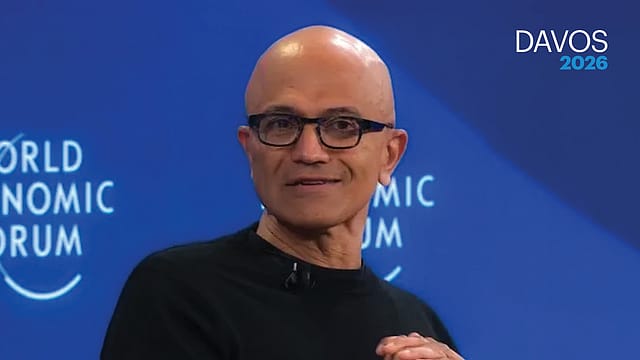
Microsoft Chairman and CEO Satya Nadella has issued a clear warning on the future of artificial intelligence: if its impact remains confined to technology companies, the current AI boom risks becoming a bubble.
Speaking at the World Economic Forum (WEF) 2026 in Davos, Nadella said AI’s long-term credibility will depend on whether it delivers real-world outcomes across the economy — from healthcare and education to manufacturing, public services and agriculture — rather than just fuelling higher valuations and spending in Silicon Valley.
“If all we are talking about are the tech firms, if all we talk about is what’s happening on the technology side, then that’s a bubble,” Nadella said during a conversation with BlackRock CEO Larry Fink. “For this not to be a bubble, by definition it requires that the benefits are much more evenly spread.”
From powerful models to real outcomes
Nadella argued that AI should not be judged by the sophistication of its models or the scale of computing power alone, but by measurable improvements in productivity and quality of life. Faster drug discovery, better health outcomes, improved learning, and more efficient public services, he said, are the real benchmarks of success.
“If these tokens are not improving health outcomes, education outcomes, public sector efficiency and private sector competitiveness, then this makes no sense,” he said.
He positioned AI as the latest phase in a long arc of computing that includes the personal computer, the internet and cloud computing — but one that could ultimately have an even deeper impact if applied broadly across sectors.
AI tokens as the new economic commodity
One of Nadella’s central ideas was that AI output — which he repeatedly described as “tokens” — should be viewed as a new economic commodity, akin to electricity. As computing efficiency improves, token prices are falling rapidly, making AI more accessible.
“Tokens are going to be diffused all around the world, just like electricity,” he said, adding that future economic growth will increasingly depend on how cheaply and efficiently countries can generate and use them.
However, he cautioned that diffusion is not automatic. Access to reliable energy, modern power grids, data centre infrastructure, skills and supportive policy environments will determine who benefits. Without visible outcomes, Nadella warned, society could withdraw its “permission” to devote scarce energy resources to AI.
Jobs, productivity and redesigning work
Pushing back against fears of mass job displacement, Nadella described AI as a “cognitive amplifier” rather than a replacement for human workers. While levels of abstraction will change, he said, human agency remains central.
The real productivity gains, however, will require organisations to redesign workflows instead of simply layering AI tools onto old structures. AI, he said, fundamentally flattens information flows, challenging traditional hierarchies and decision-making models.
He also pointed to a “barbell effect” in adoption, where startups can build around AI from scratch while large incumbents struggle with change management, despite their advantages in data and scale.
Global diffusion and the sovereignty debate
Nadella argued that AI has the potential to spread more evenly than previous technologies, including across emerging markets, because models and outputs are inherently global. He cited examples such as rural farmers accessing AI-driven advice as evidence that geography is becoming less of a barrier.
On Europe, he cautioned against an overly narrow focus on technological sovereignty at the expense of competitiveness. The more urgent issue, he said, is “firm sovereignty” — whether companies control AI systems that embed their own knowledge and competitive advantage.
“If your firm is not able to embed the tacit knowledge of the firm in a model that you control, by definition you have no sovereignty,” Nadella said.