The FAQs are AI-generated, and Fortune India is not responsible for its content or any associated copyright issues.
Economic Survey 2026 calls for swadeshi to fight prolonged geopolitical uncertainties and conflicts
/ 2 min read
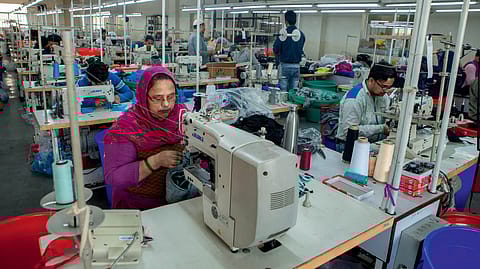
According to the survey, export controls, technology denial regimes, carbon border mechanisms, and industrial policy in the West and East alike signal the end of naïve globalisation. | Credits: Sanjay Rawat
Economic Survey 2026 calls for swadeshi to fight prolonged geopolitical uncertainties and conflicts
The Economic Survey 2025-26 advocates for 'swadeshi' or self-reliance as a strategic response to geopolitical uncertainties. It suggests a tiered framework for indigenisation, focusing on critical sectors like defence and energy. The survey emphasises the need for a proactive policy to navigate a fragmented global economy, turning challenges into opportunities for innovation.
This summary is AI-generated, and Fortune India is not responsible for its content or any associated copyright issues.
Stating that the period between now and 2045 might resemble the inter-war years of the 20th century, the survey wants India to have a proactive or offensive policy framework to survive such a turbulent period and turn necessities into innovations.
According to the survey, export controls, technology denial regimes, carbon border mechanisms, and industrial policy in the West and East alike signal the end of naïve globalisation. | Credits: Sanjay Rawat
India should consider ‘swadeshi’ (self-reliance) as a key strategy to prepare itself for a prolonged period of geopolitical uncertainties and conflicts, as well as the consequent disruptions in developed societies, states the Economic Survey 2025-26, tabled by finance minister Nirmala Sitharaman on Thursday. It defines ‘swadeshi’ as a disciplined strategy rather than a blanket doctrine and presents a decision framework for indigenisation and protection in a fragmented global economy.
Stating that the period between now and 2045 might resemble the inter-war years of the 20th century, the survey wanted India to have a proactive or offensive policy framework to survive such a turbulent period and to turn necessities into innovations.
“The global economic environment confronting India today is materially different from that of the previous phase of globalisation. Assumptions that shaped much of the post-Cold War period, such as open trade, predictable rules, stable capital flows, and relatively apolitical interdependence, hold less firmly today. Trade, technology, finance, and supply chains are increasingly shaped by strategic considerations. In this setting, outcomes depend not only on macroeconomic stability or factor accumulation, but on institutional and strategic capacity”, the survey notes.
According to the survey, export controls, technology denial regimes, carbon border mechanisms, and industrial policy in the West and East alike signal the end of naïve globalisation. “We operate in an environment where access to inputs, technologies, and markets cannot be assumed to be frictionless or permanent. In such circumstances, swadeshi becomes a defensive as well as offensive policy lever: a means to ensure continuity of production in the face of external shocks, and a pathway to build enduring national capabilities that reinforce economic sovereignty”, it states. “The policy question is no longer whether the state should encourage Swadeshi, but how it should do so without undermining efficiency, innovation, or global integration”, it adds.
Tiered framework to implement the ‘swadeshi’ strategy
The survey proposes a tiered framework to implement the ‘swadeshi’ strategy. In Tier I, it considers some inputs that are systemically critical and warrant early attention due to concentrated global supply or strategic exposure. The second tier talks of economically viable candidates for domestic capability building, where scale, learning, and export orientation can deliver competitiveness over time. The third category comprises goods for which import dependence does not translate into vulnerability, and where domestic substitution may raise costs without enhancing resilience. The most crucial category (Tier I) that requires urgent intervention includes defence-critical systems, core infrastructure inputs, energy security components, public health essentials, and foundational industrial technologies.
“For Tier I items, the objective is assured availability under stress, not short-term efficiency. Domestic production may be justified, even if it is initially costly. However, support must remain disciplined. The goal is to establish minimum assured domestic capacity within a defined timeframe, not permanent protection," the survey says.
Frequently Asked Questions
Explore the world of business like never before with the Fortune India app. From breaking news to in-depth features, experience it all in one place. Download Now